Picking a colocation provider without having laid out the costs in advance can result in budget problems. A colocation pricing calculator translates the needs of the buyer (in terms of e.g. rack size, power, bandwith, redundancy) into fixed monthly costs before any contracts are signed. The value of such a data center calculator, however, strongly depends on the correct input of variables that most potential buyers underestimate in advance.
Netrouting has operated carrier-neutral colocation facilities in Europe, North America and Asia for the last 10 years. Our own AS6206 backbone supports a large number of servers and services and has a network capacity of over 2.4 Tbps.
Here are the variables that actually matter to get the number right: power density and cooling, cross connect and remote hands, bandwidth commitment, SLA tiers. Additionally, there are hidden data center costs, like property insurance, that are rarely quoted in the headline number. For more context, see Green data center.
Blog contents
By the end of this, you will know exactly what to validate with any provider and what line items to push back on in order to get the right colocation contract. Understanding these hidden costs upfront prevents budget overruns and ensures accurate comparison between competing provider quotes.
What Goes Into a Colocation Pricing Calculator
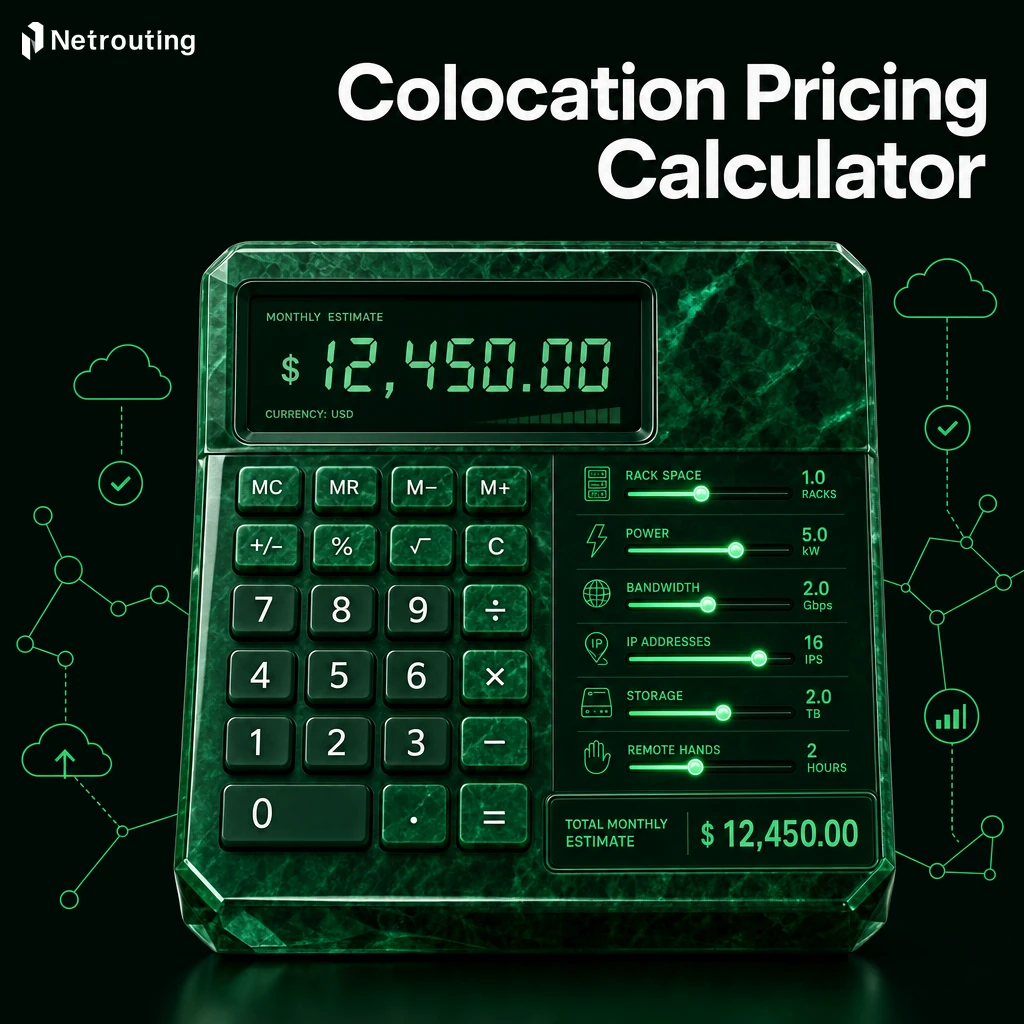
A proper colocation pricing calculation needs 4 core variables: rack space, power, bandwidth, and add-on services.
What Is the Monthly Cost of Colocation?
Colocation costs vary by footprint and power requirements. The cost of a single 1U of space in a shared cabinet can be quite low. On the other hand, a full cabinet with high-density power can cost a lot. Providers typically offer multiple rack configurations to accommodate different server densities, from standard enterprise setups to specialized high-performance computing deployments.
Choosing a rack configuration that can fit your current hardware while allowing room for future expansion prevents costly migrations down the line. Providers should help buyers model how different workloads scale within each rack tier to avoid over-provisioning or under-provisioning capacity.
In terms of data center pricing, the cost is affected by local power rates, connectivity, and the facility’s tier of service.
The Core Inputs Behind Colocation Costs and Pricing
Every colocation cost estimator needs these inputs: a well-designed calculator should let buyers adjust variables interactively and see how each one affects the monthly quote in real time.
- Rack space, measured in U or full racks.
- Power draw, your equipment's kW consumption under load.
- Bandwidth, commit level and burst headroom.
- Remote hands, hourly or contracted technician time.
How Data Center Prices Add to the Total
Other cross-connects and colocation services , like managed monitoring or OS patching, can add on to the base rate. It is wise to investigate your options for colocation services, as bundling them with other services can at times be cheaper than purchasing them separately later on. Evaluating colocation options early in the procurement process helps buyers identify which service bundles deliver the best value for their specific infrastructure needs.
Netrouting data center facilities always have DDoS protection enabled and a free private network.
Cloud vs. Colocation Data Center Cost Calculator Framework
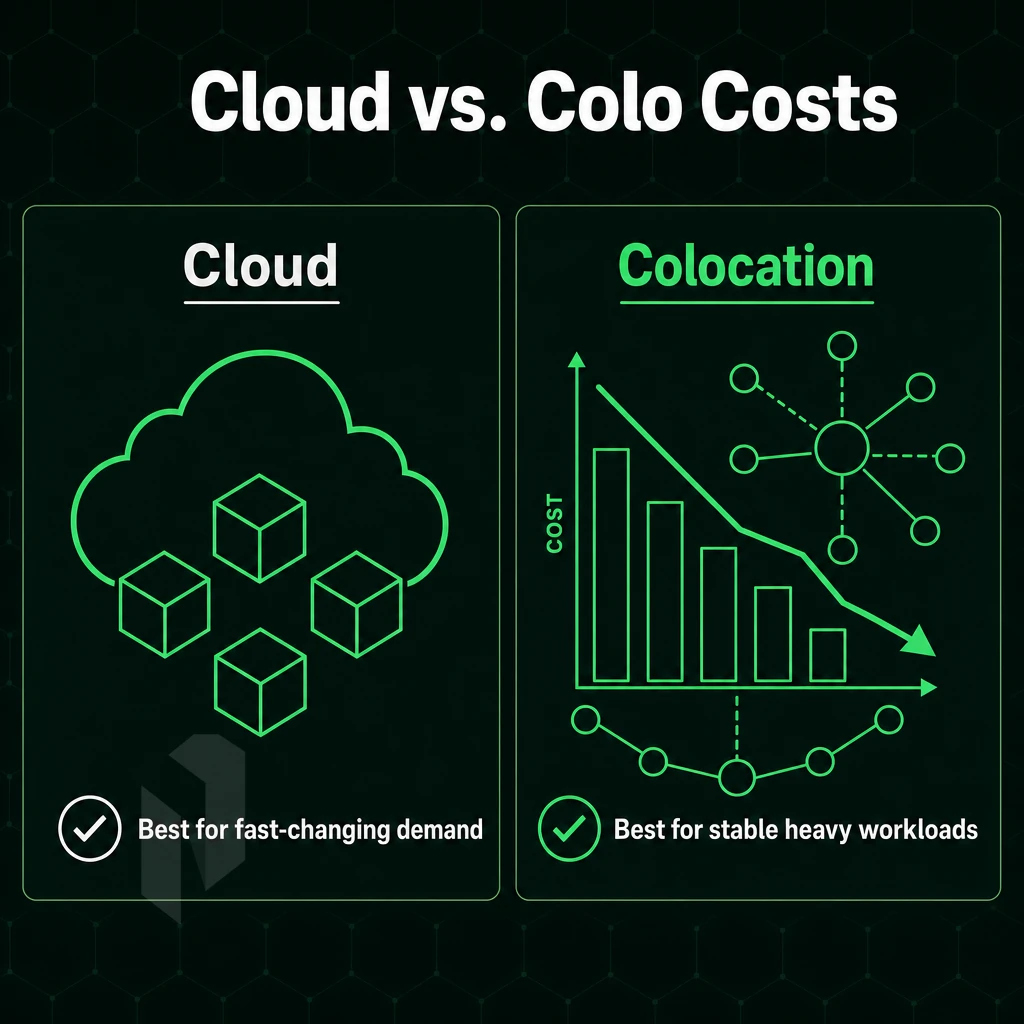
Deciding between cloud and colocation isn’t a gut call.
What Is a TCO Calculator for Colocation Expenses?
An accurate TCO calculator models ALL the cost layers: hardware, power, cross-connects, remote hands, and support. Instead of just opaque per-resource billing, it calculates out the TCO into a total monthly cost for you, which can then be compared to the monthly costs of owning and operating cloud systems and services. Detailed analysis of each cost component reveals where providers build in margin and where buyers can negotiate more favorable terms.
Data Center Workloads That Favor Each Model
Databases, media processing and on-premises storage clusters for high availability and high I/O are in fact cheaper in colocation than in cloud computing. Variable or bursty workloads on the other hand are best served by the cloud for elastic scaling. The real savings are in rack-ing up the right model choice for your specific workload. Matching workload characteristics to infrastructure type ensures the most cost effective deployment strategy over a multi-year horizon.
Side-by-Side Data Center Prices Comparison
| Dimension | Cloud | Colocation |
|---|---|---|
| Scalability | Instant, elastic | Planned, capacity-based |
| Compliance & Control | Shared responsibility | Full hardware control, easier audit scope |
| Cost Predictability | Variable; egress fees add up | Fixed; no surprise per-GB charges |
| Flexibility | High for short-term needs | High for long-term, stable deployments |
Netrouting's on premises colocation facilities are located in 10 cities across Europe, North America and Asia. Every on premises data center deployment includes always-on DDoS protection and a 99.9% uptime SLA. It is not possible to calculate the total value of a colocation using only the rack cost.
There are qualitative factors which affect the final quote that a calculator cannot take into account. However, once you start speaking to potential providers and using a tco calculator to map colocation expenses, you will understand which model is best suited to your workload.
Factors That Affect Your Final Colocation Price
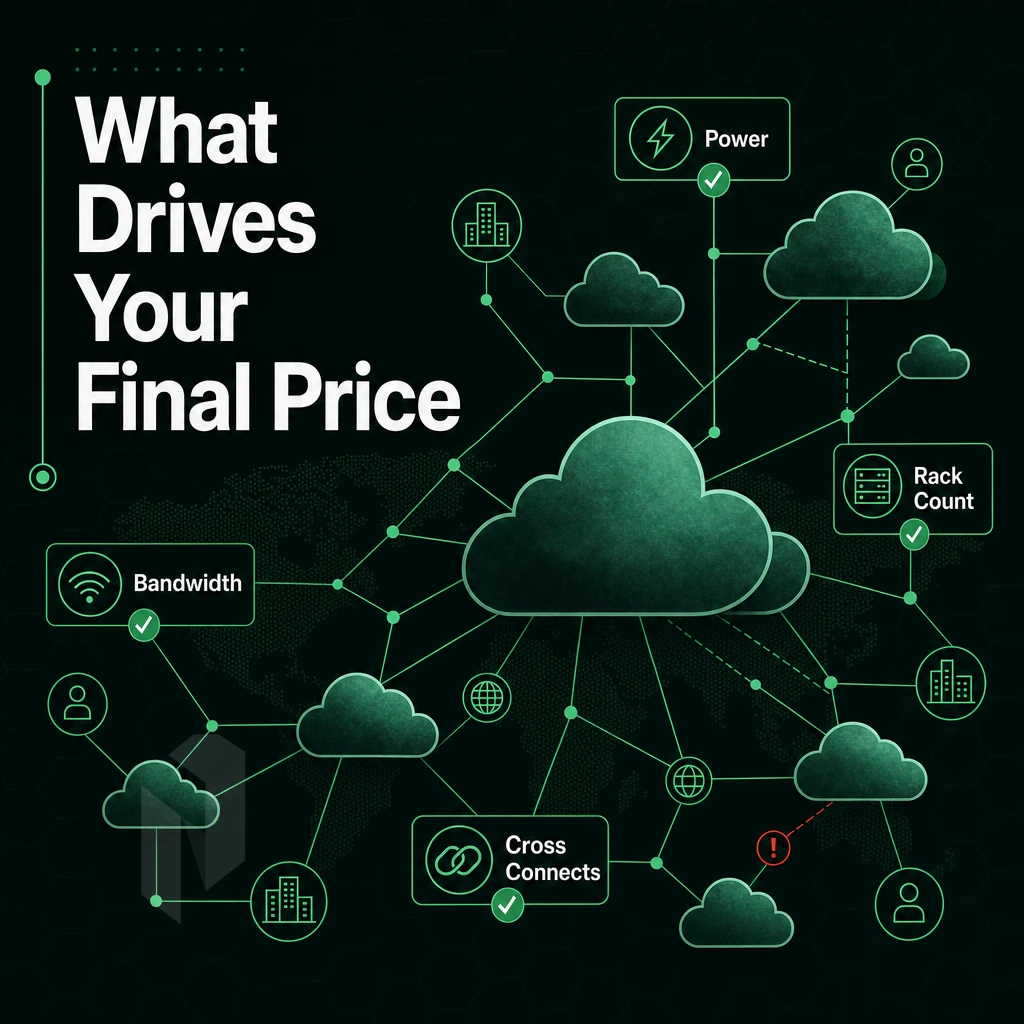
Raw data points such as power consumption, rack count and bandwidth only form the starting point for quotes on data center capacity. A number of qualitative variables specific to each facility can greatly affect data center prices and should therefore not be ignored by potential buyers and lessees. Otherwise they risk comparing apples with oranges.
Data Center Location, Density, and Contract Length
Market tier matters. Building costs, energy tariffs, and land constraints drive colocation expenses higher in APAC and prime US metro markets compared to equivalent EU sites. Power density tier also matters, in a building with standard 2 kW/rack, a high density GPU deployment would have a very different rate than that building. Regional demand for rack space also influences pricing, as markets with limited supply and high tenant competition typically command premium rates.
The contract length will determine the discount rate per unit, with month to month flexibility being the most expensive option. Typically savings of meaningful proportions are gained by locking in workloads for a period of 1 to 3 years, therefore it is worth developing a total cost of ownership model to establish the appropriate terms prior to executing the contract.
Negotiating a multi-year deal often unlocks volume discounts and rate protection that can significantly reduce total infrastructure spend. Organizations that commit to longer terms can realize substantial savings through reduced per-unit pricing and improved budget predictability across fiscal cycles.
Data Center Compliance Requirements and Carrier Neutrality
Requirements for physical security and process controls, which are audited as part of compliance, such as ISO 27001 and SOC 2. We hold both certifications for all of our facilities. People in very regulated industries often can only use certified colocation providers, so be sure to include them in your short list before you start negotiating.
Providers should be able to demonstrate how their facilities meet these standards through regular third-party audits and transparent documentation. Buyers should prepare a list of specific technical and audit questions to ask during facility tours to verify compliance claims before signing. Before finalizing a provider selection, buyers should schedule site visits to discuss security protocols, audit processes, and how the facility handles compliance documentation requests.
Carrier-neutral data center facilities allow multiple carriers to set up shop under one roof, whereas single-carrier data centers restrict that to just one. The ability to have multiple carriers in the same facility can help with issues of resilience and long-term price flexibility.
What Hidden Colocation Costs Should I Watch for in a Contract?
Watch for these cost line items that rarely appear in headline quotes:
- Cross-connect and patch fees per circuit.
- Remote-hands labour billed by the minute.
- Power overage charges above your committed draw.
- Bandwidth burst fees beyond your committed port speed.
- Contract exit or early-termination penalties.
To ensure fair comparison of quotes for hosting services, variables need to be normalized first. We look at whether a lower rate for the full term of the contract is cost effective, factoring in the rate being punished for overage. Netrouting address each of these factors in turn below.
Why Choose Netrouting for Colocation
Netrouting operates carrier-neutral colocation facilities with competitive data center prices across ten cities, Amsterdam, Frankfurt, The Hague, Rotterdam, Stockholm, Bucharest, Miami, New York, Hong Kong, and Singapore. Every data center is built for predictable colocation costs with no egress surprises.
- Power up to 20 kW per footprint with N+1 power and cooling, high-density ready.
- Always-on L3/L4 DDoS protection included on every colocation service, no add-on fees.
- Free private interconnect between your resources, up to 40 Gbps.
- ISO 9001, ISO 27001, and SOC 2 certified, meets most compliance requirements.
- 24/7 NOC with a one-hour ticket guarantee and courtesy remote hands.
Understanding Colocation Services Costs and Pricing
is transparent from a 1U starter upward. Our configurations scale to full cabinets and private suites at any cost tier. A dedicated colocation page covers specs in detail, reach out to discuss your specific rack, power, and bandwidth requirements with our team. Reach out to our engineering team to discuss your specific rack, power, and bandwidth requirements in detail.
Colocation pricing is rarely a single number. It's the sum of power draw, rack density, cross-connects, bandwidth, and support tier, each variable compounding the next. A tco calculator gives you a framework, but the real insight, including available discounts, comes from mapping those variables against your actual workload to deliver a truly accurate picture.
First, total cost of ownership almost always favors colocation over building private infrastructure at scale. Second, cloud compute carries predictable unit costs but unpredictable egress fees, colocation flips that equation, delivering consistent monthly spend with no surprise bandwidth bills.
If you're ready to run the numbers against real infrastructure, Netrouting operates carrier-neutral colocation across ten locations in Europe, North America, and Asia, with N+1 power, unmetered connectivity options, and 24/7 support. Contact the Netrouting sales team to get a colocation quote built around your specific rack, power, and bandwidth requirements.