Colocation in a Las Vegas data center offers the unique combination of a highly powered and carrier dense environment and direct access to one of the fastest growing enterprise markets in the Western United States.
Evaluating potential facilities for colocation in Las Vegas can impact the latency experienced by users on the West Coast as well as the primary and backup resources required to ensure maximum up-time. The decision therefore should not be made solely on price after a brief evaluation.
The Las Vegas metro has grown to a level of maturity as a serious colocation hub. Low cost of land and energy, combined with proximity to Los Angeles (approximately 270 miles) makes Las Vegas a very natural location for disaster recovery / secondary facilities for very California heavy companies. Today there are a number of very solid, carrier neutral facilities in the market with multiple fiber paths to peering points.
Blog contents
In this guide, we outline the key factors you should evaluate when choosing a Las Vegas colocation facility: facility, power, connectivity, compliance. Additionally, How a globally connected colocation provider can enable you to expand your footprint from Las Vegas to North America, Europe and Asia.
What Is Las Vegas NV Data Center Colocation?
Colocation is straightforward: you own the servers and we provide the space, power, cooling and connectivity. Our data center is fully managed by experienced professionals. We offer a cost effective alternative to spending your hard earned capital to build and maintain your own data center. Las Vegas data center infrastructure has become one of the most cost effective data center markets in the US for colocation.

Why Las Vegas Nevada Has Emerged as a Colocation Hub
Las Vegas, Nevada is within a day’s drive of the densest enterprise population in Southern California and yet far enough to be considered a separate geographic for failover purposes. Land costs in Las Vegas are also substantially below those found in comparable metro areas such as Los Angeles and the Bay Area.
Power availability to new buildings is a structural advantage of the region.
What Las Vegas NV Colocation Actually Covers
A standard Las Vegas colocation agreement typically includes:
- Secured cabinet or cage space with metered or unmetered power supply.
- N+1 redundant cooling and UPS infrastructure.
- Cross-connects to major carriers and internet exchanges.
- Remote hands for basic hardware tasks.
All devices remain fully under the customer’s ownership and control. We look after the physical infrastructure for you, that’s all.
Where Downtown Las Vegas Data Fits in a Broader Network Strategy
A Vegas data presence can serve as a low-latency DR site for enterprises headquartered in Southern California. The round-trip time from LA to LV is typically less than 10ms, which allows for synchronous replication with most database workloads.
If you need a presence outside of the US West coast, evaluate potential hosting providers with multiple region footprints. For our colocation and bare metal hosting services, we have established multiple region footprints within Europe, North America, and Asia. For reasons outlined below, Las Vegas has become our preferred Western US colocation for our customers.
Why Businesses Choose Las Vegas NV for Colocation
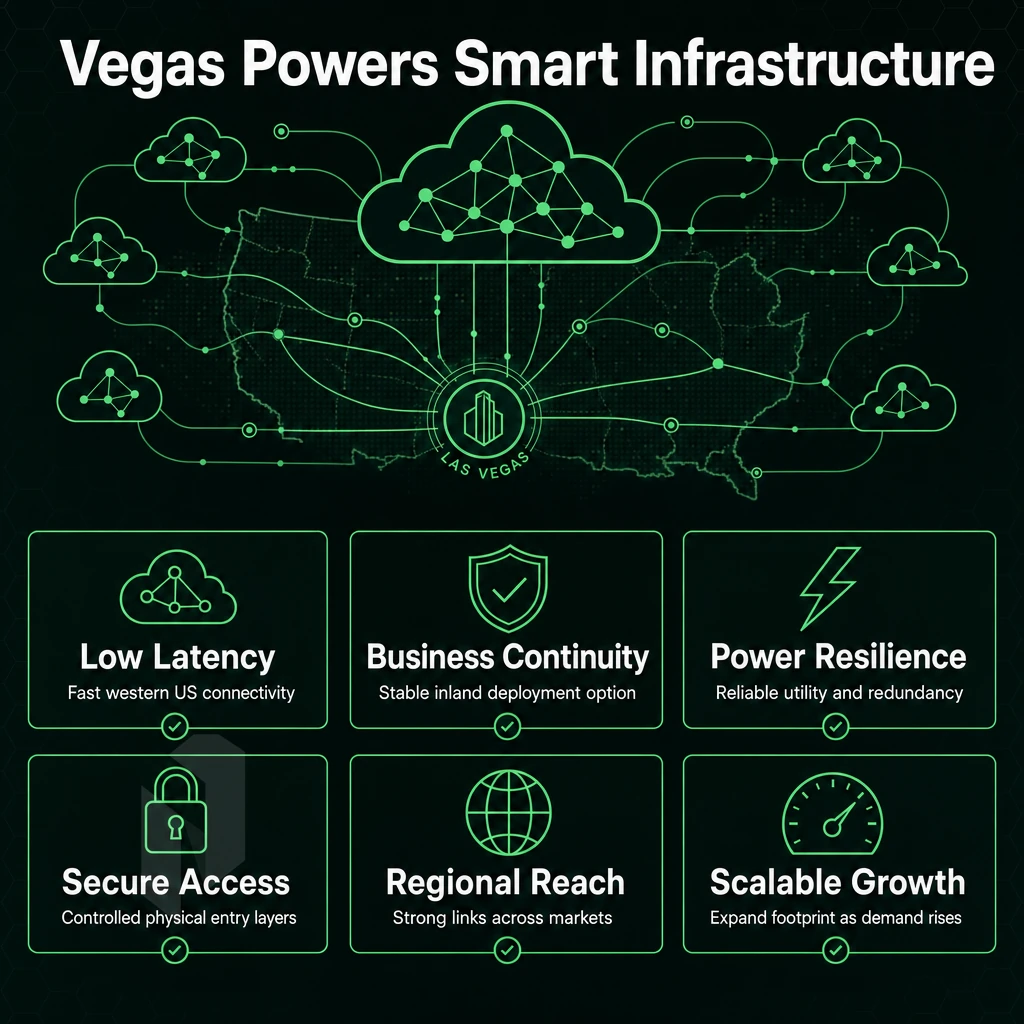
Las Vegas, NV has emerged as a serious alternative for Western US colocation in the downtown of the gaming capital. The inland colocation, geostable ground and very business friendly Nevada tax regime make downtown Las Vegas an interesting alternative to the coastal hubs for latency sensitive and disaster recovery applications.
Geographic and Risk Profile
Located approximately 270 miles from Los Angeles, Las Vegas is within a low latency radius of the West Coast while being outside of California's active fault zones. As Nevada is hurricane, tornado and flood event starved, it is an inland colocation with low natural disaster exposure. This facilitates reduced risk of infrastructure damage for the colocation customers of a Las LV data center.
Energy and Tax Advantages
Nevada offers a robust renewable energy portfolio with high levels of solar irradiance. Many renewable energy programs in the state enable on-site power generation from renewable energy resources. Nevada has no corporate income tax and offers special equipment and sales tax abatements for data centers above what would be provided in California or Oregon. The result is a lower total cost of ownership.
Fiber Density and Connectivity
With over 30 data centers and 20+ providers in the market, Las Vegas is a hotbed of activity. Several long-haul fiber routes include connections to Los Angeles, CA; Phoenix, AZ; Salt Lake City, UT. And Denver, CO. These diverse routes enable sub-10 ms latency to key Western US metros and offer the redundant pathes that enable enterprise BGP deployments.
Choosing the Right Colocation Partner
If your primary data center is already located in Europe or Asia-Pacific and you are looking for a Western US location for your workloads that require Western US presence. Renewable energy and better tax efficient operations then pairing that with a global provider that has multiple locations in Europe, North America and Asia will allow for a single management portal and consistent SLA’s.
Our Miami and New York facilities act as our East Coast anchor locations. Our 2.4 Tbps+ backbone spans all locations worldwide. While the above information provides good insight into the geographical and business case for a data center in Las Vegas. It is important to also understand what exactly you get when you sign up for a facility in Las Vegas.
How Colocation Works: What You Get in a Las Vegas Facility
Colocation is simple. You bring your hardware and own it. The facility supplies power, air conditioning and network connectivity. If you’re going to rent space in a data center in Vegas it’s good to know how colocation works and what kind of space you need before you sign a lease.
Phase 1: Choose Your Space and Power Tier
- Choose a deployment format: Cabinets are ideal for single-rack deployments. Cages provide a locked, team-only area across multiple racks. Suites provide a private, physical space for very large or specialized (compliance) operations.
- Match the power density of your equipment to your desired configuration. Standard power density for data center space is 3-5 kW per rack. Higher density applications such as GPU computing, AI inference and dense storage can range from 10-30 kW per rack and above. Las Nevada data centers can support configurations that range from a single cabinet up to multi-megawatt facilities. It is best to establish the kW per rack requirement for prospective customers prior to reserving space.
Note: Underestimating power density is the most common colocation mistake. Always add 20-30% headroom for growth.
Phase 2: Establish Connectivity
- Order your cross-connects. A cross-connect is a physical cable connection between your cage and a carrier or cloud on-ramp within the same data center. Our carrier-neutral data centers allow you to choose from all providers and get the best possible prices while avoiding lock-in.
- Check for redundant uplinks. Verify that the N+1 power and cooling configuration for the facility has a minimum of one active and one backup unit per component. Check that the stated redundancy tier for power feeds and cooling loops is actually redundant for both.
Phase 3: Go Live and Operate
- Utilize remote hands for typical day to day tasks. The remote hands technician physically completes tasks such as reboots, cable moves, drive replacements, etc. Verify what is included in the remote hands service versus what will be billed before you send the equipment to the collocation site.
- Test failover for critical systems before it matters. Test power feed failure during commissioning test for UPS, PDU and cooling systems operation under load.
Note: Carrier-neutral access is only valuable if you actually order diverse providers. Single-carrier deployments eliminate the redundancy the model is designed to deliver. Once you understand how the model operates, the next question is which provider-level factors separate a reliable facility from a risky one.
Key Factors to Evaluate When Selecting a Las Vegas Colocation Provider
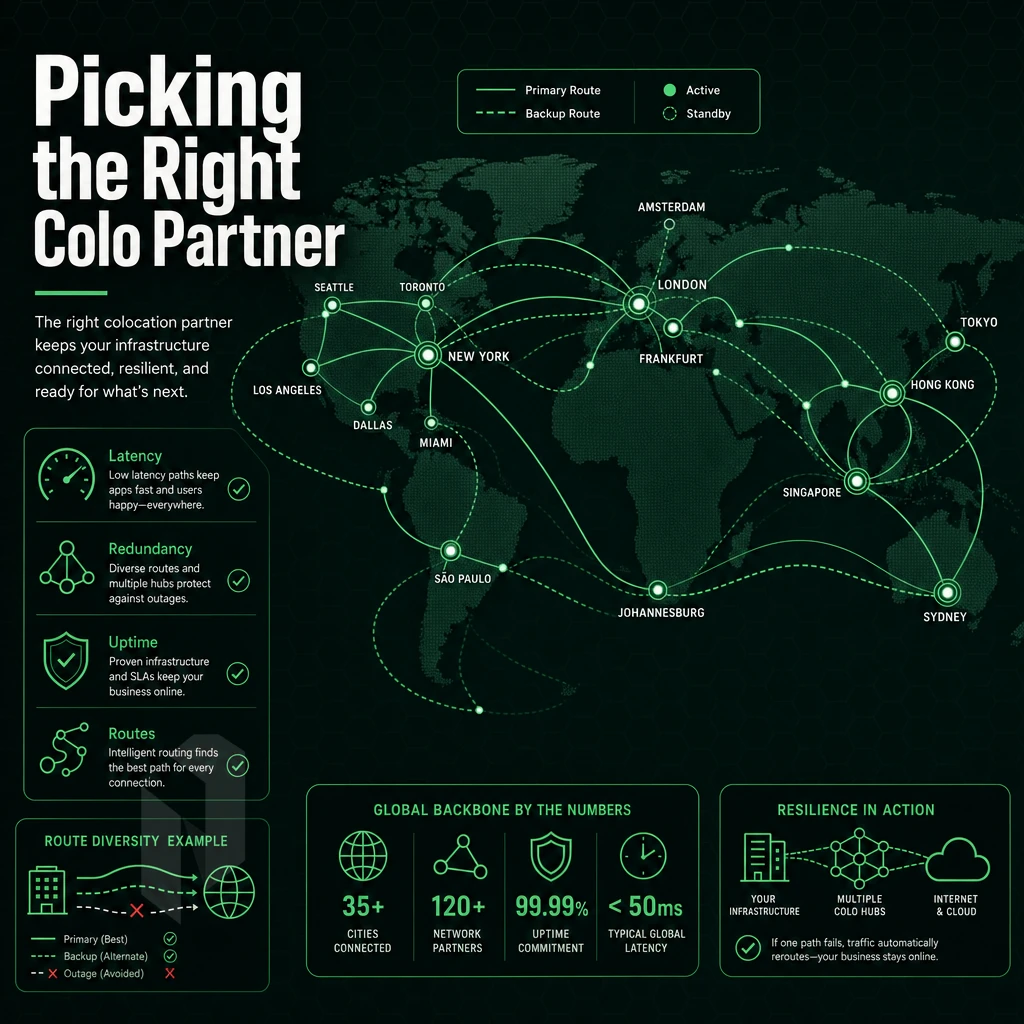
While choosing a colocation in Las Vegas may start with looking for rack space. You really want a facility that will keep your computers up and running, grow with you and allow you to pass compliance audits. Consider these issues carefully when negotiating a contract.
Power Density and Redundancy
For most applications, N+1 power protection using one redundant component per circuit is standard practice. However, high-density GPU and compute applications require 2N power to deliver fully independent power paths to eliminate single points of failure.
Verify the per-cabinet kilowatt ceiling for power in your desired facility. Many data centers advertise aggregate kilowatt power but list 5-10 kW per cabinet as the maximum. High-density environments require data center designs to support such environments.
Carrier Neutrality and Physical Security
Carrier Neutrality
In contrast, carrier-neutral facilities allow cross connects to all carriers and Internet Exchange participants, enabling flexible BGP routing, best pricing and most importantly business continuity in case of an upstream failure. Locked-in single-carrier facilities take away all control.
Physical Security
Biometric access, man-trap access, 24/7 CCTV with retention and per-cage or per-cabinet locking are basic requirements. Any gaps in these requirements create a compliance problem, especially when audited under SOC 2 and ISO 27001.
Compliance, SLA, and Scalability
Security controls audited by a third party (as opposed to operator writing up their own security controls) for SOC 2 Type II and ISO 27001 certifications.
SLA uptime commitments can vary greatly.
The scalability path to additional capacity (as opposed to merely the current capacity) must also scale. How do additional cabinets, increased power, etc. get added without moving to a completely different facility.
With your provider selection criteria in place, it’s time to determine whether colocation makes sense for you, or if a bare metal dedicated server would be a better fit for your application.
Colocation vs. Bare Metal Dedicated Servers: Choosing the Right Model
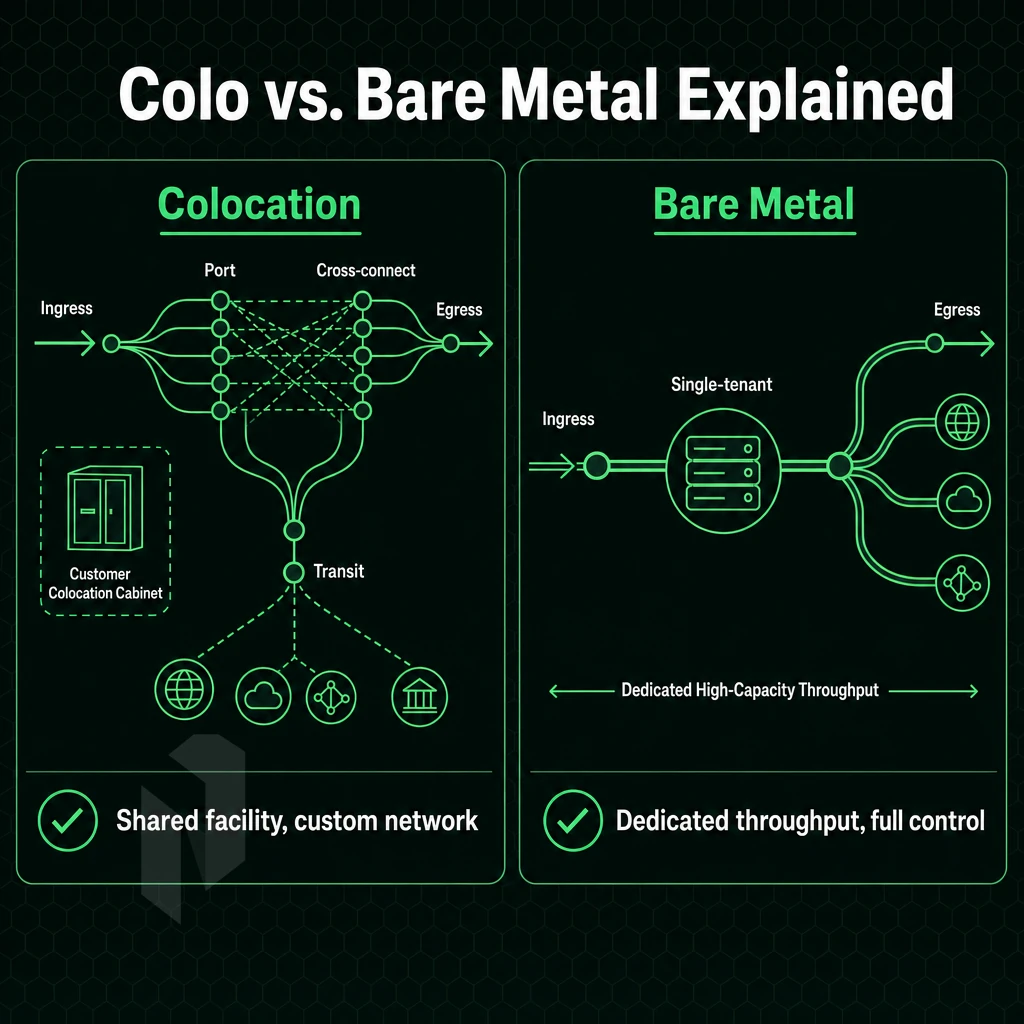
When choosing between colocation and bare metal dedicated servers, the choices made can influence your operational model, your exposure to capital and your time-to-production. Although both types of servers deliver dedicated physical resources, there are large differences with regards to issues such as ownership, up-time and responsibility.
Colocation: You Own the Hardware
Colocation, or “colo”, is when you ship your own servers to a data center and pay for space in a rack, for power consumption, and for network connections. The data center then provides the physical security, climate control, and cross connects to other networks. You can configure every component of your servers including the enclosures, hard drives, network interface cards (NICs), and even the firmware.
The colocation model is ideal for organizations with existing hardware assets or with strict requirements around particular hardware configurations. A managed service provider in Las Vegas with proprietary appliances to support their customers can benefit from the flexibility of colocation to run their proven hardware without the need to move it to a new data center.
- You get full control over the hardware, from custom NIC cards to storage controllers and GPU configurations.
- Capital already spent, colocation monetizes existing assets.
- Longer lead times, shipping, racking and cabling all add days or weeks.
- You own hardware failure risk and replacement logistics.
Bare Metal: Provider-Owned, Instantly Deployable
Dedicated server hosting is provided by the hosting provider who owns and maintains the servers. Root access to the best enterprise grade servers is provided and you do not have to pay for any of them and there is no wait for procurement.
Our bare metal servers are provisioned within 60 minutes on Dell and Supermicro hardware. All servers come with unmetered 10 Gbps connectivity. Our solution provides dedicated server hosting fast, without you having to deal with the hardware lifecycle.
Which Model Fits Your Workload
Use colocation services if you require existing hardware, or specific hardware level customizations. Use bare metal services if speed, zero capex, and predictable managed infrastructure are more important to you than owning the physical server. For more context, see Switch (company).
- Colocation wins: legacy appliances, regulatory hardware mandates, long-term owned assets.
- Bare metal wins: fast deployment, no procurement cycle, managed infrastructure without hyperscaler lock-in.
The performance of any network model depends on the underlying network. The discussion of carrier neutrality is where this conversation begins.
Network Connectivity: Why Carrier Neutrality Matters in Any Colocation Market
The most important network variable when choosing a colocation provider in the growing Las LV hosting center market is carrier neutrality.
Carrier-Neutral vs. Carrier-Controlled
A carrier-neutral facility is one where you can choose your upstreams and set up multi-homing to two or more providers and run BGP to setup auto failover should one of the paths start to degrade.
Las Vegas, NV is rapidly increasing in fiber density with dozens of facilities under construction across the metro. Not all are carrier-neutral so be sure to verify before entering into any agreement.
BGP, IP Transit, and IX Peering
BGP multi-homing allows you to announce your prefixes on several upstreams. The shortest path to a destination is chosen for each packet. IX peering even decreases latency even more as regional traffic is kept off paid internet connection paths.
| Capability | Carrier-Neutral | Carrier-Controlled |
|---|---|---|
| BGP multi-homing | Yes | Rarely |
| IX peering access | Multiple exchanges | Provider-selected only |
| Failover resilience | Automatic path diversity | Single-path risk |
| Routing control | Full customer control | Provider-managed |
Evaluating Network Quality Across Geographies
When looking for dense peering and BGP control, first look at the network quality of potential providers and later at their geographic presence.
Additionally, the 10 Gbps are unmetered on all dedicated servers and are available in ten locations in Europe, North America and Asia.
DDoS Protection and Security in Colocation Environments
For enterprise applications, security at the physical layer, network layer and compliance layer is paramount. A thorough audit prior to signing off on a colocation facility needs to ensure that physical intrusion as well as volumetric attacks are countered.
Physical and Compliance Baseline
- Verify physical access controls. Review multi-factor authentication, biometric authentication at entrances and man-trap vestibules. Verify cameras are installed and that access logs are retained and auditable. Physical access controls are the weakest link in the majority of organizations and underpin all of the network-layer controls.
- Check for compliance certifications such as ISO 27001 / SOC 2 as a minimum, these have been independently audited and are more than self claimed security controls. ISO 9001 can also be used to check for consistent processes across all aspects of a providers operation.
Network Security and DDoS Mitigation
- Request to always have L3/L4 DDoS protection enabled as standard. Volumetric attacks should be handled automatically without the need for a support ticket. As standard, L3/L4 mitigation should be included with all services and not offered as an additional service. By default, Netrouting already includes L3/L4 DDoS protection for all services.
- L7 mitigation for high-risk workloads: Application-layer attacks will defeat network-layer filtering. If you run APIs, online gaming, or financial services, verify that your provider offers advanced L7 scrubbing with custom policies.
- Check for 24/7 NOC coverage. The Network Operations Center has to monitor and respond 24/7. Check for mean time to detect (MTTD) and for escalation procedures in case of an incident.
Note: Providers that charge extra for DDoS protection on standard colocation are behind the curve. Treat always-on mitigation as a non-negotiable baseline, not a premium feature.
Verification Before Signing
- Request an audit report / test results. Typically this would be a recent SOC 2 Type II audit report as well as summaries of recent penetration tests.
- Confirm that power and connectivity have redundancy. This includes N+1 power and cooling as well as multiple upstream carriers to different locations in order to ensure that the infrastructure is running in case of failure of individual components.
Once you have established the security and compliance requirements for you, the real question is then which provider can fulfill all of these requirements globally and not only within a single market.
Why Choose Netrouting for Colocation and Bare Metal Infrastructure
Not every workload belongs in a single market. Organizations evaluating Las Vegas data center colocation often need US-based infrastructure, but the right fit depends on connectivity, certifications, and operational depth, not just geography. Netrouting operates ten carrier-neutral facilities across Europe, North America, and Asia-Pacific, with US presence in Miami and New York backed by our own Tier 1 backbone (AS6206) and 2.4 Tbps+ network capacity.
- Two US locations, dense IX peering. Miami connects directly to Latin American routes via FL-IX. New York sits at 60 Hudson Street with DE-CIX New York peering for the NY/NJ metro.
- Carrier-neutral colocation. Bring your own hardware, your own upstreams, or use ours. No lock-in.
- Bare metal provisioned in under 60 minutes. Dell and Supermicro hardware on Intel Xeon and AMD EPYC platforms, with unmetered 10 Gbps included.
- Always-on DDoS protection. L3/L4 mitigation is included on every service, no add-on required.
- ISO 9001, ISO 27001, and SOC 2 certified. Compliance-ready infrastructure for regulated workloads.
- 24/7 NOC with a 1-hour ticket guarantee. Proactive monitoring and rapid response, around the clock.
If your evaluation extends beyond Las Vegas Nevada to include globally connected, carrier-neutral alternatives, explore our colocation options or contact sales to compare configurations against your current shortlist. To understand which specific workloads drive demand in the Las Vegas market itself, the next section breaks down the most common use cases.
Downtown Las Vegas Colocation: Common Use Cases and Workload Fit
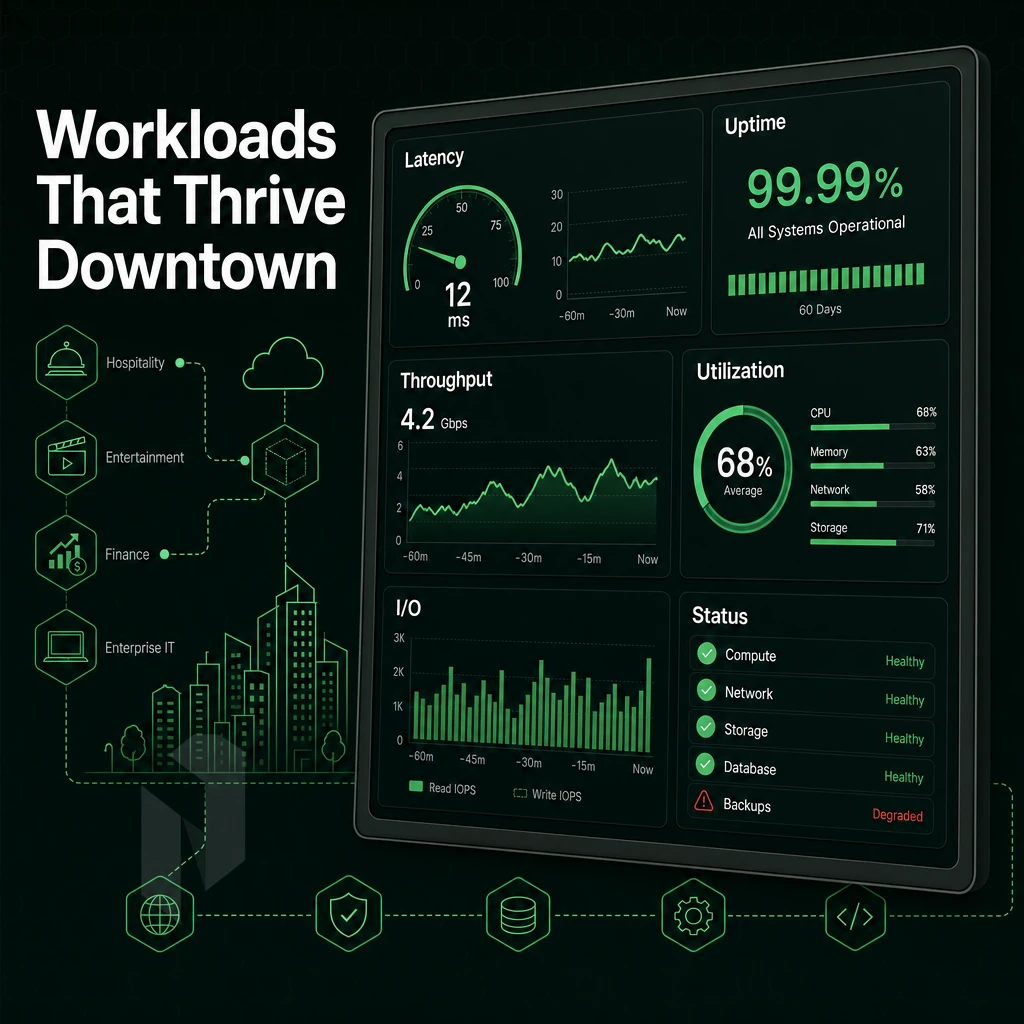
Las Vegas’ unique concentration of hospitality technology, entertainment, financial services and regional enterprise IT creates specific demands on the colocation infrastructure. By understanding the various workloads that require colocation in Las Nevada hosting centers, one can match their needed infrastructure prior to locking themselves into a contract.
Gaming, Entertainment, and Media Workloads
Gaming systems such as slot management, customer loyalty programs, real-time analytics and surveillance all require low-latency local connectivity and high power density per rack.
Media and streaming companies locate near Las Vegas, Nevada to serve Southwest U.S. from a buffering minimal location.
- High-bandwidth uplinks, 10 Gbps and above.
- Carrier-neutral facilities with multiple transit options.
- Redundant power for 24/7 playout systems.
Enterprise Disaster Recovery and Backup
The roughly 270 miles between Las Vegas and Los Angeles is far enough to meet most enterprise organizations’ primary DR separation objectives, without introducing undue latency for replication. So long as the dedicated server hosting Southern Nevada facility is being utilized as a secondary site, primary objectives include fast failover, daily incremental backup(s), and near real-time restore(s) under 45 minutes or less.
Typical DR environments are configured with a primary production environment running in the West Coast and a secondary data footprint in southern Nevada that contains replicated storage and dormant compute resources that can be brought online in minutes to support recovery.
Financial Services and Regional Enterprise IT
Nevada financial services companies need edge locations near their POS terminals and ATMs. Locations need to be physically secure and audited for companies that need to comply with PCI DSS and SOC 2 requirements.
Large regional enterprises use the Southern Nevada market colocation to manage the IT infrastructure of individual branches.
The Las Vegas NV Data Center Market: Scale and Growth
The Clark County NV market has become one of the fastest growing secondary colocation markets in North America. The Clark County, Nevada NV area is now home to over 30 facilities including carrier neutral edge facilities as well as large campus style data centers with hundreds of megawatts of reserved capacity. Enterprise adoption is increasing with corresponding development of power infrastructure to support growth.
southern Nevada is getting more data centers. Yes. And at a large scale. There are several new data center projects in the Downtown Southern Nevada area as well as several data center expansions in the Las Vegas metro area. The trends that we’re seeing with the Las LV colocation center market are similar to the trends that we’re seeing with data center markets around the country.
Good power, good geography, and a lot of connectivity in the area make for a great data center colocation market for enterprise and wholesale buyers. Below are the most common questions that buyers have when looking at the Las Nevada colocation center market.
Frequently Asked Questions
Is Las Vegas NV Getting a Data Center?
Las Vegas is already an established data center market and continues to attract new investment. Several large-scale campus expansions are underway across the metro area, driven by demand from gaming, entertainment, and enterprise workloads. The region's low seismic risk, favorable power costs, and proximity to Southern California make it a consistent target for new builds.
How Many Data Centers Are in Las Vegas NV?
The Las Vegas metro area hosts dozens of commercial data center facilities, ranging from carrier-neutral colocation campuses to enterprise-owned sites. Estimates from industry trackers place the count at over 30 operational facilities across the Henderson, Summerlin, and downtown corridors. That number grows steadily as hyperscaler and wholesale demand pushes new construction.
What Is the Largest Data Center in Las Vegas NV?
Switch's SUPERNAP campus in Las Vegas has historically been the largest facility in the market by raised-floor space and power capacity. The campus spans multiple interconnected buildings and is designed for high-density deployments. Several wholesale and hyperscaler campuses in the Henderson corridor are also among the largest by total megawatt capacity.
Who are the top 10 colocation providers?
The leading colocation providers globally include large carrier-neutral operators, regional specialists, and IaaS-focused providers that combine colocation with managed networking. Strong options for US workloads include providers with dense IX peering, redundant power, and 24/7 remote-hands support.
Netrouting offers carrier-neutral colocation across Miami, New York, and nine other locations worldwide, with N+1 power and cooling, free private interconnect up to 40 Gbps, and always-on DDoS protection included on every deployment, a strong fit for businesses that need US East Coast presence alongside European or APAC reach.
What Should I Look for in a Downtown Las Vegas Colocation SLA?
Prioritize power uptime guarantees, hardware replacement windows, and network availability commitments, these three drive the most downtime risk.
How does colocation differ from a dedicated bare metal server?
Colocation means you own the physical hardware and rent space, power, and connectivity inside a provider's facility. A dedicated bare metal server means the provider owns the hardware and leases it to you on a monthly basis, no capital expenditure, no equipment logistics.
Colocation gives you full control over hardware selection and refresh cycles; bare metal is faster to deploy and shifts hardware risk to the provider. Netrouting offers both: carrier-neutral colocation with up to 20 kW per footprint, and bare metal servers provisioned in under 60 minutes.
Can I use a colocation provider outside Las Vegas for US workloads?
Yes, most US enterprise and application workloads are not latency-sensitive enough to require a Las Vegas-specific facility. Miami and New York are both Tier 1 interconnection hubs with direct access to major IX infrastructure, making them strong alternatives with broader carrier diversity. Netrouting operates in both Miami and New York, with SOC 2-compliant infrastructure, unmetered 10 Gbps connectivity, and a 2.4 Tbps+ backbone, delivering the reliability and network performance US workloads demand without geographic lock-in.
When choosing a colocation location, such as Las Vegas, the location itself is only one piece of the puzzle. One must also choose a quality colocation provider. Be sure to evaluate power density, network diversity, and the level of response one can expect from their support team prior to signing contract. Additionally, bare metal may be a better choice than colocation for workloads that require dedicated performance and do not want to expose themselves to the risk of shared resources.
Netrouting operates carrier-neutral colocation and dedicated bare metal across ten locations in Europe, North America, and Asia, backed by a 2.4 Tbps+ network, always-on DDoS protection, and a 24/7 NOC with a one-hour ticket guarantee. If your infrastructure requirements extend beyond a single market, that global footprint matters. Talk to the Netrouting team to map the right deployment model to your workload.