Most large-scale deployments of infrastructure require more than simple hosting agreements. bulk colocation facility agreements are designed for large footprints that require dedicated power, cooling and cross-connects. With wholesale colocation agreements, you can also achieve the level of control of your environment that is not possible in standard colocation or hosting sharing environments.
Making this decision is not trivial. The number of power banks, redundancy, carrier diversity, geographic scope, and the contractual arrangements all vary greatly between individual data centers and cloud providers. Mischoose and you’ll lock yourself into a data center that cannot grow with you, or you’ll pay for excess capacity.
Organizations evaluating data center colocation must also assess uptime SLAs, network latency requirements, and disaster recovery capabilities before committing to multi-year contracts. Service level agreements should explicitly guarantee uptime percentages with financial penalties for breaches, ensuring accountability for mission-critical operations. Enterprises with mission-critical workloads must prioritize high availability architectures that minimize single points of failure across their infrastructure stack.
Blog contents
In this guide to wholesale colocation, we will explain how colocation works, how to distinguish a good colocation facility from a money pit. How to evaluate potential colocation providers against your specific needs and how Netrouting’s carrier-neutral colocation platform can host your enterprise-level solution and deliver the network performance it needs.
What Is a Wholesale Colocation Data Center?
A wholesale colocation data center is a type of facility that offers a single tenant large space (entire halls, suites, even multiple megawatts of power) that they lease instead of renting individual racks or cabinets. Wholesale colocation facilities are designed for the large, predictable communications infrastructure needs of very large organizations.
How It Differs from Retail Colocation Data Centers
Typically shared colocation is divided up into smaller sections of space and billed out by the rack or by the cabinet.
It behaves like a dedicated data center without the capital cost of building your own data center facility.
What the Tenant Controls
Wholesale tenants bring their own equipment for networking and manage their own complete end-to-end IT infrastructure. The operator supplies power, cooling and physical security and connectivity options. This arrangement grants tenants complete control over their hardware configurations, software deployments, and operational procedures while the facility handles the underlying infrastructure.
This separation of responsibilities allows organizations to focus resources on optimizing their data infrastructure rather than managing facility operations. Many internet service providers leverage this wholesale model to deploy regional points of presence without the overhead of constructing proprietary facilities.
This model is typical in the data center industry and used by large enterprises, cloud providers and carriers who require consistent high density capacities across regions. Many hyperscale data centers also adopt this wholesale model to rapidly expand their global footprint while maintaining operational consistency. Selecting a major provider with proven track records in wholesale deployments ensures organizations benefit from operational expertise and established infrastructure management practices.
A Practical Data Centers Example
A content delivery operator, for example, rents a 500 kW space and sets up their own data centers infrastructure, computers, storage, and networking, within it.
Wholesale vs. Retail Colocation Data Centers: Key Differences
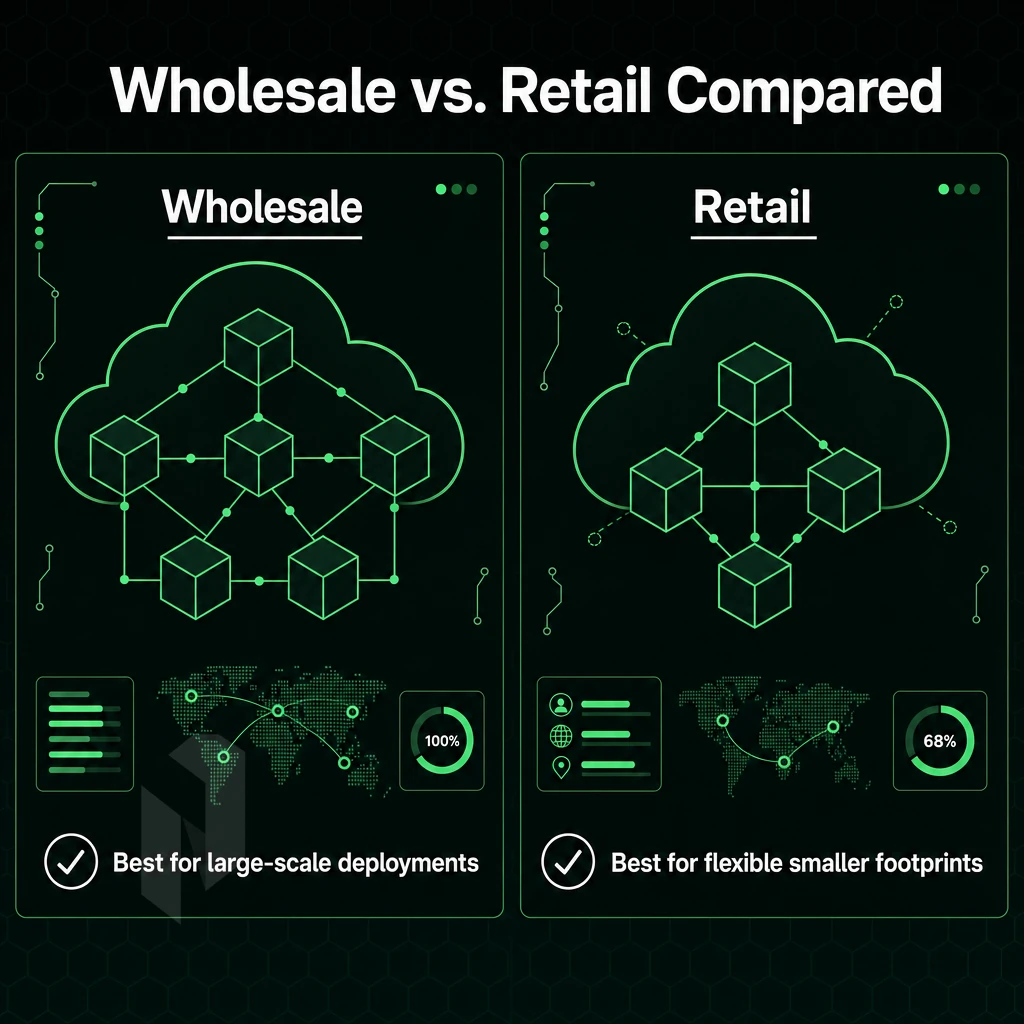
The two models are quite different in their intent to serve the needs of their customers.
Scale, Power, and Control
Wholesale colocation is provided in large power blocks of 1 MW or more leased to a single customer, who configures the space, including cooling and networking equipment, as needed. Retail colocation starts at a single rack or half a cabinet and shares power distribution and air conditioning with other customers.
Operational costs confirm this reality.
Data Centers Contract and Commitment
Wholesale agreements generally run for 5-10 years as they have invested in specialized infrastructure for their customers. Conventional data centers colocation agreements can start as short as 1 month and are typically used by customers that are currently unknown, growing quickly, or need lots of flexibility.
Colocation Pricing Model and Ideal Tenant
Power usage in wholesale datacenter colocation is a bigger driver of cost than the number of cabinets you rent. Retail datacenter colocation on the other hand is typically charged by rack space and the amount of bandwidth you consume. Here is a table that outlines the key factors to consider for each.
| Dimension | Wholesale | Retail |
|---|---|---|
| Minimum footprint | Full hall or dedicated suite | 1U to full cabinet |
| Power block size | 1 MW+ per tenant | 1-20 kW per cabinet |
| Contract term | 5-10 years | 1 month to 3 years |
| Pricing model | Per reserved kW | Per rack unit and bandwidth |
| Physical security responsibility | Tenant-managed within leased space | Provider-managed, shared perimeter |
| Ideal tenant profile | Large enterprises, hyperscalers, cloud builders | Small businesses, growing teams, edge deployments |
Wholesale data centers are more suitable for large-scale deployments that require dedicated infrastructure and have a higher than cabinet-sized amount of hardware. For teams with fewer cabinets and greater flexibility, retail is the more practical option. Netrouting’s carrier-neutral data centers are spread across ten cities and offer 20 kW per cabinet with N+1 power infrastructure. Once you have determined whether retail or wholesale data centers are more suitable for you, this page explains how the wholesale facilities operate on a day-to-day basis.
How Wholesale Colocation Providers and Data Centers Work
A large-scale colocation center is simply a building where you pay for space and power and own everything you bring into the facility. The only things you don’t own or control are the building, the cooling system, and the physical security of the facility. Modern colocation centers typically feature multiple carrier entry points and diverse fiber paths to ensure network resilience for mission-critical workloads. The facility operator maintains efficient cooling systems designed to handle high-density equipment loads while optimizing energy consumption across the entire building.
Leasing Raw Space and Power
- Dedicate space in kW or MW blocks (floorspace rented in power). Wholesale colocation is typically offered in large power blocks and rented in terms of committed power (in hundreds of kW) and the associated floor area.
- Connect to redundant power feeds. The facility has dual utility feeds with UPS and generator backup. Your servers connect directly to these feeds. Single points of failure are eliminated before they can affect your gear.
Note: Underestimating power density during rapid growth is the most common mistake. Size your power commitment 20-30% above current draw to avoid costly mid-contract amendments.
Installing Networking and Cross-Connects
- Order cross-connects to carriers. A cross-connect is a physical cable run from your cage to the carrier’s meet-me room for that carrier. All the major providers in the facility have cross-connects so that all your traffic never leaves the building.
- Advanced cooling should be deployed in high density rows. Standard air cooling is effective up to moderate densities but as density increases, high performance GPUs and AI workloads are frequently cooled with liquid cooling solutions. Check that the facility can support in-row or direct liquid cooling solutions before specifying hardware.
Formalising Uptime and Access Terms
- Review your Service Level Agreements (SLAs) carefully. A SLA will define Service Guarantees, Power Guarentees and Service Breaches. Our standard SLA is 99.9% uptime guarantee.
- Review the on-site security measures in place at the data center, such as: biometric ID readers, on-site security guards and 24/7 video monitoring. These are the minimum measures to secure your hardware around the clock.
Once the mechanics of wholesale agreements are understood, it helps to know which organizations, from data centers to telecoms, enter into them and why.
Benefits of Wholesale Colocation Data Centers Over Building Your Own
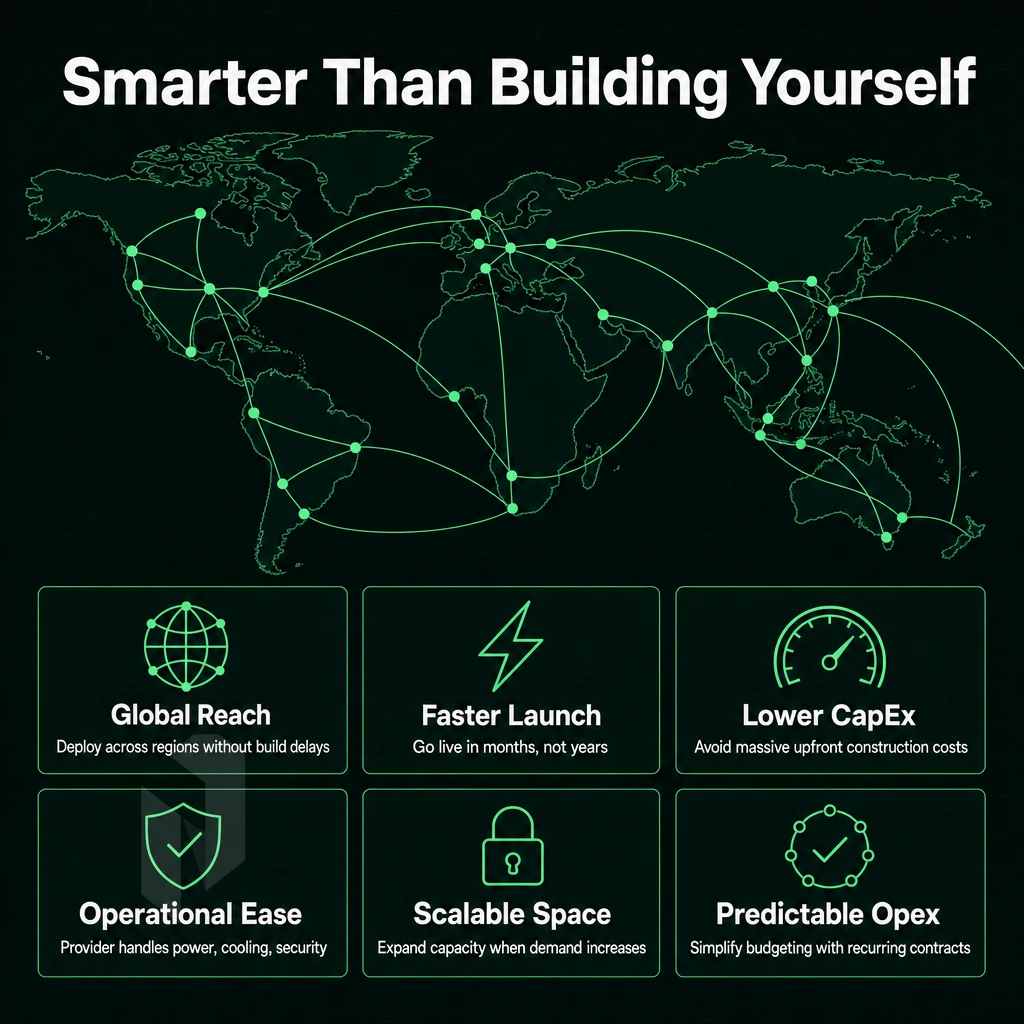
Building a data center can take years to construct, massive up-front capital and large ongoing operational expenditures. Wholesale colocation eliminates all of these, providing customers with state-of-the-art power, cooling, connectivity and security from day one, without the brick and mortar. Organizations evaluating colocation services often find that the predictable monthly expense model simplifies budget planning compared to the variable costs of facility ownership. This approach enables organizations to accelerate their digital transformation initiatives by deploying infrastructure in weeks rather than years.
Modern wholesale facilities also implement advanced sustainability practices that help organizations reduce their environmental impact while maintaining operational efficiency. A financial services firm deploying trading platforms across multiple regions can leverage this model to meet strict latency and regulatory requirements without facility construction delays. Regulated industries such as healthcare and finance particularly benefit from facilities that maintain hipaa compliance and other industry-specific security standards. Facilities that adhere to industry standards for uptime and operational excellence provide organizations with confidence that their infrastructure meets rigorous performance benchmarks.
Cost Efficiency: CapEx Avoided, OpEx Controlled
Building greenfield data centers typically takes 18-36 months and requires a significant upfront investment to get to the first server. By converting your capital expenditures into operating expenditures, wholesale colocation can be very cost efficient. Most of the costs for a data center such as a power distribution, the physical plant and the personnel are spread across all the tenants of that wholesale colocation center.
Organizations that choose this model typically realize significant cost savings within the first year of operation compared to building their own facilities. Shared infrastructure investments enable tenants to access enterprise-grade facilities at lower costs than would be achievable through independent construction and operation.
These savings extend past the initial construction phase. Facility maintenance, security personnel, and air conditioning plant upgrades in data centers are just a few of the ongoing costs that an operator will bear, rather than your IT budget.
Carrier-Neutral Connectivity and Scalable Solutions
A carrier-neutral colocation facility is typically easier to work with than an owned data center, because the cross-connects to all available networks and IX peering are already in place. Connecting a new transit provider or peering settlement to a rack can take days, not months.
Our scalable solutions mean that we have the capacity for extra cabinets when you need them. Our colocation suites are located in The Hague, Amsterdam and Miami and are designed to scale in a matter of time, with no construction lead time.
Physical Security and Energy Performance
Colocation facilities today are continuously investing in the latest digital security measures. A modern datacenter not only will have typical facility security measures such as biometric access control. Data centers feature 24/7/365 CCTV monitoring and mantrap access control points, but this is all designed into the facility from the ground up and costs far more to retro fit.
Energy consumption is where the gap really opens up. Purpose-built data centers can implement efficient cooling through hot/cold aisle containment or free-air economization, achieving a PUE that enterprise-owned machine rooms simply cannot match.
The savings are in terms of operational expenditure and in terms of reduced carbon output.
Why Choose Netrouting for Colocation
Netrouting operates carrier-neutral colocation data centers across 10 locations, Amsterdam, Frankfurt, The Hague, Rotterdam, Stockholm, Bucharest, Miami, New York, Hong Kong, and Singapore. Our colocation facilities scale from shared secured cabinets to private suites, with up to 20 kW per footprint and N+1 redundant power and cooling. That range covers small businesses needing a few rack spaces and large enterprises requiring high-density, high-availability deployments.
- Certified and compliant: ISO 9001, ISO 27001, and SOC 2 compliance certifications across our colocation centers, meeting strict data infrastructure and digital security requirements.
- Carrier-neutral with dense IX peering: Access AMS-IX, DE-CIX, NetNod, and FL-IX from our facilities. Cross connects to multiple providers keep your colocation solution vendor-independent.
- Free private interconnect: Up to 40 Gbps free private network between your resources, lower costs, lower latency, no shared infrastructure surprises.
- Always-on DDoS protection: L3/L4 mitigation included on every colocation service. No add-on required.
- 24/7 NOC + remote hands: One-hour ticket guarantee and courtesy on-site remote hands at no extra cost.
Comparing providers across the colocation landscape? Our sales team can walk you through scalable solutions, service level agreements, and competitive rates matched to your power requirements and compliance needs. Contact us to discuss your colocation requirements.
Wholesale Colocation FAQs
Wholesale colocation: Questions throughout the buying process. Answers to the most important questions about wholesale colocation: cost, data centers and the matching of your infrastructure to the respective offer.
What Does a Colocation Offer and Why Is It So Expensive?
The physical infrastructure of a datacenter is very costly.
A carrier-neutral colocation data center typically adds cross-connect and IX peering on top of basic colocation data center services. Building and maintaining that connectivity density is costly, but it's exactly where the value of colocation data center space versus running your own data center becomes clear.
What Are the Three Types of Colocation Data Centers?
The colocation market can be segmented into three distinct models. small-scale colocation is suited for companies with a few racks of servers that require hosting in a shared data center. Wholesale colocation on the other hand provides large power blocks of 250kW+ to a single customer. Hyperscale data centers are specialized giant data center campuses run by cloud companies to host their own cloud platforms.
Colocation centers are in between running your own datacenter on premises and running your datacenter 100% in the public cloud.
Wholesale vs Retail Colocation Data Centers What Is the Difference
In individual colocation, space is typically sold by rack units.
Netrouting has Carrier Neutral data centers in 10 locations around the world. Single rack units up to full high density multi-cabinet data centers setups are available and will be designed to fit the specific needs of the customers' hardware and workload.
Frequently Asked Questions
Why Are data center colocation Services Priced So High?
colo pricing reflects the true cost of enterprise infrastructure: redundant power feeds, N+1 cooling systems, on-premises security, 24/7 staffing, and high-capacity network connectivity.
What Are the Three Types of Data Center Colocation Facilities?
The three primary types are enterprise (owner-operated, single-tenant), standard colo (shared multi-tenant facilities selling space by the rack or U), and wholesale colocation (large-block deployments, typically a half-suite, full suite, or entire hall, leased to a single customer).
How do wholesale and retail colocation data centers differ?
Shared colo data centers sell space in small increments, single rack units, partial cabinets, or individual cabinets, with shared power and cooling infrastructure. Wholesale colocation leases entire suites or halls, giving the customer dedicated power capacity (often measured in hundreds of kilowatts or megawatts), dedicated cooling, and physical separation from other tenants.
Wholesale contracts run longer, carry higher minimum commitments, and deliver a lower cost per kilowatt at scale.
When do wholesale colocation data centers make more sense than retail options?
Wholesale colocation makes sense when your deployment exceeds roughly 10-20 cabinets, requires dedicated high-density power above 10 kW per rack, or demands physical isolation for compliance or security reasons.
What compliance certifications should colocation data centers have?
At minimum, look for ISO 27001 (information security management), ISO 9001 (quality management), and SOC 2 Type II (security, availability, and confidentiality controls audited by an independent third party), especially for vendors operating their own data centers. Regulated industries may also require PCI DSS compliance for payment data or HIPAA-aligned controls for healthcare workloads hosted in data centers, so confirm these requirements directly with the provider.
Can Small Businesses Use Wholesale Colocation Data Centers?
Rarely. Wholesale colocation is designed for large deployments with dedicated suites, multi-year contracts, and power commitments measured in hundreds of kilowatts, the economics only work at scale. A small business is almost always better served by conventional colo, starting with a single cabinet or even shared rack space.
What Are Carrier-Neutral Colocation Data Centers and Why Do They Matter?
Carrier-neutral colocation means the facility does not favor or restrict access to any single network provider, you can connect to any carrier, ISP, or internet exchange present in the building.
It also enables direct peering with other tenants and exchanges, reducing latency and transit costs.
Wholesale colocation provides enterprises, cloud providers and very high-density workloads with the physical infrastructure required to operate, power, cooling, space and connectivity, without the associated capital expenditure to build and run a datacenter. It provides highly competitive economics, fixed costs, rapid deployment, and access to carrier neutral connectivity through data centers that would take years to build in-house.
The model creates efficiency because it makes clear what you should own (your hardware, your network, your data) and what you should not have to run (the data centers, the power plant, air conditioning).
If your organization is evaluating wholesale colocation options across Europe, North America, or Asia-Pacific, Netrouting operates carrier-neutral facilities across ten cities, from The Hague and Frankfurt to Miami, New York, Hong Kong, and Singapore. Explore Netrouting's colocation solutions or contact the team to discuss your specific power, space, and connectivity requirements.