Costs for dedicated server hosting can vary more than most expect for the initial price. Add in bandwidth caps, setup fees, server types and support Service Level Agreements and the actual monthly cost can be very different from the advertised price. This can lead to users paying for excess capacity or experiencing problems and having to pay to move server mid contract.
We have been fine-tuning dedicated setups since 2007. As a provider of dedicated infrastructure, we operate our own AS6206 backbone with servers in 10 locations around the world (Europe, North America and Asia).
As you research different providers, there are five important things to evaluate about their services: the types of hardware they offer and how current it is. The quality of their network and the bandwidth that they include, the nature of their technical support and their guarantees for how soon you get help.
Blog contents
There, Their data centers are in relation to your own. Additionally, How their pricing compares to the cloud providers (. Amazon Web Services, Microsoft Azure, Google Cloud Platform , etc.) as well as to your other options, for the type of work that you will be doing with them.
This guide to dedicated servers goes through each of the key dimensions of a server and of a dedicated server provider. It highlights common mispricings in the invoice that you get to pay with dedicated servers.
What Dedicated Hosting Costs Cover by Server Configuration
When you are calculating the cost of a dedicated server, the monthly invoice for the server itself is only the base cost for renting the hard host. On top of that is charged the server’s bandwidth consumption, the cost for the operating system (OS), the cost for the control panel. Additionally, The cost for the support you require, which can vary greatly from server to server. License fees and support tiers vary depending on the provider's service model and the complexity of your infrastructure requirements.

Core Costs Including Your Existing Windows Server
Every dedicated server deployment bundles several cost layers:
- Hardware lease: CPU, RAM, and storage provisioned exclusively for you, no shared resources with other customers.
- Bandwidth allocation: metered or unmetered throughput; higher-traffic workloads need more headroom.
- OS licensing: Linux distributions are typically free; Windows Server adds a recurring license fee.
- Control panel: DirectAdmin or cPanel licensing billed monthly on top of the base price.
- Support tier: basic NOC monitoring versus fully managed hands-on administration.
How Much Does It Cost per Month With the Same Host?
Costs for Turnkey Servers differ greatly based on configuration and management level. Basic bare metal servers with one CPU and minimal storage start here. High-core-count EPYC servers from AMD and dual-socket Xeon servers from Intel with NVMe storage and high bandwidth packages are at the upper end. The biggest variable by far is the management level. Selecting the right configuration and management tier for your deployment requires evaluating which plan aligns with your technical capabilities and operational requirements.
Unmanaged vs. Managed Physical Servers for Multiple Websites
Unmanaged servers have lower base prices but you’ll be responsible for the full management of the server, including OS hardening, patching and incident response. Managed hosting adds an operation layer on top of the server stack that your engineers can focus on running your applications.
Unlike shared hosting your dedicated hosting server will have no noisy neighbours. All CPU power and RAM is dedicated to your server. This isolation ensures that resource-intensive websites running on your server maintain consistent performance without interference from other users' traffic spikes or security incidents.
Key Server Configuration Factors That Drive Dedicated Server Pricing
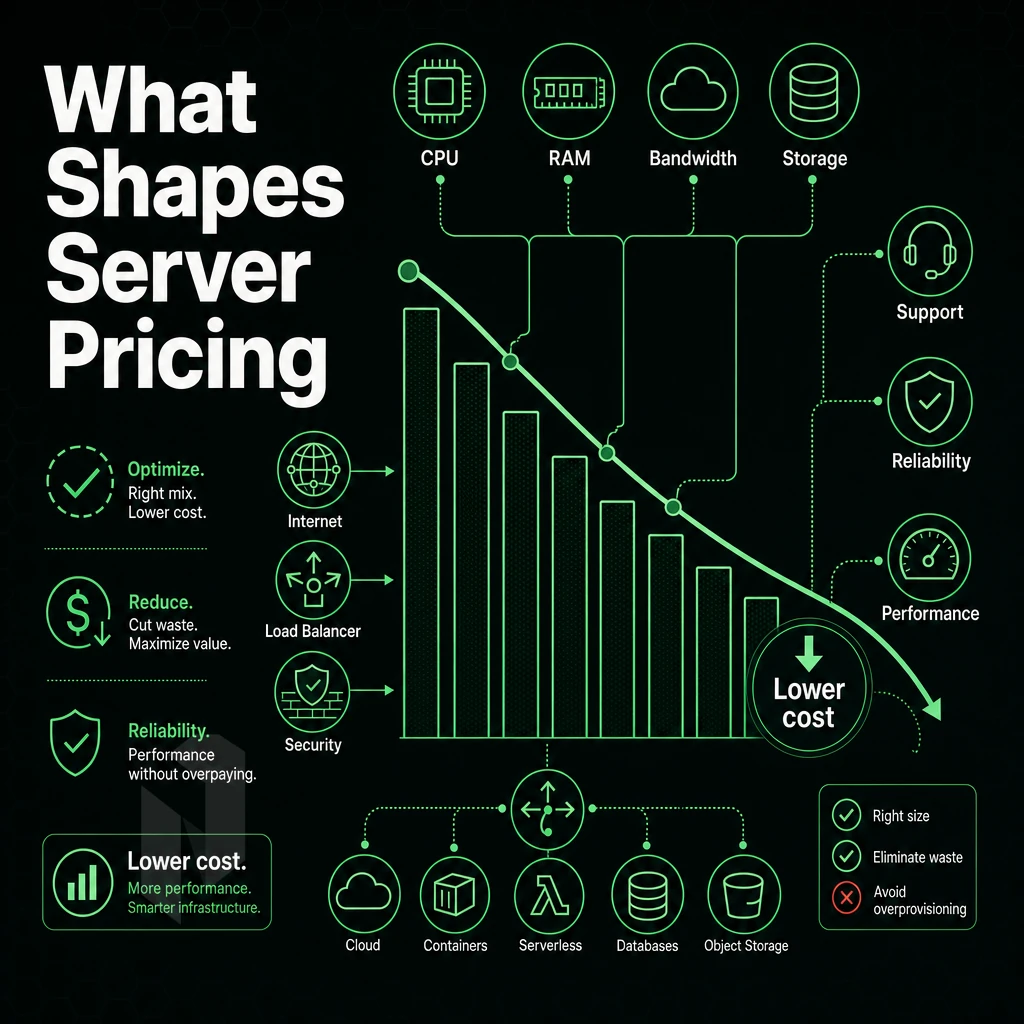
Dedicated server pricing can fluctuate greatly between server configurations. Learning about the variables that affect pricing will help you find the right server for your needs and prevent over-paying for unnecessary capacity. Evaluating each provider's pricing structure and comparing their offerings against your workload requirements helps you select the right plan without overspending on features you won't use.
Hardware Price Comparison: CPU, RAM, and Storage
Processor generation is by far the biggest cost factor for compute servers. Unlike with storage systems, where uptime guarantee considerations often dominate, the Xeon and EPYC processor platforms from Intel and AMD differ significantly in terms of core count and memory bandwidth as well as the core-based licensing models.
Organizations with intensive computational workloads should prioritize processors that deliver sufficient computing power to handle peak demand without throttling. Selecting processors with adequate core counts ensures systems remain responsive during periods of high demand when concurrent user requests spike.
This difference is compounded by considerations around RAM capacity and storage type. Storage on NVMe drives has significantly lower latency and higher IOPS than storage on spinning disks, making them very suitable for high traffic websites and database driven applications. Servers equipped with the latest generation processors and NVMe storage deliver best performance for demanding workloads that require consistent low-latency responses. Organizations running multiple websites should evaluate whether shared NVMe resources or isolated drives per site better support their traffic patterns and data isolation requirements.
Bandwidth, Location, and Contract Length
Both the bandwidth usage included in the offer and the location of our datacenters influence the monthly rate. An annual upfront payment for such a server generally results in a lower effective monthly rate than the same server paid month by month. Providers often incentivize annual contracts over monthly billing, though businesses should weigh upfront payment savings against flexibility lost through long term commitments.
Comparing quotes across multiple providers often reveals that competition in certain regions drives lower prices for equivalent hardware specifications. Choosing the right payment plan requires balancing immediate budget constraints against long-term operational needs and anticipated growth trajectories.
What Is the Difference Between Managed and Unmanaged Dedicated Servers in Terms of Cost?
Unmanaged servers are root access only, and provide no services above and beyond that. Managed tiers include OS patching, security hardening. Additionally, Monitoring, all provided as a service to you by your provider, for the cost of the tier versus the cost of your time and the time of your staff to do these things.
Licensing Add-Ons That Inflate Your Hosting Bill
In addition to the cost of the server hardware itself, Windows Server licensing and SQL server licenses are often additional costs on top that hosting providers charge. Understanding the licensing terms before committing to a provider helps avoid unexpected costs that can significantly increase your total server expenditure.
If you don’t already hold a Windows Server license under a volume licensing agreement, you’ll typically pay a per-server license fee in addition to the cost of the server. For SQL Server, the cost of licenses is typically based on the edition of SQL Server and the number of processor cores on the server.
| Variable | Lower Cost | Higher Cost |
|---|---|---|
| CPU | Older Xeon, fewer cores | Latest EPYC, high core count |
| Storage | Spinning HDD | NVMe SSD array |
| Management | Unmanaged | Fully managed |
| Contract | Annual commitment | Month-to-month |
| OS licensing | Linux (no fee) | Windows + SQL add-ons |
Choose server configurations that match your needs. Once you have mapped out the cost drivers for your use case, you can then compare providers and see where they fall within the various tiers (entry, mid-range, high-end). Providers offering transparent pricing structures with inclusive features typically deliver the most value compared to those with numerous hidden add-ons.
A small business can often find better value by selecting mid-range configurations that provide room for growth without paying for enterprise-level features they won't use immediately. Evaluating each plan against your projected resource requirements prevents both overspending on unused capacity and underprovisioning that leads to performance bottlenecks. Businesses running high-traffic websites benefit most from configurations that balance processor performance with sufficient memory to handle concurrent user sessions efficiently.
Dedicated vs Shared Web Hosting: Total Cost Breakdown
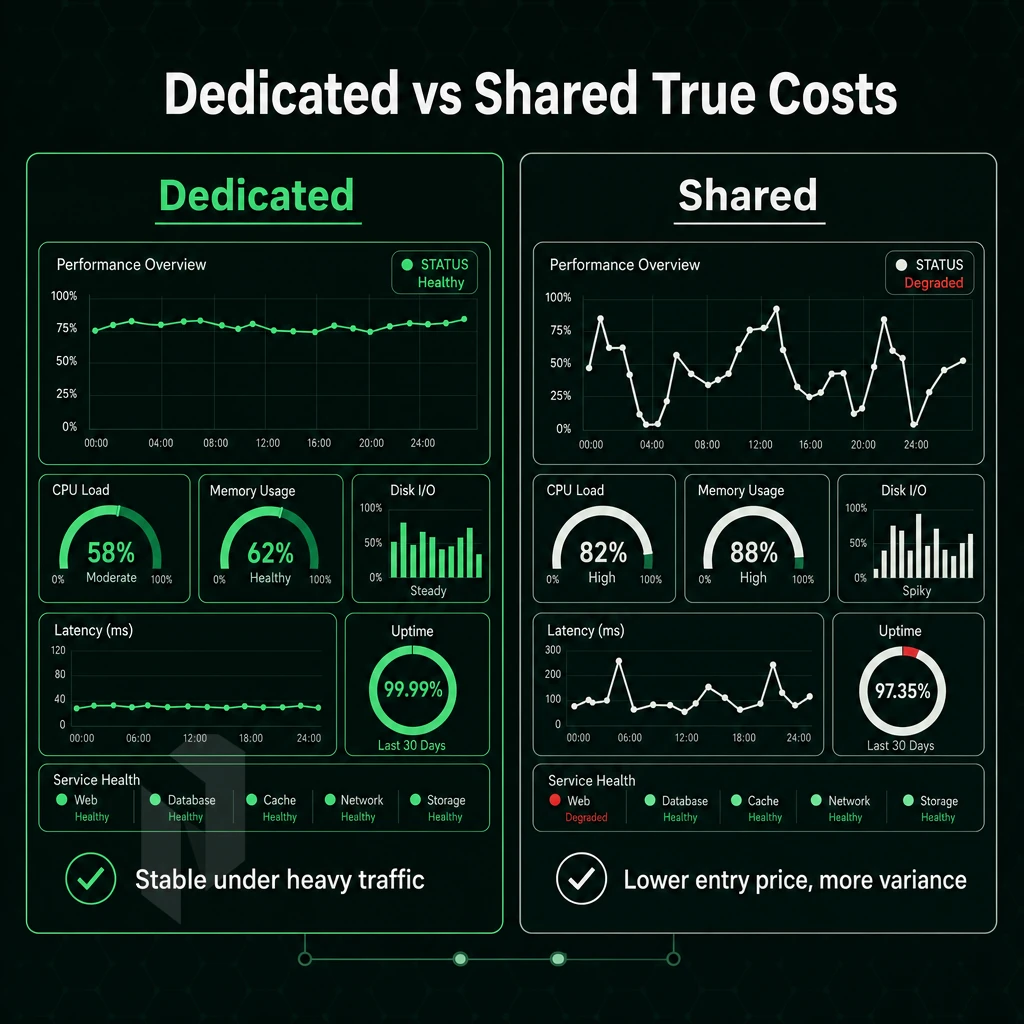
The sticker price doesn’t tell the whole story. Sure, shared hosting looks cheap at first but then your site gets slammed with traffic. Your site’s performance tank’s and before you know it, you have lost revenue, had to do an emergency move to a new host. Sites experiencing high traffic volumes require the isolated resources and consistent performance that only dedicated infrastructure can provide.
High-volume e commerce platforms especially benefit from the resource isolation and predictable performance that dedicated infrastructure delivers during peak shopping periods. Businesses running multiple websites often discover that consolidating them onto a single dedicated server reduces overall hosting expenses while improving performance consistency across all properties.
Choosing the Right Web Hosting Plan
Shared hosting accounts are packed onto a server and then resources are shared among all hundreds of accounts on that server. One very busy “noisy neighbor” account can cause problems for all others on the same server. It is suitable for low traffic sites and for people with small numbers of very inexpensive sites who need to fit into a tight budget. It does not provide isolation or root access.
For a small business with modest traffic expectations and limited technical resources, shared hosting remains a practical starting point before scaling to more robust solutions. Evaluating the right hosting plan requires understanding both current traffic patterns and anticipated growth trajectories over the next twelve to eighteen months. Small businesses running multiple websites often outgrow shared hosting when traffic increases, prompting migration to dedicated infrastructure that can handle higher concurrent visitor loads.
With dedicated hardware you get guaranteed compute power, full control over the server and the ability to run whatever custom applications you require. High traffic websites, highly regulated applications and latency sensitive applications all require dedicated hardware. Platforms running e commerce operations benefit particularly from this isolation, as transaction processing and inventory systems demand consistent performance without resource contention. Organizations operating multiple customer-facing platforms can consolidate their infrastructure by hosting several websites on a single dedicated server, reducing per-site costs while maintaining performance isolation.
Build Your Own vs Rent a Dedicated Server: Comparing Server Resources
In contrast, by building out your own in-house compute instead of relying on web hosting, you're spending money on hardware and then subsequent money on powering/cooling that hardware, physical security to the datacenter, and maintaining custom software and infrastructure to serve requests. Renting converts your initial capital expenditure to a simple monthly charge. Organizations running production websites need to carefully assess whether in-house infrastructure or rented servers provide better performance and cost efficiency for their specific traffic patterns.
Consider how many websites and workloads you intend to run. Running single physical servers to serve multiple services will typically cost less per service to run than running equivalent cloud instances. Evaluate whether a single-server plan meets your requirements or if your workload distribution necessitates multiple instances across different tiers. High-traffic websites benefit significantly from the consistent performance and resource isolation that single-tenant infrastructure provides compared to shared environments.
Managed hosting is another add to the monthly charge for your website, but removes the overhead of server management for you, which includes patching, monitoring and incident response.
Where Netrouting Fits in Your Operating System
Netrouting delivers bare metal servers within 60 minutes in 10 locations all over the world: Europe, North America and Asia. All servers are protected by always-on DDoS protection and feature an unmetered 10 Gbps uplink.
Although these features already lower the total cost of ownership in comparison to similar offers by hyperscalers, there are still some hidden costs that eat away at the value of your plan. Each configuration tier represents a distinct plan with specific resource allocations, ensuring customers select the appropriate service level for their operational requirements.
Hidden and Additional Costs Hosting Providers Don't Always Advertise
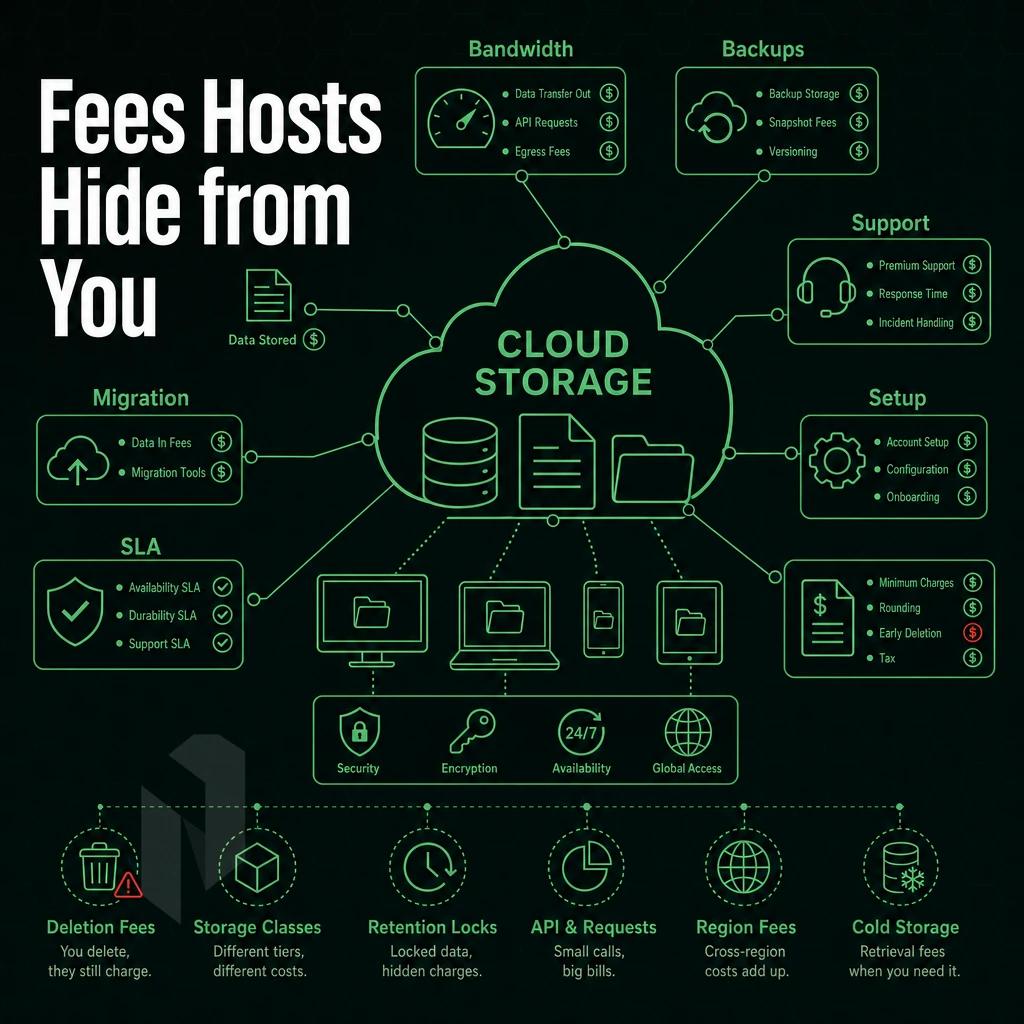
What the base price of a product or service appears to be when it’s first advertised to you is usually way different from what you actually pay once you factor in bandwidth overages. Licensing fees on top of the advertised price for so called ‘extras’ or ‘add-ons’ that quickly add hundreds of dollars to your monthly bill. For community perspectives, see How much does server/hosting space generally cost? Is ....
What Hidden Costs Should I Watch for in a Dedicated Server Hosting Plan?
Be aware of these several charges after you have made your initial purchase.
- Bandwidth overages: Many providers meter traffic and charge per GB beyond a monthly cap. These fees scale fast under real load.
- Control panel licensing: cPanel and DirectAdmin are rarely bundled. Expect a separate monthly charge per server.
- Backup storage: Off-server snapshot retention is almost always an add-on, billed by capacity or frequency.
- Software installation: Some providers charge labour fees for OS reinstalls, custom stack deployments, or panel migrations.
- NVMe storage upgrades: Faster drives are typically priced above the entry-level configuration shown in ads.
- Security add-ons: Malware scanning, security patches, and firewall management are often tiered separately from base support services.
Renewal Pricing and Annual Billing Traps
Note that promotional rates typically apply for the first term only. Although we offer annual billing to keep our lower monthly rates current, renewal rates to the standard rate can be substantially higher.
How Transparent Pricing Changes the Calculation
At Netrouting we operate on a simple model of predictable monthly charges. 10 Gbps unmetered bandwidth, DDoS protection always enabled, private network included free of charge.
Entry Level Servers: Managed vs Unmanaged Cost Over Time
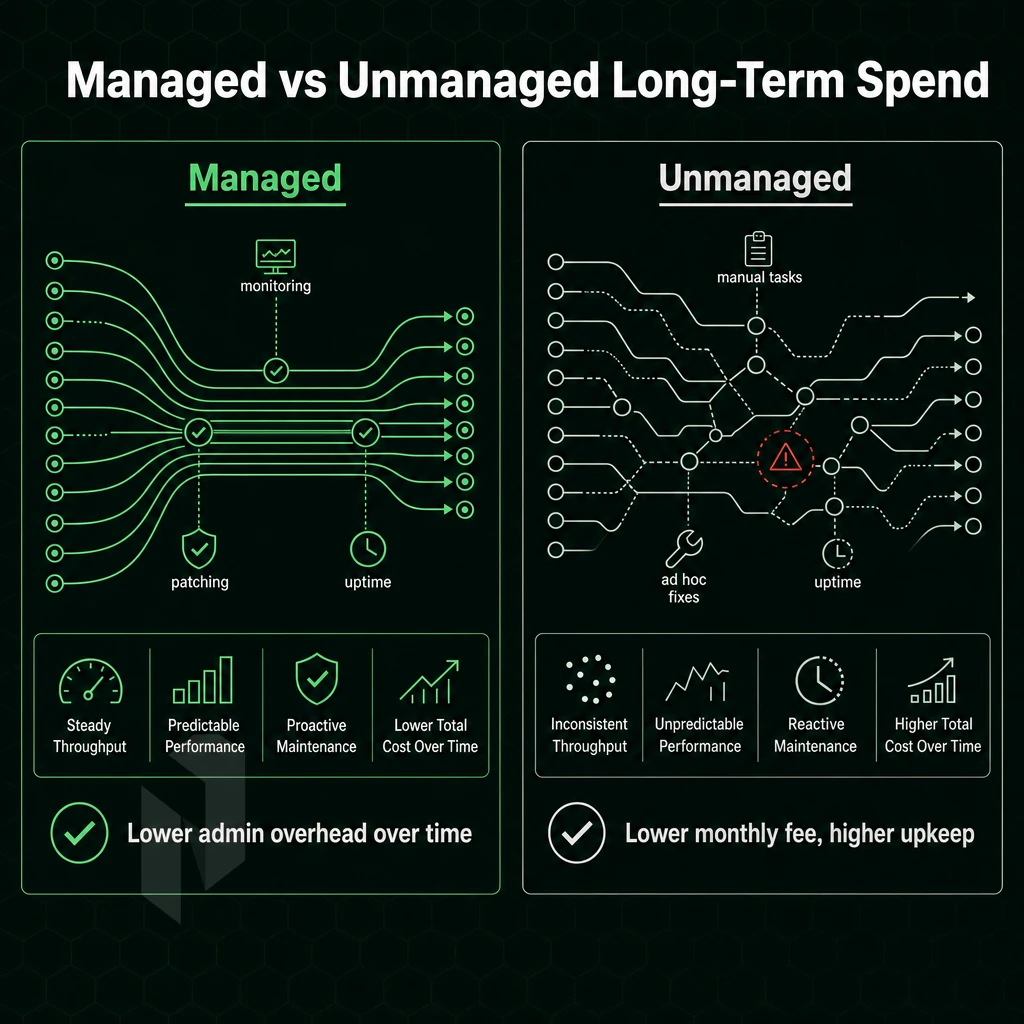
Comparing the monthly cost of dedicated servers to host your website is mainly a fool’s game. The true cost of dedicated server hosting is a Total Cost of Ownership (TCO) issue, mainly labor.
What Each Model Actually Costs You
While unmanaged servers start out with a lower cost to get started, the gap closes quickly. In addition to running the servers, someone on your team is responsible for the operating system, for applying security patches, and for managing the servers. If you don’t have any in-house people familiar with Linux distributions, you will have to hire or contract people for this work, which soon adds up to a lot of extra money.
Managed hosting turns the above model on its head. The typical support model for managed hosting includes 24/7 technical support. You pay more per month for hosting but can then apply that engineering dollar to your product instead.
| Dimension | Unmanaged | Managed |
|---|---|---|
| Admin overhead | High, fully in-house | Low, provider handles it |
| Uptime SLA | 99.9% | 99.9% + proactive monitoring |
| Best for | DevOps-heavy teams | Lean teams, web hosting operators |
When Each Makes Sense
Unmanaged servers are ideal for teams with deep sysadmin expertise and full control over servers needed. Managed servers are ideal for teams with very limited engineering time, or where the risk of poor server configuration far outweighs the cost of managed servers.
We offer managed servers as well as managed server hosting services on our bare metal and cloud compute hosts. Our managed hosts get regular OS patches, security hardening on top of 24/7 NOC coverage, all without revoking root access.
How Does Data Center Location Affect Dedicated Server Pricing?
The cost of a location is primarily composed of power, crossconnects and carrier density. A price comparison of major interconnection hubs versus locations outside them will often reveal a premium, but those hubs can offer significantly lower latency and a greater number of peers.
Choosing a location based on your user base and workload is key to avoiding expensive transit and creating effective TCO over the short term.
Data Center Location and Its Impact on Dedicated Server Costs
When choosing a dedicated server solutions service, the location of their data center can impact both performance and price.
Evaluate Location Against Your Audience
- Map your users to a region. Most businesses find that by placing servers near their end users that even minor upgrades to hardware can provide larger gains in performance over more expensive upgrades. Identify where most of your traffic is coming from.
- Carrier-neutral hubs have different prices depending on the interconnection density of a location. Although Amsterdam, Frankfurt and New York are more expensive locations in terms of real estate costs. The higher upfront cost can pay off in the long run by providing easier access to many providers and better peering which in turn can lower the bandwidth costs in the long run.
- Edge locations for secondary datacenters could be considered in cities like Stockholm. Bucharest and Rotterdam that have smaller regional user bases and less expensive real estate than primary facilities in Singapore and Hong Kong to serve Asia-Pacific users.
Note: Placing servers in a high-demand hub purely for prestige, without matching traffic patterns, inflates cost without performance benefit.
Cost Optimization Through Carrier-Neutral Colocation
- Choose carrier-neutral facilities. Lock-in to a single network provider is bad for your negotiating position. We operate carrier-neutral colocation in all 10 locations of Netrouting, so you can easily switch between your upstreams or even stack them. Migration costs are a thing of the past.
- Match the right hardware to the specific workload. For example, Intel Xeon-based platforms are optimized for memory-intensive workloads, while AMD EPYC-based platforms are optimized for core-dense workloads. By right-sizing the correct hardware in the correct location, you can achieve the lowest total cost of ownership.
Does Dedicated Server Hosting Include DDoS Protection, or Is It an Add-On Cost from Hosting Providers?
Price for mitigation varies greatly between hosters, with many charging an additional premium to their regular service. Netrouting, for example, includes always-on L3/L4 DDoS protection for all of its dedicated servers.
Contract Length, Commitment, and Paying Upfront
- When reviewing the terms of a commitment for a data center review the monthly rate in relation to the term of the commitment. Typically the longer the commitment the lower rate you can negotiate; but be sure to verify that the location performs for your specific use case prior to committing to longer term.
We can now detail out how Netrouting’s offering of Dedicated Servers addresses the location, the management and the hidden costs for you.
Why Choose Netrouting for Dedicated Server Hosting
Dedicated server hosting costs vary widely across hosting providers. Netrouting keeps dedicated server pricing transparent, no egress surprises, no hidden fees on your hosting bill. Our dedicated servers run on enterprise hardware: dual Intel Xeon E5-2690v4 configs, dual Intel Xeon E5-2680v2 builds, and the AMD EPYC 7402p in Miami with 512 GB RAM and 4× 4 TB SSD. Every dedicated hosting plan includes unmetered 10 Gbps bandwidth as standard.
- Always-on DDoS protection: L3/L4 mitigation is included free on every server, no add-on fee, no separate plan.
- 99.9% availability SLA backed by a 24/7 NOC and a 1-hour ticket response guarantee.
- Bare metal provisioned in under 60 minutes, faster than most managed infrastructure hosting alternatives.
- 10 data center locations across Europe, North America, and Asia, Stockholm, Amsterdam, Frankfurt, Miami, New York, Hong Kong, and more.
- ISO 9001, ISO 27001, and SOC 2 certified, enterprise-grade security features without enterprise-level complexity.
- Lower total cost of ownership than hyperscaler compute, with predictable monthly dedicated server pricing and discounts for longer-term commitments.
Compare our dedicated server configurations or contact sales to discuss server management, managed hosting add-ons, and the right hosting plan for your workload. If you're already committed to dedicated hosting and want to reduce what you spend, the tactics below make the biggest difference.
How to Reduce Your Dedicated Server Management and Hosting Bill
dedicated server pricing are determined by a few choices that can be influenced in a positive way.
Ensuring your server is properly sized for your work load can help prevent wasting money with over provisioned dedicated servers. Unmanaged Linux servers can save money by reducing the amount of server management necessary. Host more sites on a single, well configured dedicated server rather than running several underpowered dedicated servers.
When comparing the total cost of ownership for dedicated hosting solutions, look beyond the initial price. Hosting packages that bundle bandwidth with DDoS protection with the server itself are generally more cost effective than offers with very low headline rates but excessive add-ons. On all of our dedicated servers DDoS protection is always included and the bandwidth is always unmetered and at 10 Gbps. Simple cost optimization without any surprise extra charges.
In addition to the actual hardware, the dedicated server cost also comprises the underlying network and the respective support offer. The most important cost drivers for dedicated servers are the CPU generation, the amount of RAM, the storage and the bandwidth. The total cost of ownership often deviates greatly from the promotional price.
The key thing to remember when assessing cost is total cost of ownership vs. monthly cost. A well-configured bare metal server with 10 GbE unmetered, DDoS protection 24/7/365 and 24/7 NOC incurs no hidden costs as you would with other providers.
If you're ready to spec a dedicated server without the guesswork, explore Netrouting's dedicated server configurations, or contact the sales team directly to discuss a custom build matched to your workload.