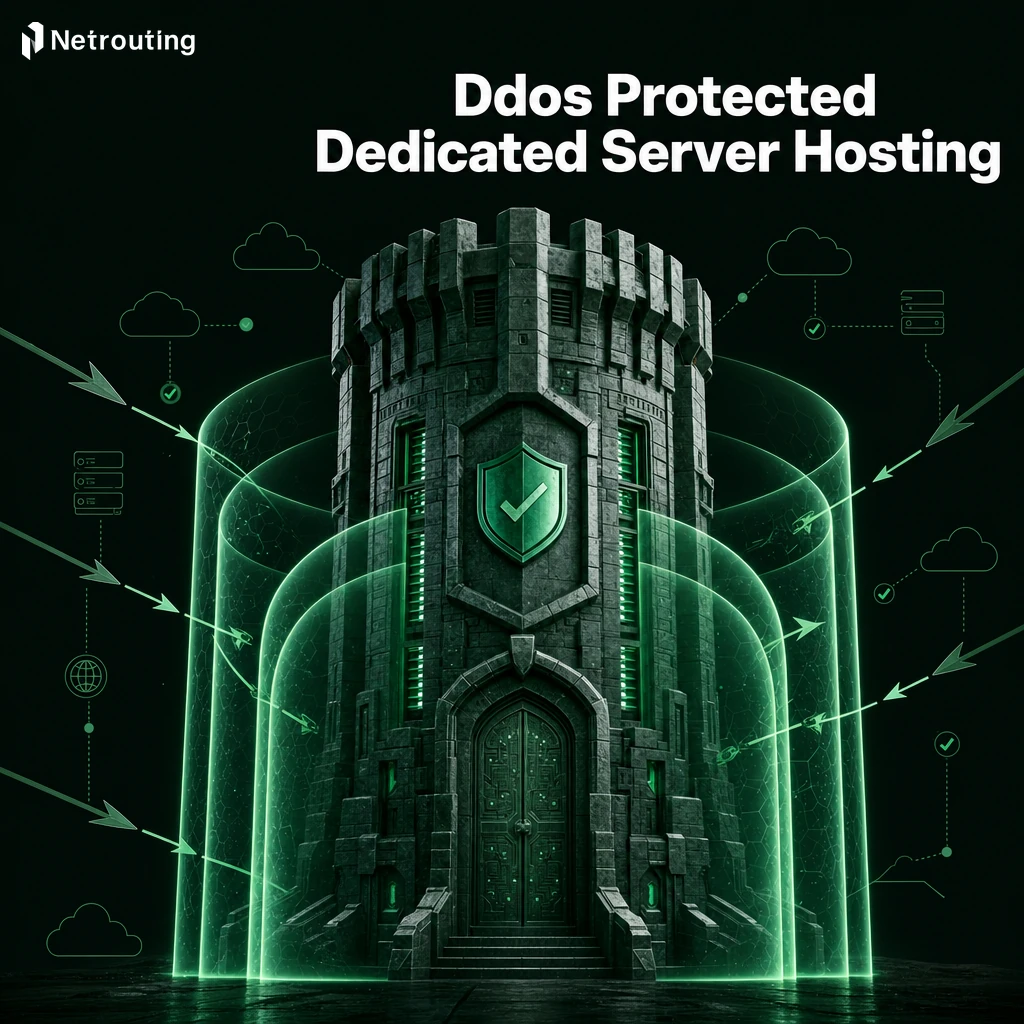
One volumetric flood is enough to take a non-protected server down in seconds, and recovery time can take hours. There is dedicated server hosting with DDoS protection. These servers are equipped with special purpose hardware and are continuously protected by mitigation. The effects of a failure are immediate: in dollars and in customer trust. For companies in regulated industries, a failure can even mean immediate non-compliance.
In this guide we are going to explain what distinguishes a serious DDoS protection service from mere marketing. How mitigation is set up at network level and what you should insist on a potential provider before signing up.
We will explain the difference between L3/L4 and L7 mitigation, why the capacity of the scrubbing center and the routing topology of a provider matter just as much as the bandwidth they advertise.
Blog contents
What Is DDoS Protected Dedicated Server and VPS Hosting?
DDoS protected dedicated server hosting is single-tenant bare metal hosting protected by always-on DDoS mitigation. This means you get to use the full power of a physical server without sharing CPU, RAM or I/O with other users, and you get to keep it online when it’s under attack. That’s the really important part.
What Makes It Different From Shared Mitigation
Resources to mitigate an attack on shared hosting or VPS servers are spread across dozens of customers. One customer under attack can impact protection of all other customers on the server. With Dedicated Server Hosting, the hardware and mitigation power are dedicated to you.
We apply DDoS protection at the infrastructure layer as opposed to a feature added on after the fact. We inspect traffic before it reaches your servers as opposed to your servers being brought down by saturated CPU before we can intervene.
L3/L4 vs. L7 Attacks in Enterprise Grade DDoS Defense
Not all attacks are created equal. Many only target a single layer of the attack stack. You must mitigate based on the attack type.
- L3/L4 (volumetric): UDP floods, SYN floods, ICMP amplification. Goal: exhaust bandwidth or connection tables.
- L7 (application-layer): HTTP floods, Slowloris, DNS query abuse. Goal: exhaust server-side application resources.
We include basic L3/L4 layers of mitigation on all servers.
Why Dedicated Hardware Strengthens the Defense
Dedicated servers enable mitigation systems to have a clean and predictable traffic stream. Such systems are able to better model a single tenant’s traffic stream (i.e. form a traffic profile) rather than dealing with noisy traffic in shared environments that can only slow down detection and generate excessive false positives.
Understanding a system’s architecture is only half the story. In order to be able to defend yourself against attacks on a dedicated server, you first need to understand how such attacks are carried out in the first place.
How DDoS Attacks Target Dedicated Servers
Dedicated servers make for high-value targets. They have fixed IP addresses, stable traffic and are used for critical production services. That makes them easy to target for long periods of time and costly to take down. Attackers often conduct reconnaissance to identify which data centers house these servers, allowing them to plan sustained campaigns against specific infrastructure locations.
Three Enterprise Grade Attack Vectors
Volumetric attacks are simply dumping a lot of unwanted traffic up a victims uplink.
Protocol-based attacks attempt to exhaust a devices stateful resources such as those found in firewalls, load balancers and TCP stacks by sending them maliciously formed SYN packets.
| Attack Type | Primary Target | Visible Symptom |
|---|---|---|
| Volumetric | Network uplink | Bandwidth saturation |
| Protocol | Stateful devices | Connection table exhaustion |
| Application-layer | CPU / application stack | High CPU, slow responses |
Why Dedicated Servers Draw Attacks
Dedicated servers are managed as single tenant environments, meaning attackers know exactly what they are attacking. Unlike in shared environments. There, The only harm caused by a DDoS attack is disruption of service, a successful attack on a gaming server. Payment processing environment or media site causes immediate and measurable harm making such a target worth the effort to attack.
The Cost of No Enterprise Grade Protection
Malicious traffic can win by volume. Without mitigation uplinks fill, latency maxes out and the OS freezes. Then you have to recover from this kind of failure by hand, with minutes or hours of down time, against a 99.9% uptime SLA target.
Each of the three attack scenarios affects a different layer of the network stack. When choosing a suitable mitigation for an attack, it is therefore important to first identify the affected layer.
L3/L4 vs L7 DDoS Mitigation: What the Layers Mean
Different layers of the OSI model can be affected by a DDoS attack. Understanding which layer is under attack helps to choose the right mitigation option and explains why all protection is not equal.
Network and Transport Layers (L3/L4)
- Detects volumetric and protocol attacks. L3/L4 attacks like UDP amplification attacks, SYN attacks and ICMP storms overload the bandwidth or the connection tables of your application before the traffic even reaches it.
- Apply always-on baseline mitigation. Always-on L3/L4 protection automatically detects and drops malicious traffic. It requires no configuration at all and is included as a standard feature in the always-on L3/L4 protection of all dedicated servers of Netrouting. Most DDoS attacks are handled by this baseline automatically.
Note: L3/L4 mitigation alone is insufficient against slow-rate or application-layer attacks. Those require deeper inspection.
Application Layer (L7) Filtering Malicious Traffic
- Application-layer attack patterns: These are attacks that are disguised as legitimate traffic such as HTTP-floods, slow POSTs or even abuse of APIs. They use server resources and look like legitimate traffic, thus are hard to detect as they don’t use high bandwidth.
- Enable advanced DDoS protection with custom policies. Deep packet inspection and per-workload rules are required for L7 mitigation. Our advanced protection adds application-layer filtering on top of the included L3/L4 protection and allows for granular custom policies.
Choosing the Right Protection Level
- For most dedicated server hosting workloads, the included baseline for always-on L3/L4 mitigation is sufficient to mitigate standard volumetric threats.
- Advanced protection for high-risk workloads such as gaming servers, financial APIs and high-traffic web applications. It adds the level of inspection needed for such services exposed at L7.
Determining the right level of protection that you require is key to selecting the right protection. Next, you need to establish the criteria to measure potential service providers before you make a commitment.
Key Features to Look for in a DDoS Protected Dedicated Server
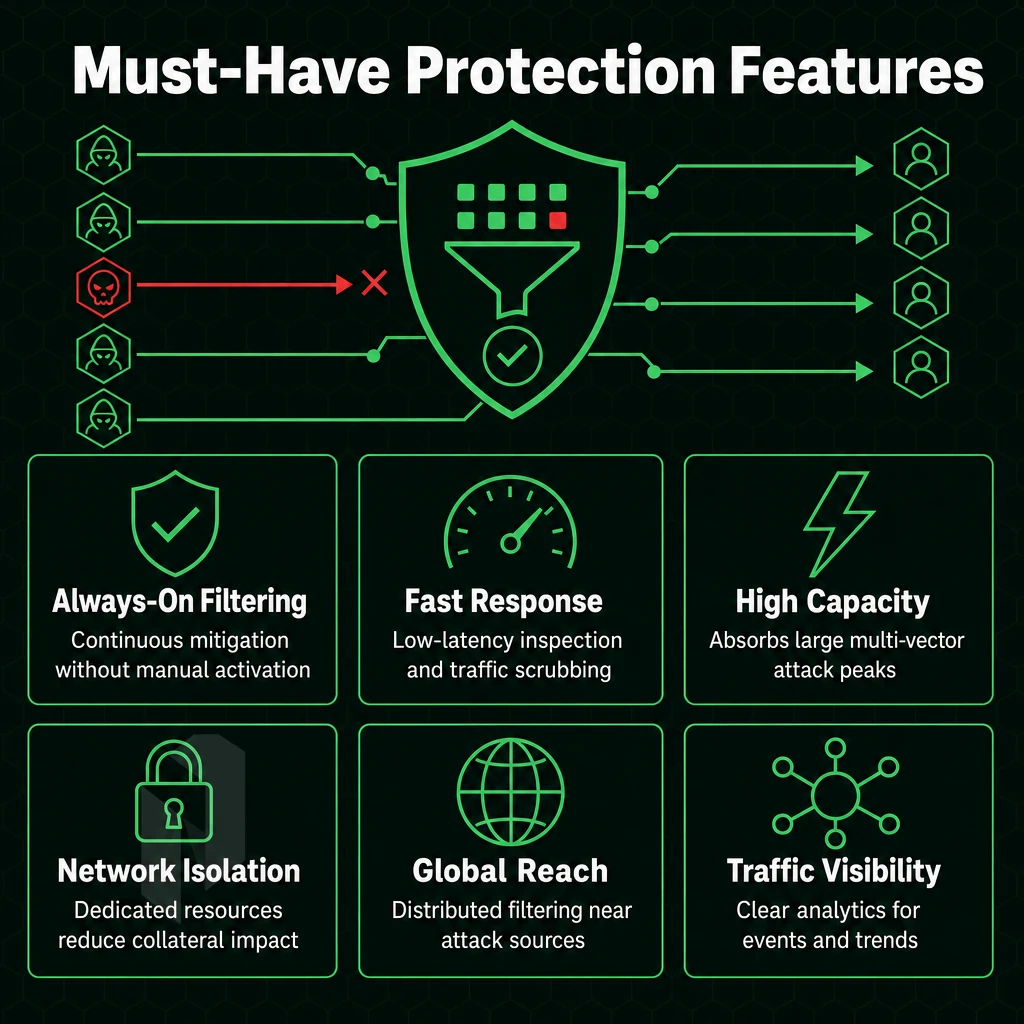
When choosing a DDoS protected dedicated server don’t just compare the mitigation numbers of different providers. This checklist explains in detail the important mechanisms of a serious DDoS protection and how they differ from simple filtering.
Malicious Traffic Detection and Scrubbing Architecture
Continuous scrubbing keeps always-on scrutiny going full tilt on all traffic.
Measuring a hosting provider's mitigation capacity in Gigabits is no longer enough, many volumetric attacks exceed 500 Gbps. A hosting provider now needs Tbps-scale scrubbing infrastructure to counter amplification attacks like DNS reflection or NTP floods.
Protocol Layer Coverage
L3/L4 baseline protection covers volumetric and network-level attacks like UDP floods, SYN floods and ICMP floods. L7 advanced protection in addition covers application-level attacks like HTTP floods, slow HTTP attacks and abnormal HTTP requests. Full control over custom protection policies allows for application specific thresholds instead of application unaware generic policies.
Blackhole routing is used as a last resort to stop attacks.
Hardware, Network Quality, and SLA
Latency of scrubbing depends on where the scrubbing happens.
Start with a solid underlying server hardware platform, such as Intel Xeon or AMD EPYC processors, with sufficient RAM and storage for your needs. Add a 99.9% uptime SLA, same business day hardware replacement, and 24x7 support with a documented response time guarantee. Finally, deliver provisioning in a timely fashion (i.e. bare metal in under 60 minutes) to minimize exposure during incident response.
After you have created your feature list, the question remains what architecture will outperform your VPS when the attack hits?
DDoS Protected Dedicated Servers vs VPS Hosting
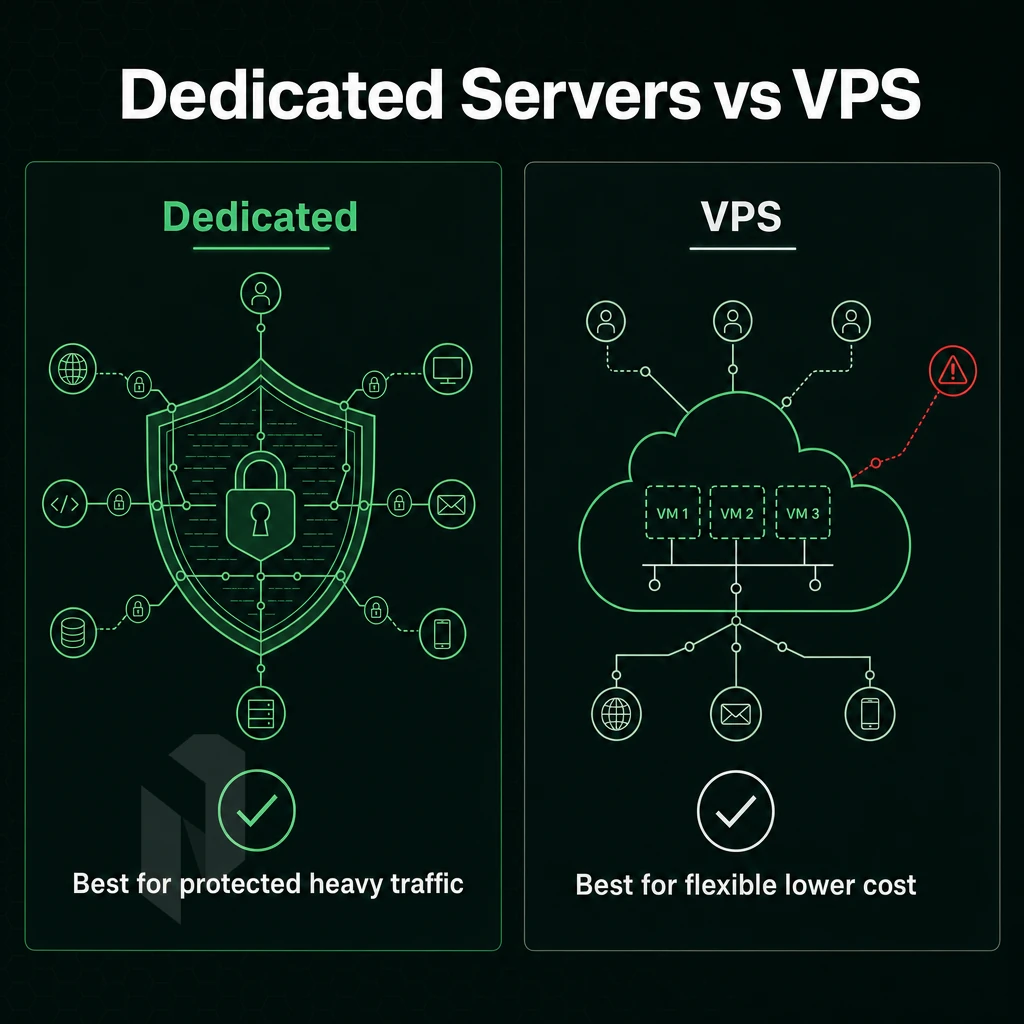
While cost is a significant factor in selecting a server for high-risk or high-traffic workloads. The ability to absorb and defend against a Denial of Service (DoS) or Distributed Denial of Service (DDoS) attack is far more important. Bare metal clouds excel on all of these dimensions.
Resource Isolation and the Noisy-Neighbor Problem
A DDoS attack on a single tenant in a shared virtual environment fills the physical host’s network interface and severely impacts all other co-resident workloads. The blast radius is not under your control.
A dedicated server gives you the full pipe. No other workload competes for NIC bandwidth, CPU cycles or kernel interrupt capacity. When volumetric traffic hits your mitigation stack runs on your dedicated hardware.
Control Over the Network Stack
Tuning the kernel on dedicated server enables you to change values such as the size of the TCP connection queue, to activate SYN cookies, and to configure iptables or nftables rules at hardware level. This type of granular tuning is not usually possible with virtual servers.
- Custom kernel parameters for connection-rate limiting.
- Protect storage under sustained attack load with hardware RAID configurations.
- Dedicated IP reputation, your address history is yours alone.
- Full BGP control for traffic engineering and blackhole routing.
Where Dedicated Servers Outperform VPS for DDoS Scenarios
In this scenario, a 50 Gbps UDP flood is absorbed by a game server. The virtualized instance hits bandwidth ceiling and starts dropping players. The dedicated server on the network, protected by always-on L3/L4 mitigation, continues to process traffic and drops attack traffic upstream of it.
The VPS is ideal for very low risk, variable load services where the entry cost is more important than the ability to isolate.
The architectural advantage is obvious, but workloads vary a lot. We will describe a few use cases where this advantage is most critical.
Common Use Cases for DDoS Protected Dedicated Hosting
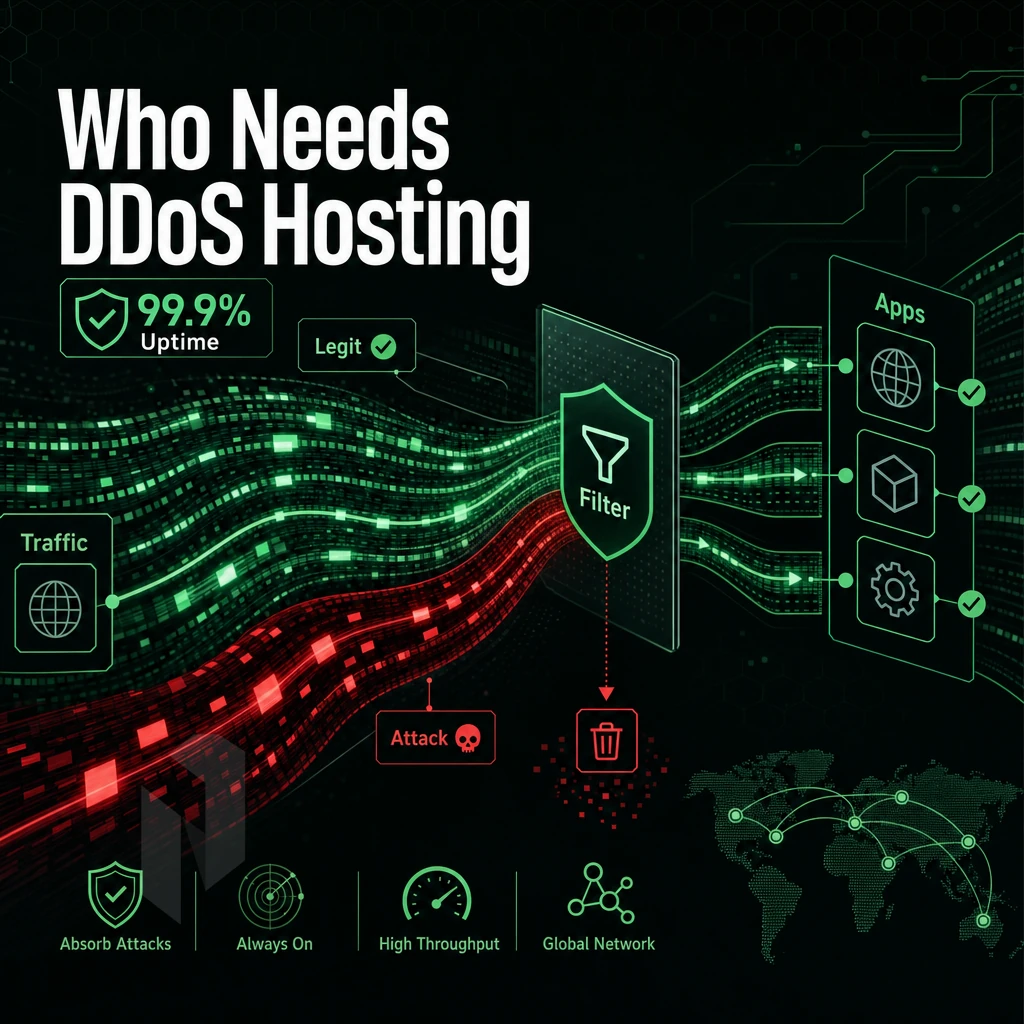
Not all workloads need DDoS-protected dedicated server hosting in equal measure. Here are 6 use cases where the highest risk and highest damage is done and therefore where such hosting is required most.
Workloads Under Constant Attack
Online gaming servers are frequently hit with DDoS attacks. Delivering low-latency gaming requires sub-20 ms response times and high single-threaded CPU performance. Dedicated video streaming servers also demand large bandwidth, made easier with unmetered 10 Gbps ports that keep streams running even during volumetric floods.
Providers of VPN services have fixed public IPs that are under attack constantly due to the high number of connections. Mitigation of such attacks has to be performed on network edge level (per VPN server) as opposed to on host level.
Revenue-Critical Infrastructure
For e-commerce and financial services, downtime can translate to real dollar losses. As such, a 99.9% uptime SLA is critical. API and SaaS backends are similar in nature, a single dropped connection can have negative effects on dependent services.
AI/ML Inference Endpoints
Workloads that require high core count.
Our dedicated servers are optimized for all 6 workloads, with unmetered 10 Gbps connectivity, DDoS protection always enabled and hardware deployed within 60 minutes at 10 locations worldwide.
The choice of server hardware and use case is only half the story. Where the server is located and how the surrounding network is configured determines how quickly attack traffic is absorbed.
Network Quality and Data Center Location: Why They Matter for DDoS Defense
Scrubbing effectiveness is not solely based on the amount of mitigation capacity that is available. A hosting provider with globally distributed scrubbing nodes and with very dense peering at Internet Exchanges can absorb and reroute large amounts of traffic before it ever reaches your dedicated servers.
Evaluate Network Architecture
-
Check carrier-neutral peering.
Multiple Tier 1 upstreams mean traffic can be rerouted during an attack without relying on a single path. Look for active IX presence at AMS-IX, DE-CIX, FL-IX, and NetNod.
-
Confirm port utilization headroom.
A server hosting provider running links below 40% utilization has genuine burst capacity when volumetric attacks hit. Saturated ports drop legitimate traffic first.
Note: Providers that advertise high-capacity networks but run near-full links offer little real protection during a sustained flood.
-
Verify 100G+ interconnects.
DDoS protection at scale requires 100 Gbps or larger connections between scrubbing centers and upstream peers.
Match Location to Your Malicious Traffic
-
Place your data center close to your users.
Mitigation applied closer to the attack source reduces latency impact on clean traffic.
-
Confirm always-on protection is included.
On-demand scrubbing introduces activation delay. Always-on L3/L4 mitigation starts blocking the moment an attack begins, no manual intervention required.
Our DDoS-protected dedicated server hosting is offered through our AS6206 network with 2.4 Tbps+ capacity, sub-40% average port usage and DDoS scrubbing centers in all 10 locations. DDoS protection is included by default on all of our services and actively enabled as a base-line.
The underlying network infrastructure is what it all boils down to. This is what we can translate into a hosting offer for your specific workload.
Why Choose Netrouting for DDoS Protected Dedicated Server Hosting
Netrouting builds DDoS protection into every dedicated server, no add-ons, no configuration required. Our always-on L3/L4 mitigation blocks malicious traffic automatically. For high-risk workloads, advanced L7 protection with custom policies is available on top.
- 1 Tbps+ mitigation capacity on a 2.4 Tbps+ network running below 40% port utilization, malicious traffic gets absorbed without touching your server.
- Unmetered 10 Gbps on dedicated servers (up to 40 Gbps available), clean traffic flows freely even during an active DDoS attack.
- Enterprise-grade hardware from Dell and Supermicro, Intel Xeon and AMD EPYC, bare metal provisioned in under 60 minutes.
- 10 locations across Europe, North America, and Asia-Pacific, Stockholm, Amsterdam, Frankfurt, Miami, New York, Hong Kong, and more.
- ISO 27001 and SOC 2 certified, 24/7 NOC, and a 1-hour ticket guarantee.
bare-metal hosting with built-in DDoS protection, enterprise-grade infrastructure, and a global network, contact our sales team to find the right dedicated server for your workload.
Once you've chosen Netrouting, getting your protected server online is straightforward. Here's exactly what to expect from order through day-to-day operations.
Setting Up and Managing Your DDoS Protected Dedicated Server
Getting a DDoS protected dedicated server is as easy as ordering it. What happens after that and how fast you’ll be productive depends on how you will be dealing with the provisioning and the day-to-day management of your server.
Provisioning and Initial Configuration
Bare metal servers deployed in under 60 minutes.
We handle the network configuration for you. Your server comes with always-on L3/L4 DDoS protection activated by default. No setup required.
Advanced users can bring their own IP space via BYOIP and announce it through our AS6206 backbone using BGP. We fully support both IPv4 and IPv6.
Access, Remote Hands, and Add-On Management
You have full control of your server(s) from the word go with root access. In addition to these full facilities, we also provide courtesy remote hands on basic tasks such as cable checking, power cycling etc. subject to remote hands being available and these being viewed as minor tasks suitable for viewing etc.
Additional managed hosting add-ons are available to manage the operations on your behalf if desired.
- OS patching and security hardening.
- Proactive monitoring with 24/7 NOC oversight.
- Control panel setup, DirectAdmin or cPanel.
Ongoing Server Management
Our 24/7 helpdesk guarantees a response within one hour for all tickets. We handle licensing, updates, and security for control panel environments, so you can focus on your work while we maintain your Dedicated Server Hosting.
Frequently Asked Questions
How Do Always-On and On-Demand Enterprise Grade DDoS Protection Differ?
Always-on protection inspects and filters traffic continuously, mitigation kicks in within seconds of an attack starting, before your server is ever impacted. On-demand protection only activates after you manually trigger it or after a threshold alert fires, meaning your server absorbs attack traffic during the detection window. For dedicated servers running latency-sensitive workloads, gaming, streaming, financial applications, always-on is the only viable model. On-demand is a cost-cutting measure that trades response speed for a lower baseline overhead.
Can a DDoS attack take down a dedicated server even with protection?
Yes, if the attack volume exceeds the provider's scrubbing capacity or targets application-layer vulnerabilities that L3/L4 mitigation doesn't cover.
Is DDoS protection included with dedicated server hosting or a paid add-on?
It depends on the provider. Netrouting includes always-on L3/L4 mitigation at no extra cost on every dedicated server, no configuration required. Advanced protection, which adds application-layer mitigation, custom filtering policies, and higher scrubbing capacity, is available as an upgrade for high-risk or mission-critical workloads. Always confirm whether baseline protection is genuinely always-on or simply a marketing label for a reactive blackhole routing policy.
What types of DDoS attacks does L3/L4 mitigation stop?
L3/L4 mitigation targets network and transport-layer attacks: UDP floods, ICMP floods, SYN floods, ACK floods, IP fragmentation attacks, and amplification attacks such as DNS reflection, NTP amplification, and memcached abuse.
How does DDoS protected dedicated hosting differ from using a CDN for protection?
A CDN proxies HTTP/HTTPS traffic and can absorb L7 web attacks, but it only protects services running over those protocols, it does nothing for UDP-based traffic, non-HTTP TCP services, or direct IP attacks against your server.
DDoS protected single-tenant hosting defends the server's IP address at the network edge, covering all protocols and ports regardless of application type. For game servers, VoIP, VPN endpoints, or any non-web workload, network-layer mitigation on the hosting side is essential. The two approaches are complementary, not interchangeable.
Do I need DDoS protection if I already use a firewall?
A firewall enforces access control rules, it cannot absorb or scrub volumetric attack traffic.
What should I look for in a hosting provider's DDoS mitigation capacity?
Start with total scrubbing capacity, it must comfortably exceed the largest attack volumes your workload is likely to attract.
Check whether L7 protection is available for web-facing workloads, and confirm the provider's network capacity overall: a provider running 2.4 Tbps+ of total network with consistently low port utilization has headroom to absorb large attacks without degrading legitimate traffic.
To attack a dedicated server, an attacker only has one target of high value. To protect a dedicated server from always-on threats (L3/L4 and L7), mitigation must always be on. Additionally, shared servers restrict the amount of mitigation that can be applied, whereas a dedicated server provides the necessary resources as well as customized policies to protect high value workloads.
The decision on a suitable provider for DDoS protection should be based on 3 key factors: the provider’s capability to mitigate traffic. The quality of the network and the time it takes for the provider to react in case of an attack. Netrouting includes always-on L3/L4 DDoS protection on all dedicated servers. It is backed by a 2.4 Tbps+ network with 10 locations in Europe, North America and Asia. Advanced L7 mitigation is available for very critical servers.
If you're evaluating DDoS protected physical server hosting, browse Netrouting's dedicated server configurations or contact the sales team to discuss mitigation requirements for your specific workload.