When looking for web hosting for an online business, one of the biggest decisions you can take online is choosing the right web hosting. Depending on whether you are running a simple website, an online business or an online shop (e-commerce solution), your web hosting provides functions regarding performance, security as well as growth. In this article we would like to inform you on how to make the right choice so your website functions perfectly and continues to grow.
Despite its importance, many businesses underestimate the long term implications of choosing a web hosting solution. A poorly selected web hosting company can result in slow websites, frequent downtime, and limited scalability. On the other hand, the right web hosting provider acts as a reliable foundation for your digital presence, helping your website remain competitive in today’s fast paced environment. For example, dedicated hosting offers a single physical server for one client, providing maximum performance, reliability, and security, making it suitable for high traffic websites or those handling sensitive data.
Read on to learn how to choose the right web hosting for you, and compare the best web hosting services for your project.

Blog contents
1. What Kind of Server Reliability and Uptime Scores Do You Offer?
Evaluating server reliability and the uptime guarantee of a web hosting service is one of the most important criteria when choosing a host. It determines how consistently your web server keeps your site online and accessible. The best web hosting services guarantee an uptime of 99.9% or more, and 99.9% is the industry standard. Even a very short outage can still affect your quality of service.
Losing sales, having customers leave your site in a hurry and losing customer trust due to frequent site down times can be prevented. Choose a web hosting company with the best uptime guarantee. When looking for web hosting reliability for your small business or eCommerce site, the web host's reliability is crucial. Downtime on your site equals lost revenue for you and your customer's frustration and distrust with you. We can help you choose a web hosting company with the best infrastructure to host your site and the best uptime guarantee.
What Does 99.9% Uptime Really Mean?
First it seems positive that 99.9% uptime is offered, but the 0.1% allows for some downtime for your website.
- Around 43 minutes of downtime per month
- Higher tier plans may offer 99.99% uptime guarantees
- Important for eCommerce sites and online business operations
- Can impact SEO rankings and traffic if outages occur
How Hosting Uptime Affects Your Business Performance
Reliable uptime plays a direct role in your website’s success and user experience.
- Prevents revenue loss during outages
- Improves overall user experience
- Supports consistent SEO performance
- Builds trust with visitors

2. What Is Your Security Policy?
Choosing a web hosting provider also means evaluating the security framework put in place to protect the data of your websites from cyber attacks. In addition to the basic protection measures implemented by most of the web hosting companies, the best web hosting providers also offer more advanced features including firewalls, a malware scan, SSL certificates and most importantly DDoS protection. DDoS protection is designed to protect your website from peak traffic. It is used to ward off malicious traffic so that your website does not go down.
Essential Security Features Every Host Should Provide
Each reliable hosting service has to have a basic protection of the web site.
- Firewalls to protect your web server
- Malware scanning and automated removal
- DDoS protection to handle traffic spikes and malicious attacks
- Secure server management practices
- Free SSL certificate or premium SSL certificates
How Hosting Security Protects Your Website Data
Security features help protect both your business and your users’ information.
- Prevents unauthorized access to website data
- Protects sensitive customer information
- Ensures compliance with data regulations
- Maintains trust for eCommerce sites
- Supports long term business continuity

3. Do You Offer a Range of Hosting Offers? How Easy Is It to Scale Up/Down?
A reliable web hosting provider should offer a wide range of hosting options that can adapt to your business needs as they evolve. When choosing a web hosting service, scalability is not just a convenience it’s a necessity. As your website grows, attracts more traffic, or adds new functionality, your hosting environment must be able to support increased demand without causing downtime. The right web hosting makes it easy to upgrade or downgrade hosting plans without complex migrations or disruptions, ensuring your site remains stable and responsive. This flexibility is particularly important for small business owners, startups, and growing online businesses that need to balance performance with cost efficiency.
Types of Hosting Available (Shared, VPS, Dedicated, Cloud)
With so many different hosting packages on the market all designed to provide a different level of performance, different level of control and different level of technical complexity to a user there is first a need to establish what your needs are when looking for web hosting.
- Shared hosting is the most affordable option, where multiple websites share the same server resources, making it ideal for beginners or a personal site with low traffic
- VPS hosting (virtual private server) provides a more isolated environment with dedicated resources, offering better performance and control compared to shared hosting
- Dedicated hosting gives you access to a dedicated server, ensuring maximum performance, customization, and security for high traffic websites or eCommerce sites
- Cloud hosting uses multiple interconnected servers to provide scalability, high uptime guarantees, and improved reliability during traffic spikes
- Managed hosting simplifies server management by allowing the hosting provider to handle updates, security, and technical maintenance
When Should You Upgrade Your Hosting Plan?
Upgrading your hosting plans becomes necessary when your current environment can no longer support your website’s performance, growth, or technical requirements.
- Increased traffic spikes that slow down your website page performance or cause instability
- Limited disk space restricting your ability to upload website files
- Slower load times that negatively affect SEO rankings and user experience
- The need for higher tier plans with advanced features like better security or server management
- Growth of multiple websites within a single hosting account

4. Do You Provide SSL?
Free SSL certificates are one of the basic features of modern web hosting. They are used to secure the transfer of all data between your website and your visitors. Many web hosts include the free SSL certificates in their web hosting packages. Higher-end SSL certificates are also offered as premium SSL certificates. These certificates offer increased validation and more trust indicators for businesses that transmit sensitive data on the Internet. If you run a WordPress site, an online-shop or any other type of website, you should pay attention to whether your hosting provider offers easy installation of SSL certificates. A hosting provider who includes the easy installation of SSL certificates in his services is serious about security and is generally more professional than a hosting provider who does not.
Why SSL Is Essential for SEO and User Trust
SSL is a feature every website needs to improve its search engine optimization and to make visitors feel safe on your site.
- Improves SEO rankings as search engines prioritize secure HTTPS websites
- Builds trust with users by displaying secure indicators in the browser
- Secures data transmission, protecting sensitive information
- Prevents browser warnings that can drive users away
- Essential for eCommerce sites handling payments and personal data
Free vs Paid SSL Certificates: What’s the Difference?
When comparing the options for SSL encryption of a website (free SSL certificates and paid SSL certificates) there are big differences regarding the number of validations needed for these certificates, the trust signals which get sent to your customers, and if the SSL certificate is suitable for your business.
- Free SSL certificate is suitable for blogs, personal websites, and basic WordPress sites
- Paid SSL certificates are ideal for eCommerce hosting and business websites requiring higher trust
- Higher validation levels verify business identity and legitimacy
- Includes warranty protection and enhanced trust indicators
- Better suited for professional online business platforms and customer facing services

5. Do They Provide Multiple Add on Domains?
For the business, developer and entrepreneur who manages many websites from one hosting account. If your web hosting company includes add on domains in your hosting package then you can run all of your sites from the one account instead of needing separate hosting plans for each site. Add on domains save a lot of time and can also save a lot of money by being able to keep all sites in one central location. Great for businesses who are running many different projects as well as businesses that operate in many different markets.
What Are Add on Domains and Who Needs Them?
Add on domains allow you to host many independent sites off of one hosting account, each site having its own settings.
- Ideal for web developers managing multiple websites for clients
- Supports businesses operating multiple brands or regional websites
- Useful for affiliate marketers or niche site owners
- Reduces costs compared to separate hosting plans
- Simplifies site management through a single dashboard
Limitations to Watch for in Hosting Plans
Not all hosting plans offer the same level of flexibility, so it’s important to understand potential limitations.
- Limits on the number of add on domains allowed
- Shared resources on the same server may impact performance
- Risk of slow websites if one site uses excessive resources
- Additional fees for exceeding domain limits
- Restrictions on storage space, disk space, or bandwidth allocation

6. What’s Your Downtime History?
Evaluating a hosting provider’s downtime history is essential when choosing a web hosting, as it reflects real world reliability beyond advertised uptime guarantees. While most website hosts provide uptime statistics, these claims should be verified through independent sources. A consistent track record of high availability indicates strong infrastructure, proper server management, and dependable performance key factors for maintaining a stable online presence.
How to Check a Hosting Provider’s Past Performance
When selecting a web hosting service it is wise to check out their previous work in order to choose from among the best web hosting services.
- Use third party monitoring tools to track uptime independently
- Check reviews of hosting companies from real users
- Analyze uptime guarantees and compare them with actual performance
- Review real world case studies and testimonials
- Monitor long term trends rather than short term data
Warning Signs of Unreliable Hosting Providers
Some clear red flags can indicate a hosting service is not delivering the performance you expect.
- Frequent downtime complaints from users
- Lack of transparency regarding uptime statistics
- Unrealistic uptime guarantees such as 100%
- Outdated infrastructure or weak website server performance
- Poor customer support during outages

7. What Is Your Back up Policy?
A reliable backup policy is an essential component of every web hosting service. Your website's files as well as your data must be restorable as quickly as possible in case of malfunctions, in case of an attack by hackers or in case of a failure of the system.Many web hosting providersSome web hosting companies offer backups, but the frequency and/or the automation of them can vary greatly. Moreover, even when the feature is included, the access to your previous files may not be as easy as you need. When choosing a web hosting company, be sure to select a hosting company with a reliable backup feature, so to avoid data loss and to be able to get back online as soon as possible in case something bad happens to your web site.
How Often Should Backups Be Performed?
Decide how often the information on your website changes and how critical that information is to your business. This will decide how often you need to backup the information on your website.
- Daily backups for eCommerce sites and frequently updated content
- Weekly backups for static or low traffic websites
- Real time backups for mission critical applications
- Additional backups before major updates or changes
- Off site storage to ensure redundancy and security
Manual vs Automatic Backups: What’s Better?
Both methods have their own uses. The best method of backup is usually a combination of them.
- Automatic backups ensure consistent and scheduled data protection
- Manual backups provide control before making changes
- Automation reduces the risk of human error
- Manual backups can be time consuming but more flexible
- Combining both offers maximum protection and reliability
8. What Are You Accountable for in Terms of an Outage?
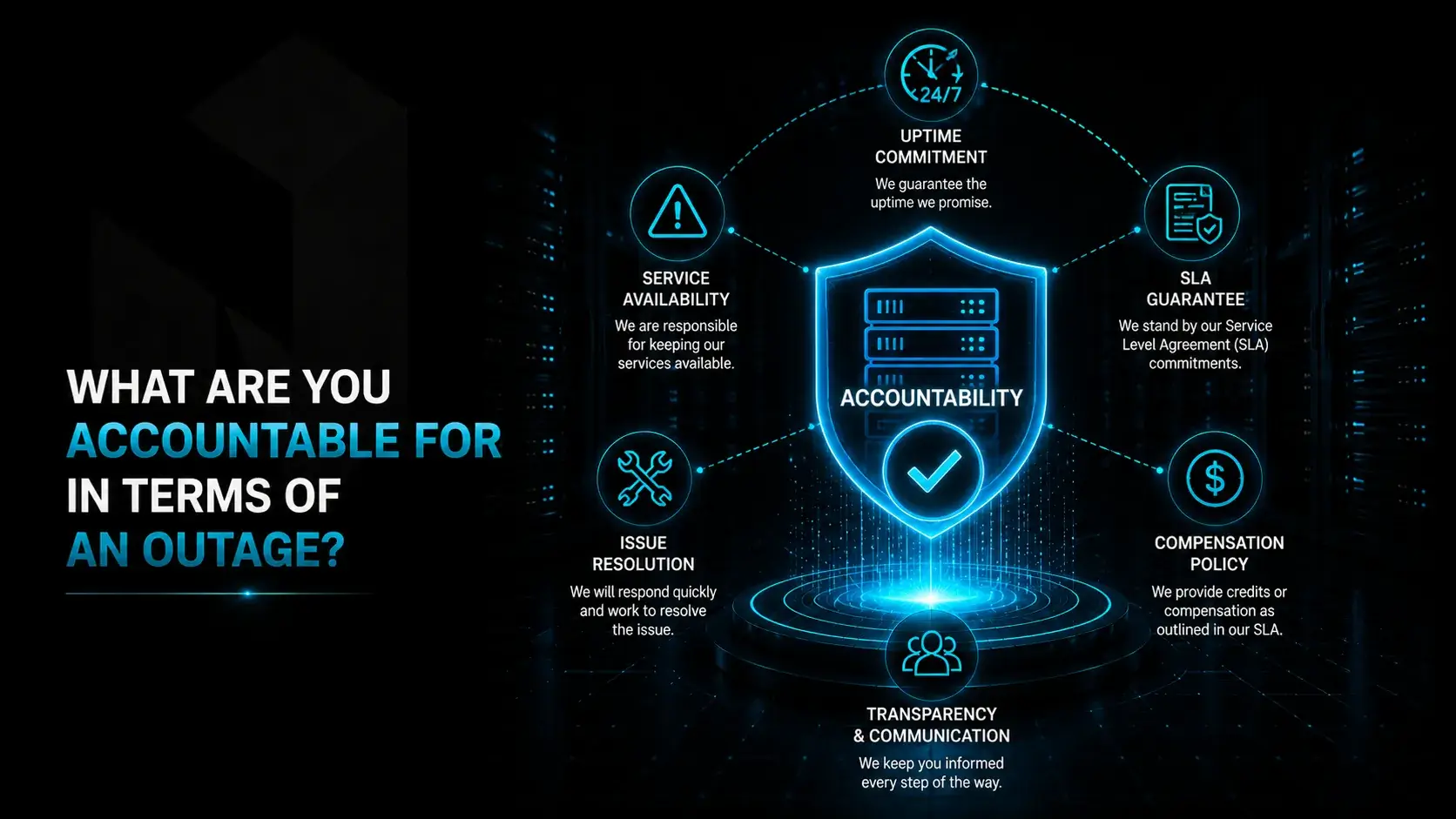
Understanding what a hosting provider is accountable for during outages is essential for risk management. This accountability is typically outlined in a Service Level Agreement (SLA). A transparent SLA reflects a provider’s commitment to reliability and customer trust.
Understanding SLAs (Service Level Agreements)
SLAs establish clear expectations between you and the hosting provider.
- Defines uptime guarantees and performance standards
- Outlines response and resolution times for technical issues
- Specifies service limitations and exclusions
- Clarifies customer responsibilities
- Provides measurable performance benchmarks
Compensation Policies for Downtime
A provider's compensation policy shows how it handles service failures, but it rarely covers the full business losses you incur.
- Service credits applied to future billing
- Refund options for extended outages
- Tiered compensation based on downtime duration
- Defined claim procedures for customers
- Limits on maximum payouts
9. How Responsive Is Your Customer Service and Tech Support?
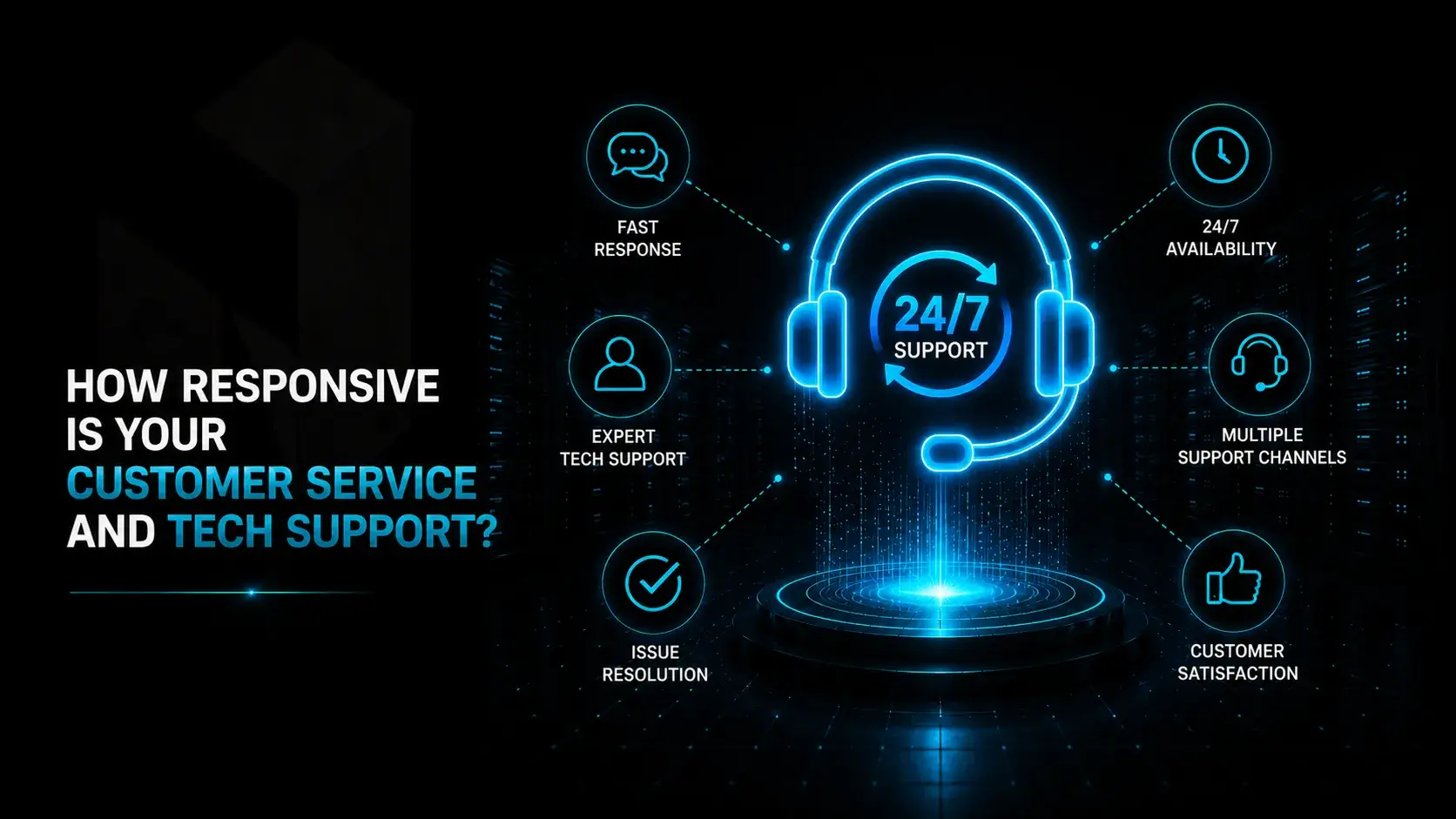
Quality Customer support is one of the criteria when choosing a web hosting provider. Every now and then, there are technical issues with websites. Good quality customer support will deal with problems fast and professional. Many Small and medium enterprises do not have their own IT department. Therefore they highly benefit from quality support.
What to Expect from 24/7 Hosting Support
Reliable hosting providers offer 24/7 online support.
- 24/7 availability
- Multiple channels (chat, phone, email)
- Quick response times for urgent issues
- Skilled and knowledgeable support staff
- Proactive monitoring and issue prevention
How to Test a Hosting Provider’s Support Before Buying
Testing support before committing helps evaluate reliability and responsiveness.
- Ask pre sales questions
- Measure response speed
- Assess clarity and accuracy of answers
- Try different support channels
- Check customer reviews on support quality

10. How Many Customers Are on Each Server?
Server allocation among hosted sites is a critical performance aspect to us here at our hosted shared web site services. With so many hosted sites on one server, it can quickly become over loaded and therefore slow. As well, from time to time all servers are subject to periods of poor performance and occasionally even down time. Monitoring a server's resources and how the server is allocated to the hosted sites is key to diagnosing problems such as these.
How Server Overcrowding Affects Website Speed
Too many users sharing the same server can negatively impact performance and reliability.
- Slower loading speeds due to limited resources
- Reduced CPU and memory availability
- Increased downtime risk during traffic spikes
- Performance inconsistencies across different times
- “Noisy neighbor” issues affecting other sites
Shared Hosting vs Dedicated Resources Explained
Different hosting options provide varying levels of control and performance.
- Shared hosting distributes resources among multiple users
- VPS hosting offers isolated environments within a shared system
- Dedicated hosting provides a dedicated server for exclusive use
- Cloud hosting allows scalable resource allocation
- Dedicated resources ensure consistent performance

11. What If I Am Not Happy?
Flexibility is important when choosing a hosting provider, especially if the service does not meet expectations. Understanding refund policies and contract terms ensures you are not locked into a long term commitment with an unsuitable provider.
Refund Policies and Money Back Guarantees
Most hosting providers offer refund policies to reduce risk for new customers.
- 30-90 day refund periods are common
- Full or partial refunds depending on usage
- Clear policy terms and conditions
- Easy cancellation process
- Risk free evaluation of services
Things to Check Before Committing Long Term
Before committing to a hosting provider, review all terms carefully to avoid unexpected issues.
- Renewal pricing after initial discounts
- Contract length and flexibility
- Migration options if you switch providers
- Exit conditions and cancellation policies
- Hidden fees or additional charges

How Does Hosting Speed Affect Your Website Performance?
Hosting speed plays a crucial role in your website’s performance, influencing search rankings, user experience, and business results. It determines how quickly your website page loads and how efficiently your website server handles requests, especially during traffic spikes. Web hosting speed is critical, as 53% of mobile visitors will leave a site if it takes more than three seconds to load. For online businesses, including eCommerce sites and WordPress sites, choosing a high performance web hosting provider is essential to maintain fast load times and smooth functionality.
Why Page Load Time Matters for SEO
Page load speed is a key ranking factor, as search engines favor fast loading websites that deliver a better user experience. Slow websites can lead to higher bounce rates, lower engagement, and reduced visibility in search results. Even a one second delay can negatively impact both rankings and conversions.
- Faster websites improve SEO rankings and visibility
- Reduced bounce rates from slow websites
- Better user experience across devices
- Increased dwell time and engagement
- Higher conversion rates for eCommerce sites and online business
Tools to Test Hosting Speed
Regular testing helps ensure your hosting provider delivers consistent performance and can handle demand effectively. These tools allow businesses to monitor speed, identify issues, and optimize their hosting environment.
- Speed testing tools for page load performance
- Load testing platforms to simulate traffic spikes
- Performance monitoring dashboards for real time insights
- Global latency tools to measure regional speed
- Core Web Vitals tools for SEO focused metrics
Regular performance testing helps maintain speed and ensures your hosting service can support your website as it grows.

How Much Should You Pay for Web Hosting?
Pricing varies across hosting providers, from cheap hosting to premium hosting solutions. The key is balancing cost with performance and features.
Understanding Pricing vs Renewal Rates
Costs can change over time.
- Low initial pricing
- Higher renewal rates
- Discounts for long term plans
- Transparent pricing models
- Value based decision making
Hidden Costs to Watch Out For
Additional fees can increase total cost.
- Domain or free domain name limitations
- Backup fees
- Migration charges
- Add on services
- Premium support costs
Choosing Based Solely on Price
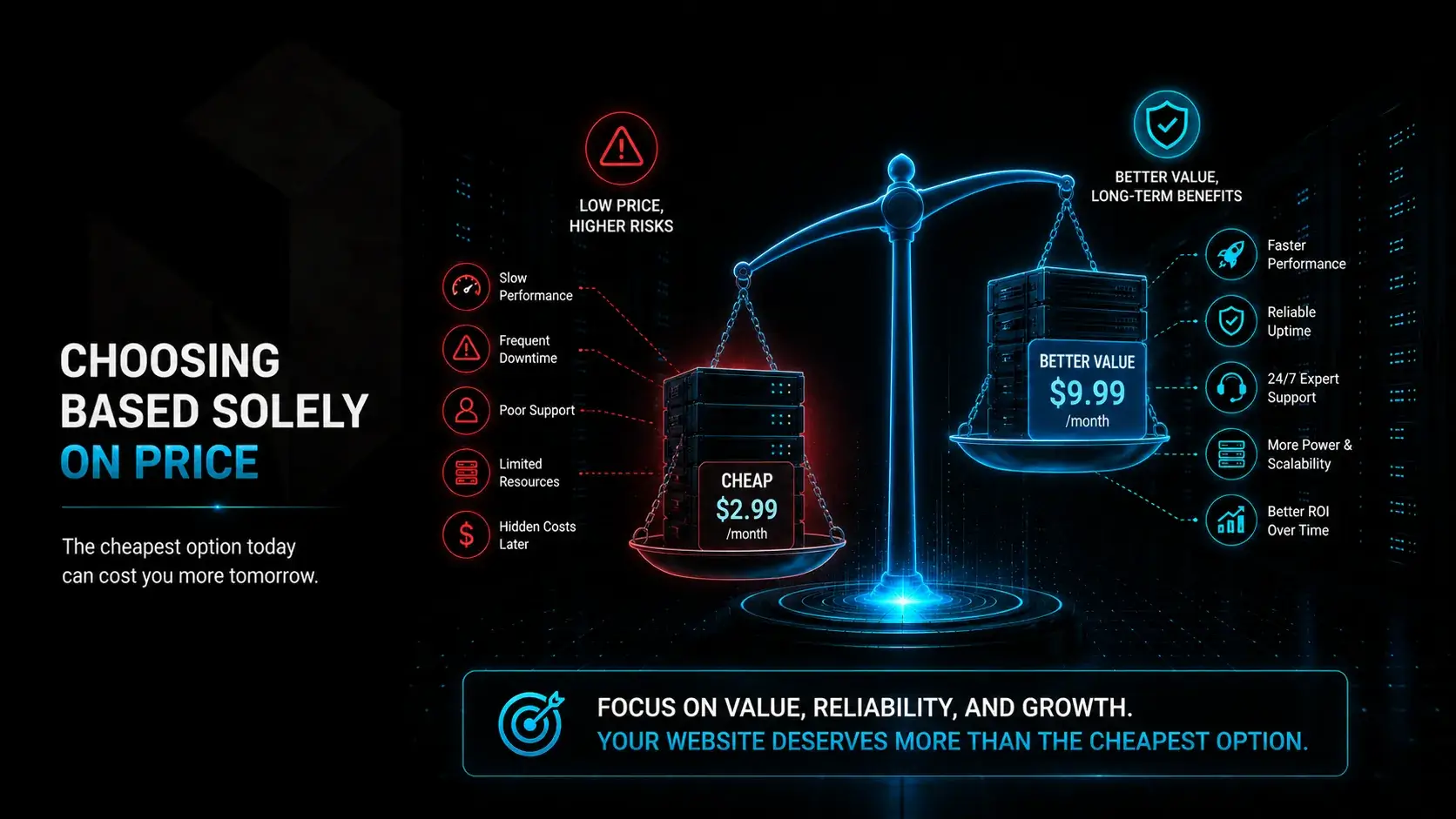
One of the most common mistakes when choosing a hosting is focusing only on cheap hosting or the lowest priced packages. While affordable options may seem attractive, they often come with limitations in performance, security, and customer support. Many low cost providers also increase significantly upon renewal, making them less cost effective over time.
- Cheap hosting often lacks advanced features and scalability
- Lower tier plans may limit disk space, bandwidth, and performance
- Hidden costs can increase the overall price
- Poor performance can lead to slow websites and lost traffic
- Limited customer support can delay issue resolution
Ignoring Scalability and Future Growth
Failing to consider scalability can create major challenges as your website grows. A hosting provider should offer flexible hosting options such as VPS hosting, cloud hosting, and dedicated hosting to accommodate increasing traffic and resource demands.
- Inability to handle traffic spikes effectively
- Difficulty upgrading to higher tier plans
- Limited resources for growing websites
- Migration challenges when switching providers
- Missed opportunities for business expansion
Overlooking Security Features
Security is often underestimated when selecting web hosting. Without proper protections, your files and data are vulnerable to cyber threats, which can harm your reputation and disrupt operations.
- Lack of SSL certificates or free SSL certificate options
- No malware scanning or firewall protection
- Weak server management practices
- Increased risk of data breaches
- Non compliance with data protection standards
Not Reviewing Uptime Guarantees and Reliability
Many users fail to properly evaluate a web host's reliability before committing. Uptime guarantees and historical performance are critical indicators of how stable a hosting provider is.
- Frequent downtime affecting site accessibility
- Poor performance during peak traffic periods
- Lack of transparency in uptime guarantees
- Negative impact on SEO rankings
- Reduced trust from users and customers
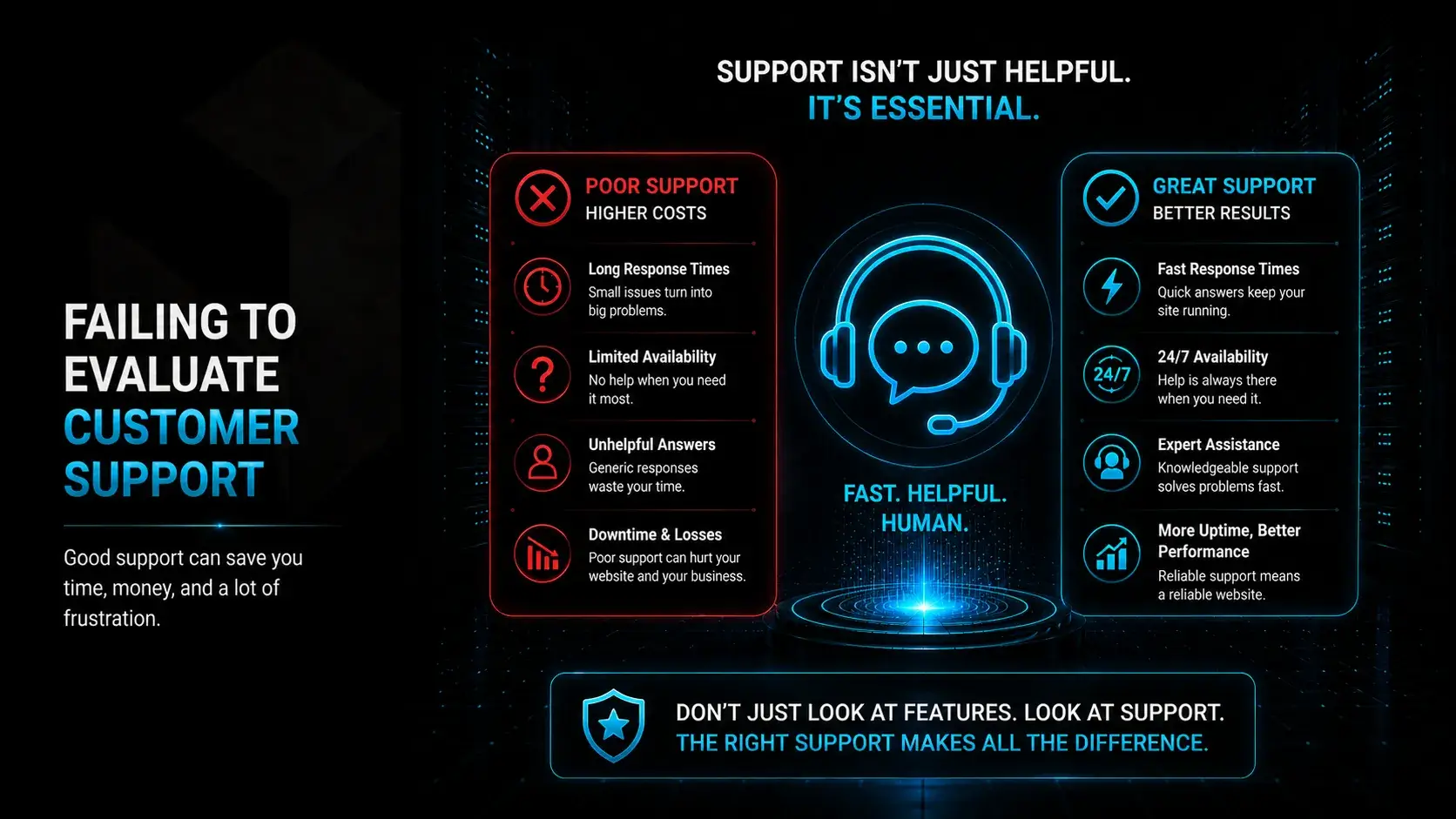
Failing to Evaluate Customer Support
Customer support quality can make a significant difference, especially when technical issues arise. Many users overlook support quality until they encounter a problem. Testing a web host's customer support before purchasing services is recommended, as potential customers should reach out with questions to evaluate response quality and speed.
- Limited availability of support channels
- Slow response times during critical issues
- Lack of technical expertise from support teams
- Poor communication during outages
- Inadequate documentation or knowledge base
Choosing the Wrong Type of Hosting
Selecting the wrong hosting type, such as shared hosting instead of a virtual private server or a more powerful hosting solution, can limit your website’s performance and flexibility.
- Shared hosting may not handle high traffic websites
- VPS hosting may be required for better resource allocation
- Dedicated hosting offers more control but at higher cost
- Cloud hosting provides scalability for growing businesses
- Managed hosting simplifies maintenance for non technical users
Not Checking Resource Limits
Many web hosting services advertise features like unlimited bandwidth, but in reality, these often come with restrictions.
- Hidden limits on storage space and disk space
- Bandwidth throttling during high usage
- Restrictions on server resources
- Performance issues with multiple websites on the same server
- Unexpected upgrade requirements
Ignoring Renewal Rates and Hidden Costs
Introductory pricing can be misleading if you don’t consider long term costs. Many hosting companies offer discounts initially but charge higher renewal rates later.
- Significant price increases after initial term
- Extra fees for add ons like backups or security
- Charges for domain registration or free domain renewal
- Costs for website migration or upgrades
- Premium fees for advanced features
Not Testing the Hosting Provider Before Committing
Many users skip testing a hosting provider before purchasing long term plans. This increases the risk of dissatisfaction later.
- Not checking support responsiveness
- Ignoring trial periods
- Failing to test performance and speed
- Overlooking user reviews and feedback
- Committing to long term contracts too early
Avoiding these common mistakes is essential when choosing a hosting. By focusing on performance, scalability, security, and support rather than just price you can select the right web hosting service that supports your website’s long term success. A well informed decision ensures your site hosted environment remains stable, secure, and capable of handling future growth.
WordPress 4.5 Field Guide
The WordPress 4.5 update introduced important usability and performance improvements that still highlight what to look for in a reliable wordpress hosting environment. For businesses managing wordpress sites, choosing a compatible hosting provider ensures smoother performance, better security, and easier site management. A well optimized hosting setup allows WordPress features to run efficiently while supporting growth and scalability.
Key Features and Improvements
WordPress 4.5 enhanced both user experience and backend performance.
- Inline linking for faster content creation
- Live responsive previews for different devices
- Custom logo support for branding
- Faster customization with selective refresh
- Improved script handling for better performance
Why WordPress Hosting Matters
Not all hosting environments are optimized for WordPress, which can affect speed and reliability.
- Optimized servers for better performance of wordpress sites
- Automatic updates and security patches
- Built in caching for faster load times
- Simplified management for non technical users
- Enhanced security tailored for WordPress
Choosing specialized wordpress hosting ensures your WordPress websites remain fast, secure, and scalable. It reduces technical complexity while improving overall performance, making it a smart choice for both beginners and growing businesses.
FAQs
Q: How do I choose the right web hosting plans for my needs? Choosing the right hosting solution depends on your website size, traffic expectations, and technical requirements. Beginners may start with shared hosting, while growing businesses may need VPS or cloud hosting for better performance and scalability.
Q: What do I need to launch my own website? To create your own website, you need a domain name, a reliable web hosting provider, and a platform like WordPress or a website builder. Many hosting services also offer tools to simplify setup and site management.
Q: What should I look for in e commerce hosting? When selecting e commerce hosting, prioritize security features like SSL certificates, fast loading speeds, uptime guarantees, and scalability to handle transactions and traffic spikes effectively.
Q: Does the operating system of a hosting server matter? Yes, the OS used by your hosting provider can affect compatibility and performance. Most users prefer Linux based hosting for flexibility and cost efficiency, while Windows hosting is suitable for specific technologies like ASP.NET.