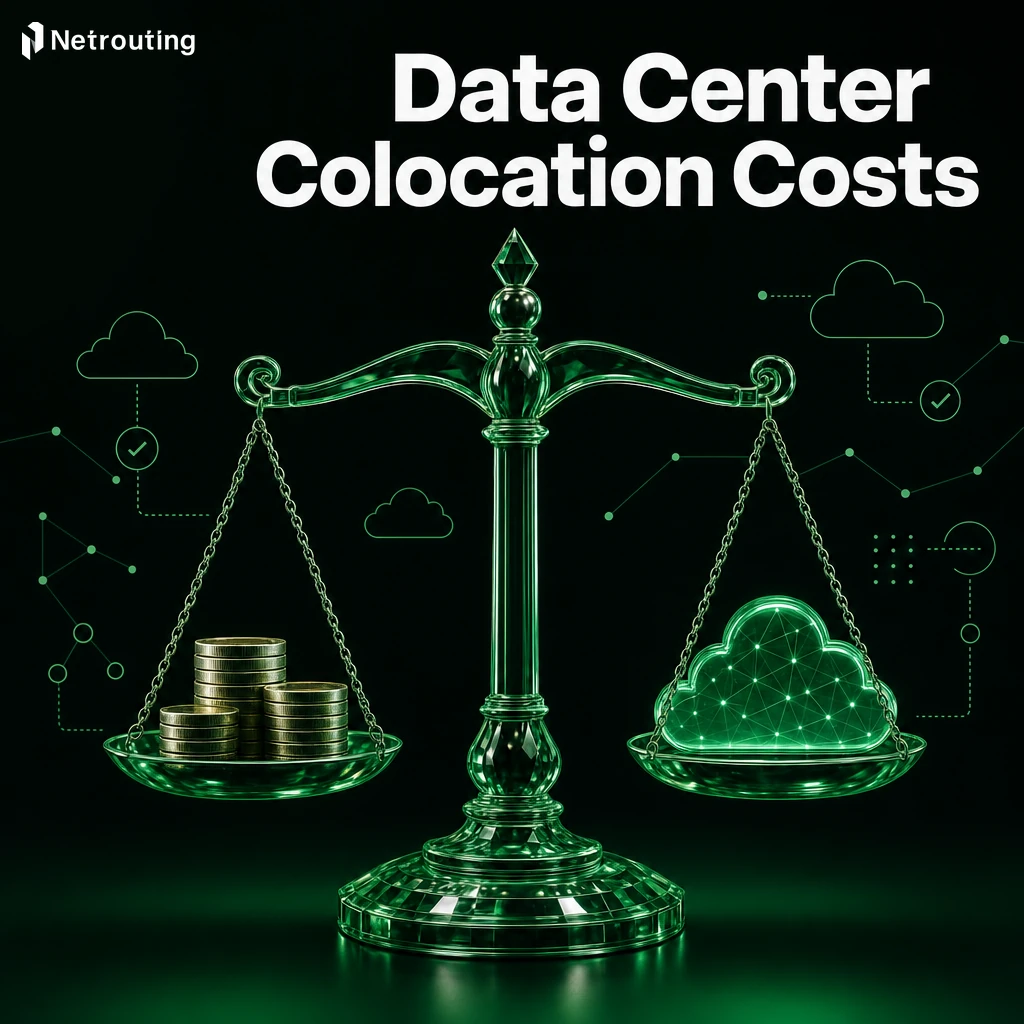
While the cost of the rack space itself may be the easiest to research, the real cost of the facility can include a host of additional charges including power density. Cross-connect fees, remote hands charges and even bandwidth charges can vary greatly across different network solutions and facilities, even within the same city. Installation and configuration charges for networking equipment can also add substantial upfront costs that vary significantly between providers and deployment scenarios.
We operate 10 carrier neutral datacenter locations across Europe, North America, and Asia-Pacific, all connected to our own managed backbone (AS6206) since 2009.
Our in-depth guide to colocation pricing breaks down each key cost variable so you know what to look out for in a proposal and have a framework to compare Apples with Apples quotes. Comparing multiple providers side-by-side ensures you can negotiate a better deal and avoid paying inflated rates for equivalent infrastructure. When evaluating colocation providers, request detailed breakdowns of recurring versus one-time charges to understand the true long-term financial commitment of each facility.
Blog contents
Providers often incentivize multi-year commitments through volume discounts, so understanding the implications of long term contracts is essential before signing. Providers often incentivize longer commitments through volume discounts, so understanding the implications of long term contracts is essential before signing. Transparent pricing structures with predictable monthly billing help organizations budget accurately and avoid unexpected cost fluctuations throughout the contract term.
We break down the typical cost structures for power and cooling, bandwidth and cross connects, Service Level Agreements and what they’re actually worth, remote hands and the key facility certifications that affect your compliance requirements. Start with the 4 major variables that influence the total cost of your colocation.
What Drives Data Center Colocation Costs
Pricing for colocation services isn't a simple flat monthly rate.

Data Center Space and Colocation Providers Pricing
Typically, providers charge by unit (single 1U slot, partial cabinet, full rack, private cage, etc.). More space in the data center equals more cabinet real estate, more cooling spend, etc. and thus higher base fees. However, high-density deployments (blade chassis, GPU nodes, etc.) use up more vertical space than typical 1U servers and thus increase costs even faster.
Providers must also account for available capacity in their pricing models, as facilities with limited remaining infrastructure headroom often charge premium rates to preserve expansion options. Facilities must carefully balance available power against current tenant demand to ensure they can accommodate future growth without overprovisioning costly electrical infrastructure. Careful capacity planning for future expansion helps clients avoid costly mid-contract migrations when their infrastructure needs outgrow their initial deployment footprint.
Data Centers With Lower Costs and Higher Density
The largest variable when it comes to the cost of a data center in a colocation facility is power. In a colocation data center, that can be charged on an allocated kilowatt basis or a metered basis and therefore can vary greatly from server rack to server rack.
A typical server rack is 2-4 kW but actual consumption can be much higher for GPU or storage dense servers, and that differential multiplies with usage. Metered billing tracks actual consumption in kilowatt hours, allowing tenants to pay only for the electricity they use rather than a fixed allocation.
Internet Connectivity and Colocation Services at Data Centers
Connectivity over the Internet (server bandwidth consumption plus cross-connects) is usually charged separately from space and power consumption. The cost of a 1 Gbps port is less than that of a 10 Gbps port. Remote hands and managed colo hosting also incur varying charges: OS patching, hardware swap, full rack-and-stack services, etc. are charged either hourly or on a retainer.
Why Are Data Centers So Expensive for Colocation?
The price difference between a 1U rack and a full cabinet comes down to one factor in actual usage: infrastructure density.
Colocation providers amortize fixed costs across all of the facility's tenants, so a smaller footprint will inevitably carry a greater share of those costs.
Key Factors That Make Colocation Services More or Less Expensive
These six factors will determine whether you are paying colocation prices at the bottom or top of the market when housing your own equipment.
Data Centers Infrastructure and Compliance
- Assess the required power redundancy tiers. While providing N+1 power redundancy is cost effective to ensure required uptimes, a fully fault-tolerant 2N power architecture doubles the required electrical infrastructure space and associated costs. The number of required redundancy tiers depends on the required uptimes.
- Cooling systems and efficiency should be assessed. High density areas need precise cooling in highly distributed IT environments. Areas of high power density designed as facilities charge a premium. The associated mechanical plant is more complex and expensive to operate.
- Please confirm compliance certifications here. ISO 27001 and SOC 2 audits bring significant operational overhead. This is factored into the rack rate but is non-negotiable for workloads that are subject to regulation.
Data Centers Location and Capacity
- You should also factor in geographic location as primary markets such as Amsterdam, Frankfurt and New York typically command higher baseline rates to reflect higher land costs as well as greater demand. Meanwhile, Secondary markets command lower rates but with potentially lower peering density.
- Assess the site’s power delivery and reserve capacity. A near-to-fully loaded site may have limited power available and may even incur penalties. Verify the committed power against your expected power consumption.
- Review the efficiency of power distribution within a data center. A poorly efficient PDU and UPS chain greatly increases the effective cost of the associated power consumption. Check the PUE rating for the associated facility, lower is better.
Note: A colocation solution that looks cost-effective on space alone can become expensive once metered power, cross-connects, and remote-hands fees are added. Always model the fully loaded monthly cost.
How Much Does Full Rack Colocation Typically Cost per Month?
Rack prices vary by location, power consumption, and required redundancy.
Netrouting offers colocation in 10 locations (Amsterdam, Frankfurt, Miami and New York amongst others) with N+1 power and cooling, 24/7 DDoS protection and a 99.9% uptime SLA.

How a Colocation Data Center Prices Space, Power, and Connectivity
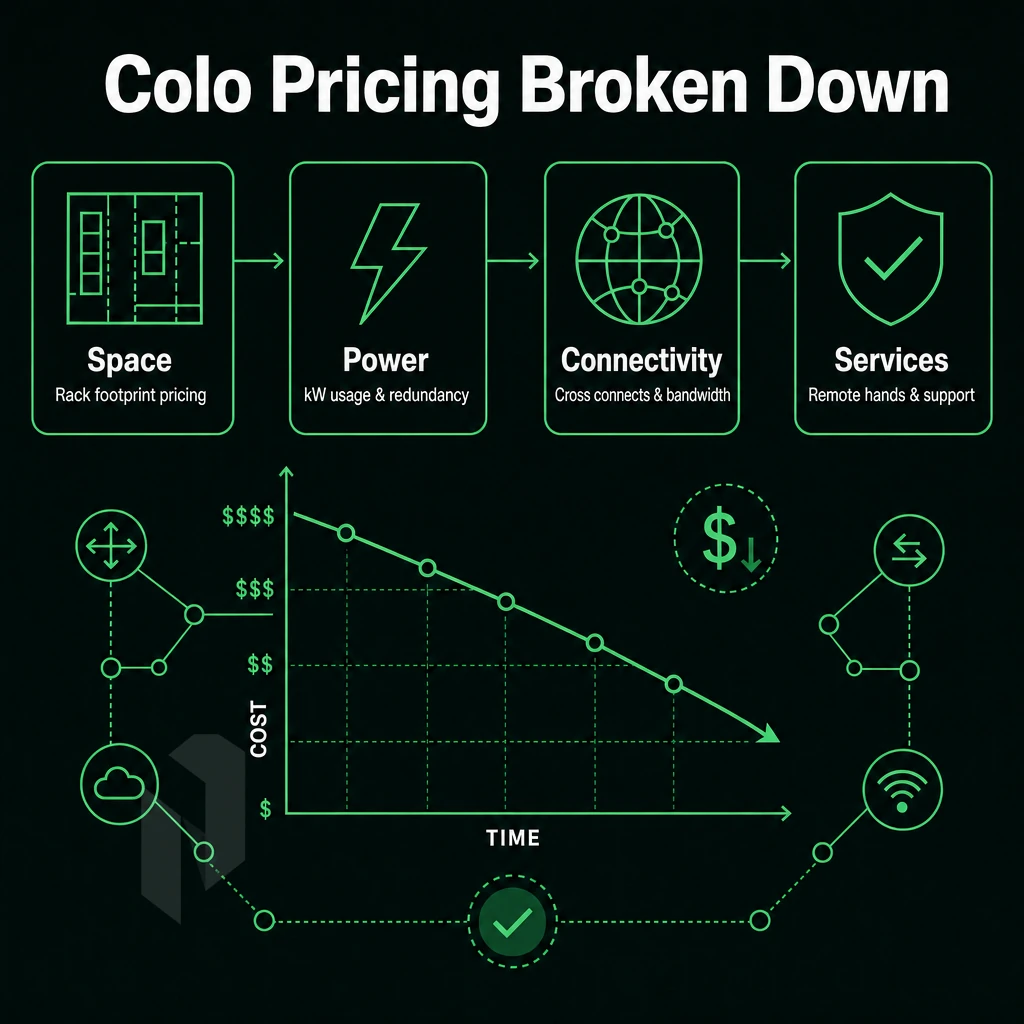
Colocation pricing typically consists of 4 elements: space, power, connectivity, and additional services. It is useful to understand how data centers price colocation in order to properly compare offers and understand the bill of costs later on.
How Data Centers Price Colocation: Space and Power Support
Space is generally offered up in Rack Units (U), half racks or full cabinets. Power is quoted as either a committed kW or a metered reading of kWh consumption. High density offerings such as GPU clusters and storage arrays may incur a power allocation charge on top of the space of the cabinet.
The power redundancy tier (N+1 vs. 2N) and the data center infrastructure cost of the facility itself can greatly affect the rate per U. A 2N-redundant, Tier III data center with modern facilities will typically cost more per U than a Tier II data center with the same U count. Older facilities built before 2010 may also lack the electrical distribution systems needed to support modern high-density racks, further limiting their competitiveness on price.
Cross Connects and High Performance Cloud Providers Connectivity
Price for internet connectivity is based on the size of the port(s) you need plus the bandwidth you commit to use. Cross connects (hard-wired connections between your cage and a carrier or Internet Exchange) have a one time installation cost plus a monthly charge after that.
Geographic Location and Managed Services Data Centers
Location Premium, Tier 1 metros command a premium, edge markets run leaner. managed solutions (such as OS patching, remote hands, monitoring) build on top of the foundational infrastructure costs and are typically scoped out per engagement.
| Deployment Size | Typical Space | Power Allocation | Notes |
|---|---|---|---|
| Single server / 1U | 1U | ~200-350 W | Shared cabinet; entry-level bandwidth commit |
| Quarter rack | ~10-12U | 1-2 kW | Shared or locked section; contact sales |
| Half rack | ~20-22U | 2-5 kW | Dedicated section; contact sales |
| Full rack | 42U+ | 5-20 kW | Private cabinet; high-density ready; contact sales |
What Is Included in Standard Colocation Pricing?
Typically a colocation contract at most data centers will cover a physical server rack space, power consumed (either on a usage basis or capped) and a minimum of a single Internet network port connection. Physical security, environmental monitoring and basic remote hands services are typically provided by datacenter facilities. Service credits are often awarded when a provider fails to meet a service level agreement (SLA) of 99.9% or better.
We offer N+1 power availability and cooling, always-on L3/L4 DDoS protection and a free private interconnect to your resources in our datacenters. This brings us to the most important question when comparing hosted solutions to cloud: total cost of ownership.
Why Choose Netrouting for Colocation Services
Netrouting operates carrier-neutral colocation across ten own data centers, Amsterdam, Rotterdam, The Hague, Frankfurt, Stockholm, Bucharest, Miami, New York, Hong Kong, and Singapore. Every colocation solution includes N+1 redundant power and cooling up to 20 kW per footprint, always-on DDoS protection, and a free private network between your resources. No egress surprises. No overage fees on connectivity.
- Carrier-neutral, globally distributed: Ten colocation data centers across Europe, North America, and Asia, dense IX peering at every site for high-performance connectivity.
- Power redundancy built in: N+1 power and cooling, up to 20 kW per footprint, from single rack to larger deployments.
- Remote hands at no extra cost: Courtesy remote hands support included. Project-based rack-and-stack available on request.
- Certified and compliant: ISO 9001, ISO 27001, and SOC 2, meets common compliance requirements out of the box.
- 24/7 NOC, 1-hour ticket guarantee: Proactive monitoring with a committed response time, around the clock.
Competitive rates, consistent monthly pricing, and no lock-in surprises make Netrouting a cost-effective colocation provider for any deployment size. Explore our colocation services or contact sales to compare configurations.
Colocation costs are driven by three variables above all else: power draw, network connectivity, and contract length. Shared cabinets work for modest deployments; private suites and high-density power make sense when workloads scale.
On total cost of ownership, colocation consistently beats the major cloud platforms for predictable, compute-heavy workloads, no egress surprises, no per-API billing, no resource contention. The trade-off is upfront planning, not ongoing expense.
Netrouting operates carrier-neutral colocation data centers across ten locations in Europe, North America, and Asia, from The Hague and Amsterdam to Miami, New York, Hong Kong, and Singapore. Every deployment runs on a 2.4 Tbps+ backbone with always-on DDoS protection included. Explore Netrouting colocation or contact the sales team to discuss your power and connectivity requirements.