Many Enterprise IoT deployments fail at the network layer.
It often takes a team underestimating the necessary infrastructure for their production devices until it’s too late. One misconfigured uplink or shared public network segment can undermine reliable connectivity across the entire fleet, causing dropped telemetry, failed OTA updates, and even device management security issues for thousands of endpoints. The difference between a proof-of-concept IoT project and production-grade iot services often comes down to the underlying network architecture and a centralized interface for managing it, not the individual devices. Building a resilient iot ecosystem requires deliberate architectural choices that account for device diversity, network redundancy, and operational visibility from day one.
Operators who fail to design for the unique demands of an iot environment often discover these shortcomings only after deployment, when remediation becomes exponentially more costly. Successful integration of iot technologies demands not only robust hardware selection but also a network design that anticipates scale, latency constraints, and the operational complexity of managing diverse device types across geographically distributed sites. Organizations operating in heavily regulated industries must also account for how their network design addresses compliance frameworks and regulatory demands that govern data sovereignty and transmission security.
Blog contents
A step by step guide to enterprise IoT connectivity covering the key factors such as network topology, bandwidth and latency. Private interconnects, DDoS protection at scale and the underlying infrastructure to create a robust deployment versus a fragile one. The guide begins with the fundamentals of what enterprise IoT connectivity actually means and how it differs from normal internet services.
What Are Managed Cellular IoT Connectivity Services for Enterprise?
Enterprise IoT connectivity services are specialized infrastructure and management solutions that connect, monitor and secure large numbers of IoT devices deployed at distributed locations. They are fundamentally different from consumer IoT solutions in terms of scale, reliability and control. For more context, see Internet of things.
What Managed IoT Connectivity Services Actually Deliver
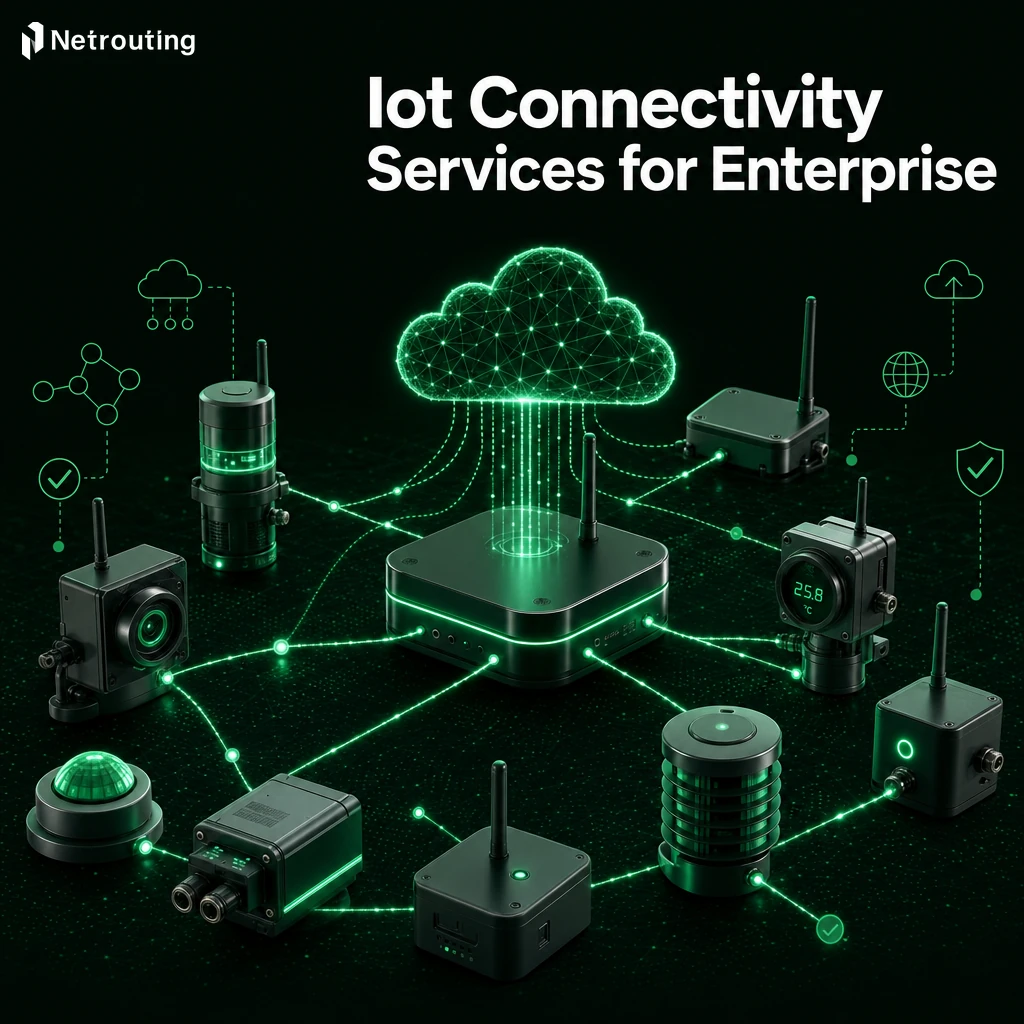
Managed IoT connectivity services give operations teams a single control plane for hundreds or thousands of endpoints, such as sensors, gateways, cameras and industrial controllers. These managed IoT connectivity services differ fundamentally from standard internet connectivity and include the management of the device lifecycle, SIM and/or network policy management, data usage monitoring, as well as traffic segmentation from the start.
In addition to proactive monitoring and automated failover, IoT managed services enable companies to leverage purpose-built IoT services that guarantee 100% uptime for mass quantities of sensors and the related data. Such as every point-of-sale sensor across 500 stores for example. Standard broadband is unable to guarantee such. Real time monitoring of device health metrics ensures that anomalies such as connectivity drops or sensor failures are detected immediately, allowing operations teams to respond before service degradation impacts end users.
Key Connectivity Technologies for Data Handling
Enterprise IoT connectivity solutions can operate across several transport layers depending on the use case.
- Cellular (4G/5G, NB-IoT, Cat-M): Wide-area coverage for mobile or remote assets.
- Private networking: Dedicated LAN or MPLS for campus and factory environments.
- Wired Ethernet: Deterministic latency for industrial control and high-throughput connected devices.
Selecting the appropriate layer or a combination of layers to meet specific requirements is where IoT connectivity services can really add value to engineering compared to off-the-shelf solutions. Also fundamental is security. Organizations that partner with providers offering managed iot services gain access to engineering expertise that tailors connectivity stacks to specific device profiles and operational constraints. Many iot platforms now integrate directly with these connectivity stacks, enabling unified orchestration of device provisioning, data routing, and policy enforcement across heterogeneous transport layers.
How Does Private Networking Improve Security for Enterprise IoT Environments?
Private networking means 100% isolation of IoT communication from the public internet. On top of that, all IoT solutions on private networks enforce strict access control on a network level, far beyond the application level. This removes a large class of attacks that take advantage of shared networks and subsequent lateral movement.
Our private network fabric at Netrouting provides free interconnection of all resources within the fabric up to 40 Gbps. Thus, IoT services are provided with a secure, low latency communication backbone without public exposure. On top of this communication backbone, the various managed platform components are organized, which enable the interconnection of the device connectivity. Organizations can deploy managed iot services on top of this infrastructure to gain centralized orchestration, automated provisioning, and real-time visibility across all connected endpoints.
Core Components of Managed IoT Connectivity Services Platforms
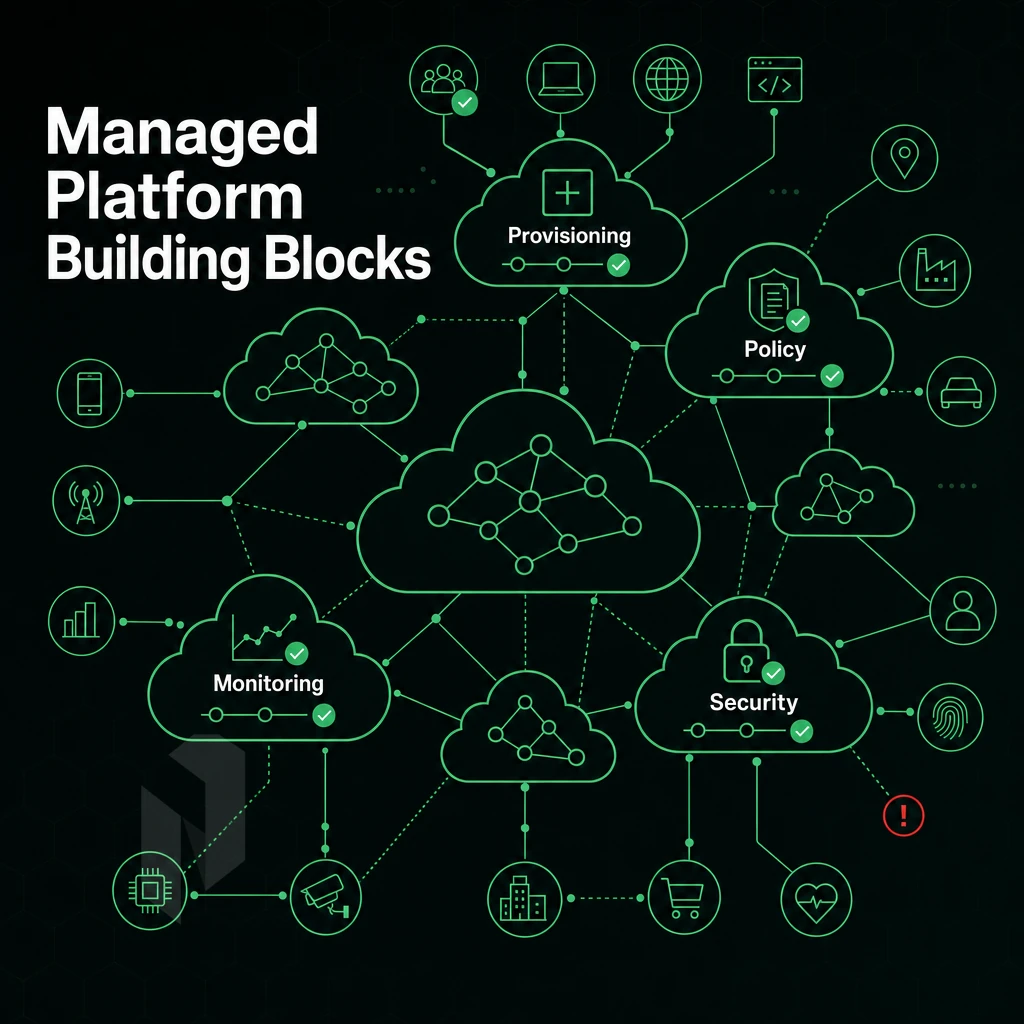
A managed IoT connectivity platform is more than a SIM dashboard. A managed IoT connectivity platform provides a unified hardware provisioning, network orchestration and real-time monitoring operational layer that can manage thousands of connected devices across distributed locations. These platforms enable businesses to scale IoT deployments rapidly while maintaining centralized visibility and control over device behavior, network performance, and data flows. Modern iot platforms integrate device provisioning, connectivity orchestration, and analytics into a single operational environment, reducing the complexity of managing heterogeneous device fleets.
Connectivity Management Platform: Unified Network Control
A connectivity management platform provides a single interface to connect devices to different networks (cellular, Wi-Fi, LPWAN) and communicate using various protocols (MQTT, CoAP, HTTP). It allows operators to use managed iot services to monitor and manage devices, receive data and set alert thresholds from a single platform, instead of switching between different carrier portals.
Operators gain visibility into real time data streams from every connected endpoint, enabling immediate detection of performance degradation or connectivity anomalies across the deployment. Modern iot platforms integrate these connectivity management capabilities with analytics engines and device registries, enabling operators to correlate network performance with application-layer behavior across heterogeneous device populations.
SIM and Device Management for Provisioning
On the other hand, the SIMs are provisioned on devices for secure onboarding (i.e. the certificates, firmware baselines and network profiles are “pushed” to the device before it is deployed in the field). Proper device deployment workflows ensure that each endpoint arrives at its installation site fully configured and ready to authenticate, minimizing field technician intervention and reducing the risk of misconfiguration errors.
Which Cellular Connectivity Technology Is Best for Large-Scale Enterprise Deployments?
For global IoT connectivity at enterprise scale, the choice of technology typically boils down to LTE-M and NB-IoT. For mobile or latency-sensitive assets, LTE-M provides typical latency of under 100 ms, voice support and even firmware update capabilities.
These cellular technologies optimize data transmission by balancing throughput requirements against power consumption constraints, making them ideal for battery-operated sensors deployed in remote industrial environments. NB IoT excels in stationary deployments where devices transmit small payloads infrequently, offering extended battery life that can exceed ten years in low-power modes.
Typically, choice will be determined by factors of mobility, data rate and battery life, rather than simple coverage. Low-power wide-area technologies such as NB IoT excel in scenarios where devices transmit small payloads infrequently, making them ideal for battery-operated sensors deployed in remote or hard-to-reach locations.
Meeting Connectivity Needs With Device Lifecycle Management
The lifecycle management of devices, including their retirement, is tracked. Device connectivity health (e.g. signal strength, packet loss, session drops) is used for automated remediation. Devices are automatically reprovisioned or failed over as needed within managed iot services to maintain uptime close to 99.9%, which is typical of many enterprise operations' Service Level Agreements (SLAs).
Real-time visibility into device status allows operators to identify connectivity anomalies before they escalate into service disruptions across the fleet. Operators can also trigger diagnostic commands and configuration updates through remote management interfaces, reducing the need for costly field visits to troubleshoot connectivity issues.
| Technology | Typical Latency | Best Use Case | Mobility Support |
|---|---|---|---|
| LTE-M | <100 ms | Mobile assets, OTA updates | Yes |
| NB-IoT | 1-10 s | Static sensors, low-power | Limited |
| 5G SA | <10 ms | Edge compute, high-throughput | Yes |
The low-latency compute is what device management platforms need to process high volumes of data. Edge computing nodes deployed alongside cloud services enable this low-latency processing by distributing workloads closer to the device endpoints themselves. Efficient data handling at the edge reduces the volume of raw telemetry transmitted to centralized cloud infrastructure, lowering bandwidth costs and improving response times for time-critical applications. Processing real time data at the edge minimizes latency for applications such as predictive maintenance, anomaly detection, and automated control systems that require immediate decision-making capabilities.
Optimizing data transmission protocols at the edge further enhances system responsiveness by reducing packet overhead and ensuring that only actionable insights are forwarded upstream. Organizations deploying edge infrastructure often pair these nodes with managed iot services that orchestrate compute resources and network policies across distributed sites, ensuring consistent performance and simplified operations. Many iot platforms now integrate edge orchestration capabilities directly into their management consoles, allowing operators to deploy containerized workloads and configure data pipelines without manual intervention at each site.
Managed IoT Connectivity Services: 4G, 5G, NB-IoT, and Beyond
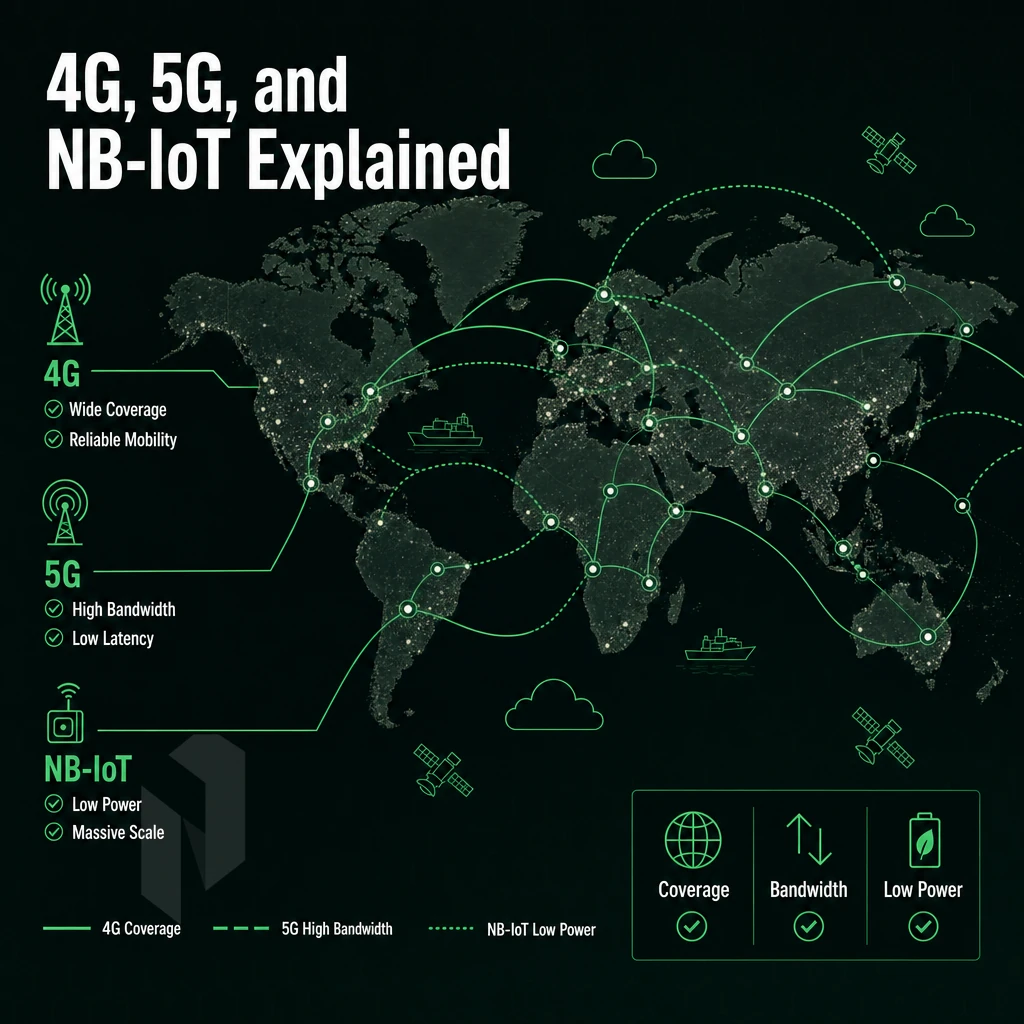
Selecting the wrong technology will consume unnecessary power, money and bandwidth.
Managed IoT Connectivity Services: Matching Technology to Workload
Not every device needs broad band. Cellular IoT connectivity can be sorted into four practical classes, by means of throughput, power consumption and coverage. NB IoT stands out as a low-power wide-area network technology optimized for static sensors transmitting small data payloads infrequently, making it ideal for smart metering and environmental monitoring applications.
- 4G LTE for high-throughput devices. The high data usage of LTE is better suited for devices that stream video, push large telemetry payloads, require low latency, etc. Only use LTE on assets that cost justify.
- 5G for latency-critical and dense deployments. 5G can deliver latency of below 10 ms and massive amounts of devices. Smart Factories, Autonomous Vehicles and IoT-based control systems benefit from 5G, if there is no 4G headroom left.
- Low power wide area sensors using NB-IoT. NB-IoT provides good coverage indoors and underground. Long battery life, ideal for meters, asset tracking and environmental sensors with low data volumes.
- Cat-M for mobile low-power devices. Cat-M adds voice support and gives moderate throughput while keeping power low. Cat-M is suitable for wearables, for tracking of fleets of vehicles and for mobile devices that frequently change cell towers.
Note: Mixing technologies in one deployment without a unified SIM strategy creates fragmented network connectivity and multiplies management overhead. Careful device deployment planning that aligns SIM provisioning with network technology choices prevents these fragmentation issues and streamlines operational workflows across the entire fleet.
Global IoT Services via Multi-Network SIM and eSIM
Many deployments don't even stay within a country's borders. Having a multi-network SIM or eSIM profile for your device means you don't have to physically change out SIMs for different carriers. A single profile can support 2G through 5G networks in dozens of countries, facilitating remote data collection for logistics, agricultural and utilities fields. Multi-network profiles also optimize data transmission costs by automatically selecting the most cost-effective carrier in each region based on negotiated rate agreements.
For very remote areas, such as offshore or polar area sites, Satellite IoT is an emerging option to fall back on. The latency will be higher than with a terrestrial cell signal, but for low frequency sensor reporting, the option for IoT connectivity does remain.
How Do Enterprises Manage Security Across Thousands of Connected IoT Devices?
This can be countered by the use of layered controls, enforced at both network and device levels.
- Segment IoT traffic on isolated VLANs or private APNs. Do not connect IoT devices to the corporate LAN. Private APNs allow cellular traffic to be routed directly to your infrastructure instead of going over the public internet.
- Enforce mutual TLS and use certificate-based device identity. Shared passwords will not scale. Every device should have a unique certificate that is provisioned at manufacture or first boot.
- Over-the-air firmware update policies should be applied. Unpatched firmware is the most common exploit vector. Automatically updating OTA with the ability to roll back is recommended.
- Monitor for anomalies against the traffic baselines and alert accordingly. A sensor that suddenly starts to generate triple the amount of data will be either compromised/misconfigured or caught by the behavioral monitoring.
A Private Network Fabric, free between customer resources and up to 40 Gbps, lets you control internet exposure while delivering low-latency IoT connectivity solutions between field gateways and processing resources. These network-layer controls form the foundation of Netrouting’s overall security and compliance offering.
Security and Compliance in Enterprise IoT Solutions
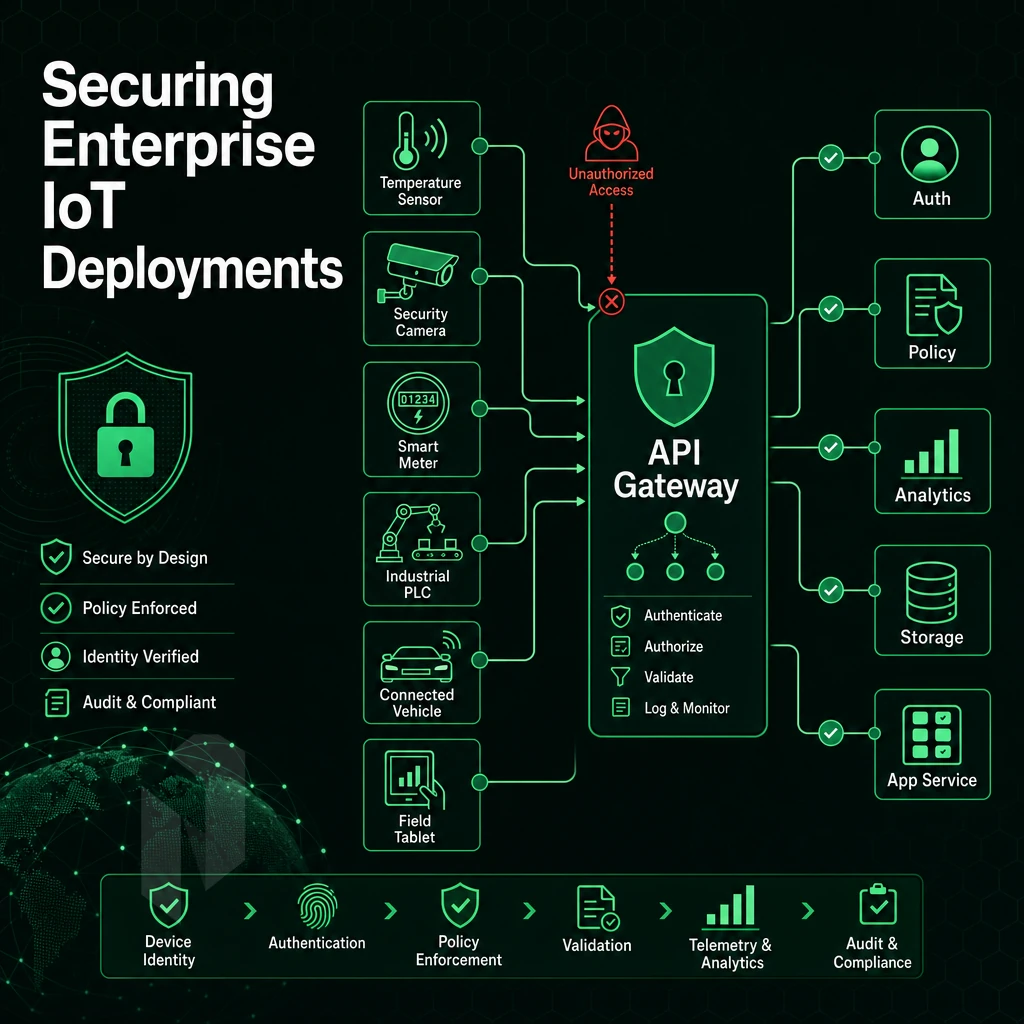
Big IoT creates new security challenges for which traditional IT security measures are not designed. Large numbers of endpoints, heterogeneous protocols and big amounts of data are attacking surfaces that require managed IoT connectivity alongside a structured and layered security approach from the edge of the device to the core network.
Network Isolation and Private Networking
Private networking for IoT exposure control is most effective.
This will satisfy requirements for organizations deploying IoT services within healthcare (HIPAA) and critical infrastructure (IEC 62443), for example, by enabling seamless connectivity within defined device groups while stopping lateral flow between them.
Security Controls and Access Management
Connectivity policies are set up on a granular basis.
Encryption in transit of sensitive data leaving the device layer is required. This must be using TLS 1.2 or higher.
What Is a Connectivity Management Platform and What Does It Do?
Connectivity Management Platforms for IoT enable organizations to manage connectivity for entire fleets of IoT devices, creating interfaces to manage provisioning, monitor, and enforce policy. Real-time insight into IoT devices, combined with streamlined device provisioning, enables users to monitor usage, detect anomalies, and administer each device on a per-device basis.
By basing a Managed IoT service on this architecture, security for regions and operators can be managed as a single entity. This enables such deployments to be managed with unified policy enforcement, automated SIM control, and auditable reporting.
Such a service facilitates data security on a per-fleet basis rather than a per-device basis.
Best IoT Platforms for Enterprise Solutions: What to Look For
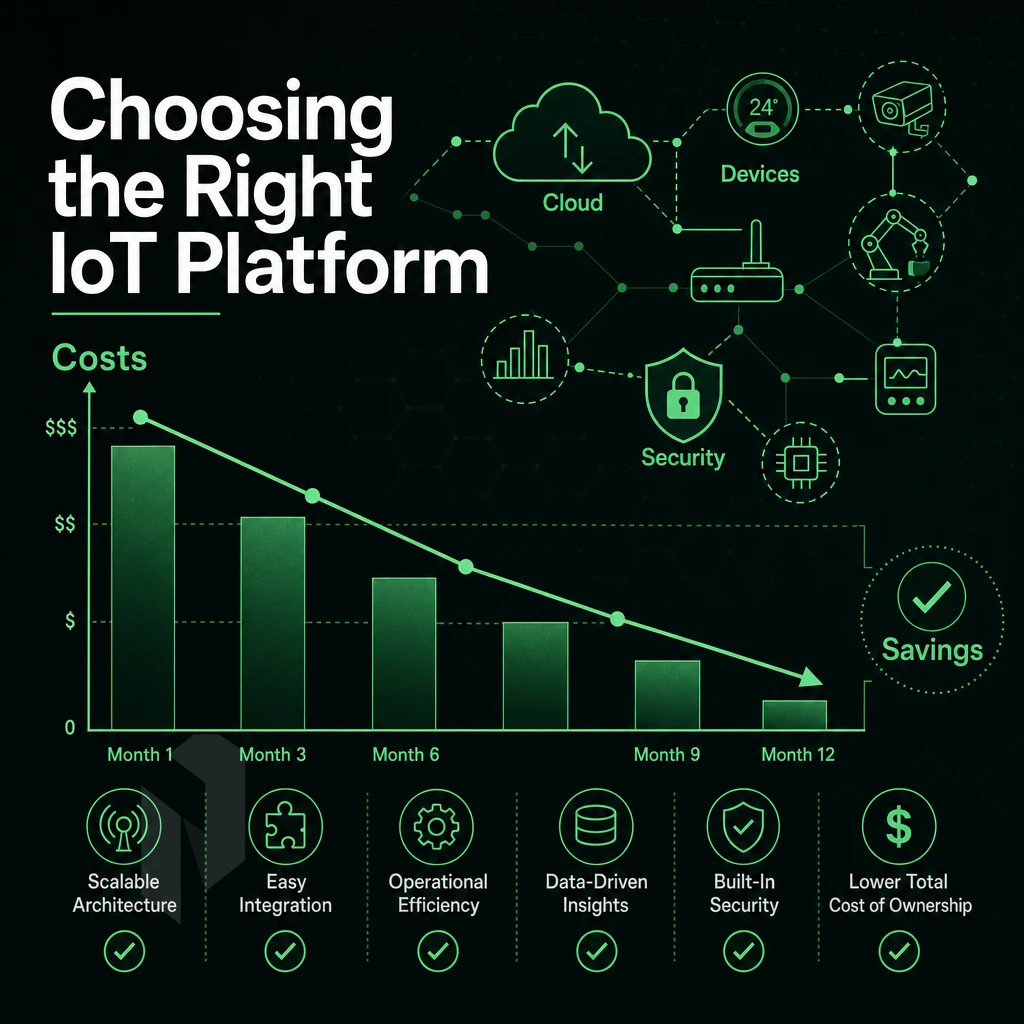
An Enterprise IoT platform does a lot more than just transfer data between devices and cloud. The best IoT platforms are offering a multi-protocol support, real-time monitoring, edge computing and adequate security in one operational layer. This is fundamentally different from simple connectivity offerings.
Connectivity Technologies: Multi-Network and Multi-Protocol Support
Most Enterprise deployments operate on multiple radio technologies. Therefore a platform needs to support cellular (LTE, NB-IoT, 5G), Wi-Fi, LoRaWAN, and Zigbee in multiple networks without creating silos per protocol.
In terms of protocol support, it’s all equally important. MQTT, CoAP, HTTP and AMQP need to be supported. Different devices within IoT solutions, relying on cellular connectivity or otherwise, and each with different latency requirements, need to be able to talk to the platform and have their data sent to a unified data pipeline in order to remove integration friction at scale.
How Do NB-IoT and 5G IoT Services Differ for Enterprise Applications?
NB-IoT is designed for low power consumption, low data rates and long battery life for sensors such as smart meters, environmental sensors and asset tracking devices. Latency for such applications is measured in seconds rather than milliseconds.
Use 5G for high speed.
Operational Efficiency: Monitoring, Security, and Support Integration
Operations teams have real-time device performance visibility to immediately see connectivity issues before they snowball into problems. Real-time data and monitoring as well as edge compute for reduced latency to process the data near where it was collected.
All aspects of security management and network security have to be managed at platform level, not after the devices have been deployed. Therefore, when evaluating iot services, look for device management options with certificate-based authentication and/or encrypted transport, as well as options that allow automated policy-making and enforcement for all endpoints.
This provides low-latency, high-availability infrastructure for your IoT workloads.
Enterprise IoT Devices: From Manufacturing to Smart Infrastructure
While Enterprise IoT deployments are to be found in many industries, every use case however has same basic needs: large number of reliable device connections, low latency data transfer. Additionally, Robust underlying infrastructure that supports important business processes.
Use Cases Across Key Verticals
| Vertical | IoT Application | Connectivity Requirement | Business Outcome |
|---|---|---|---|
| Manufacturing | Industrial automation, sensor monitoring | Sub-10ms latency, uninterrupted connectivity | Reduced downtime, operational efficiency |
| Smart Buildings | HVAC, access control, energy management | Always-on, seamless management across zones | Lower energy costs, improved occupant experience |
| Logistics & Fleet | GPS tracking, condition monitoring | Wide-area coverage, real-time telemetry | Improved route efficiency, customer satisfaction |
| Retail & Supply Chain | Inventory sensors, cold-chain monitoring | High device density, reliable data sync | Reduced shrinkage, digital transformation |
| Healthcare | Remote data collection from patient devices | Secure, compliant transmission with security controls | Better outcomes, reduced clinical overhead |
What Infrastructure Supports IoT Data Collection and Processing at Scale?
Scalable processing of IoT data across multiple devices, a core requirement for modern iot services, requires edge computing for low-latency processing, high-throughput ingestion, and storage that can handle the continuous stream of sensor readings.
Enterprises require dedicated bare metal or high-density cloud compute with reliable connectivity and lifecycle management, covering provisioning, patching and decommissioning of IoT devices as device fleets scale. Wireless logic architectures abstract SIM and connectivity lifecycle management, but require reliable, carrier-grade processing backend infrastructure to function.
Where Netrouting Fits
Netrouting's high-performance network infrastructure with 2.4 Tbps+ offers ten locations throughout Europe, North America and Asia for the co-location of IoT backends in close proximity to the device populations relying on cellular connectivity and their data usage demands. In addition, our 24/7 DDoS protection as well as our 99.9% uptime SLA ensures the necessary reliability for IoT applications.
Find the appropriate deployment for your connected devices with the help of our team of experts. In the following section we describe in detail how our network infrastructure is implemented for enterprise IoT applications.
Key Takeaways: Choosing Managed IoT Connectivity Services for Enterprise
Managed IoT connectivity services consolidate device management, SIM provisioning, cellular IoT connectivity, and real-time monitoring into a single platform. That seamless management layer reduces operational complexity, enforces consistent security controls, and gives teams the visibility they need to optimize costs and data usage across large IoT deployments.
IoT connectivity services for enterprise only perform as well as the network infrastructure beneath them. Reliable, low-latency connectivity, built on private networking and a carrier-grade backbone, is what keeps connected devices online and data streams flowing. Evaluate your connectivity needs carefully before committing to a platform. For the infrastructure layer, explore Netrouting's connectivity services.
Enterprise IoT connectivity, much like managed iot services, is not a single technology decision, it's a layered architecture spanning cellular protocols, platform management, and security compliance. The most resilient deployments treat connectivity as infrastructure: redundant, policy-driven, and monitored end to end. Choosing the right managed IoT services platform means evaluating SIM management, network coverage, device lifecycle tooling, and data sovereignty requirements before committing to a vendor.
Netrouting's 2.4 Tbps+ global network, spanning Europe, North America, and Asia, gives IoT deployments the low-latency, high-availability foundation they need.
Ready to build your IoT infrastructure on a carrier-grade backbone? Talk to the Netrouting team about dedicated servers, IP transit, and colocation options engineered for enterprise-scale connected workloads.