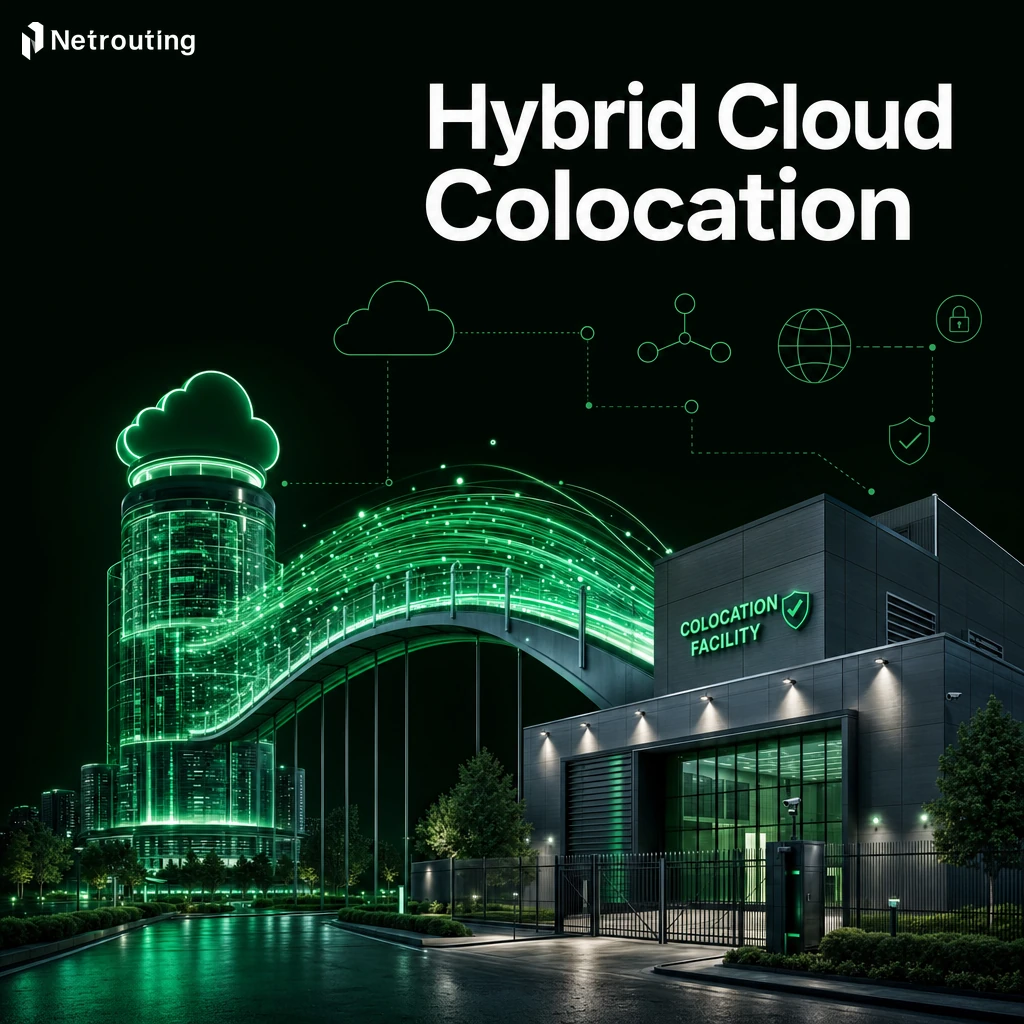
The hybrid cloud colocation model helps to circumvent the typical problems that come with the full transfer of an IT infrastructure to cloud-based solutions.
In this colocation vs cloud hybrid approach, the core of latency-dependent as well as data-sovereign applications are hosted on dedicated hardware in a data center, while compute-intensive applications with variable usage are migrated to cloud-based compute services as required. This hybrid approach allows organizations to allocate computing resources dynamically, directing workloads to the most cost-effective and performant tier based on real-time demand patterns.
Deciding on a good colocation facility, designing the interconnect, implementing failover, and keeping the whole stack observable are all part of realizing the benefits of hybrid cloud, and each involves long-lived decisions that will have big impact on performance and cost for years to come. Selecting the right cloud connectivity architecture, whether direct cross-connects, VPN tunnels, or SD-WAN overlays, determines both the resilience and cost profile of your hybrid deployment.
Blog contents
Organizations that invest early in robust cloud infrastructure connectivity patterns avoid costly re-architecture later when traffic volumes scale or compliance requirements tighten. Equally important is planning for disaster recovery across both colocation and cloud tiers, ensuring that failover mechanisms can restore service rapidly regardless of where the primary workload resides.
The rest of this article covers the essential elements of a hybrid cloud colocation solution, the key network and physical aspects of the infrastructure.
What Are Hybrid Cloud Computing Solutions for Colocation?
Hybrid cloud colocation solutions combine the customer’s own hardware (or leased hardware) in a third party data center with public cloud services. The result is a unified hybrid infrastructure: private compute hosted through a colocation provider for situations where control is needed most, and cloud for situations where scale is demanded. Optimizing your colocation footprint means right-sizing rack space and power allocation to match actual workload requirements, avoiding the overprovisioning that drives up monthly recurring costs.
Enterprises that architect their colocation infrastructure with future scalability in mind can seamlessly add capacity as workloads grow without renegotiating contracts or migrating to new facilities. This architectural balance between colocation and cloud tiers delivers superior cost efficiency by eliminating the premium pricing of hyperscale compute for steady-state workloads while preserving cloud elasticity for variable demand.
Private Cloud Infrastructure: On-Premises Control Without the Overhead
The colocation layer in a hybrid cloud environment is where you host your servers in a datacenter, any datacenter, carrier-neutral. So you have full control over the servers (hardware) and your data (sovereignty). Private cloud (database, latency-sensitive apps, etc. regulated data) on your own hardware, not subject to the compute costs of the hyperscalers which can be random.
Colocation environments deliver this control by giving you direct access to the hardware layer, ensuring predictable performance for mission-critical workloads that cannot tolerate the variability of shared infrastructure. Colocation infrastructure proves especially valuable for critical systems that demand guaranteed uptime and deterministic performance, where even brief interruptions can cascade into significant operational or financial impact.
A dedicated bare-metal node in our datacenter for example will provide deterministic levels of throughput as opposed to shared virtual servers. Bare-metal colocation infrastructure ensures consistent performance by eliminating the noisy-neighbor effects and resource contention inherent in multi-tenant virtualized environments.
Public Cloud Services vs Private Cloud: Elastic Capacity on Demand
Cloud providers handle burst traffic, dev/test environments and globally distributed workloads. A colocation provider connects its it infrastructure to these platforms via private circuits or the internet, typically offering low latency and very predictable data paths.
Organizations often adopt this cloud and colocation strategy to balance operational flexibility with cost predictability, especially when workload patterns are well understood. Many enterprises architect their colocation and cloud integration around workload characteristics, placing stateful databases and compliance-sensitive systems in the colocation tier while routing ephemeral compute to hyperscale platforms.
Why Hybrid Cloud Solutions Bridge the Public Cloud and Private Cloud Gap
Pure public cloud is convenience over control. Hybrid cloud sits in between: colocated hardware (servers, storage, etc.) forms the core of your infrastructure, while cloud connectivity is then used to extend your edges (e.g. extra web servers, development environment etc). Organizations choosing this hybrid model retain the governance and compliance advantages of on-premises infrastructure while gaining the elasticity that cloud computing delivers for unpredictable or seasonal demand.
Here at Netrouting we have colocation facilities that can house your hybrid architecture. Understanding the two layers that form the hybrid infrastructure and how they work together to serve your users is key to maximizing the potential of your Hybrid Cloud infrastructure.
Realizing the benefits of hybrid cloud requires careful orchestration of workload placement, ensuring that latency-sensitive applications remain colocated while elastic workloads leverage cloud scalability. Effective hybrid cloud computing depends on selecting colocation partners that offer direct connectivity to major cloud providers, minimizing latency and maximizing throughput for workloads that span both environments.
Hybrid Infrastructure Security and Data Protection
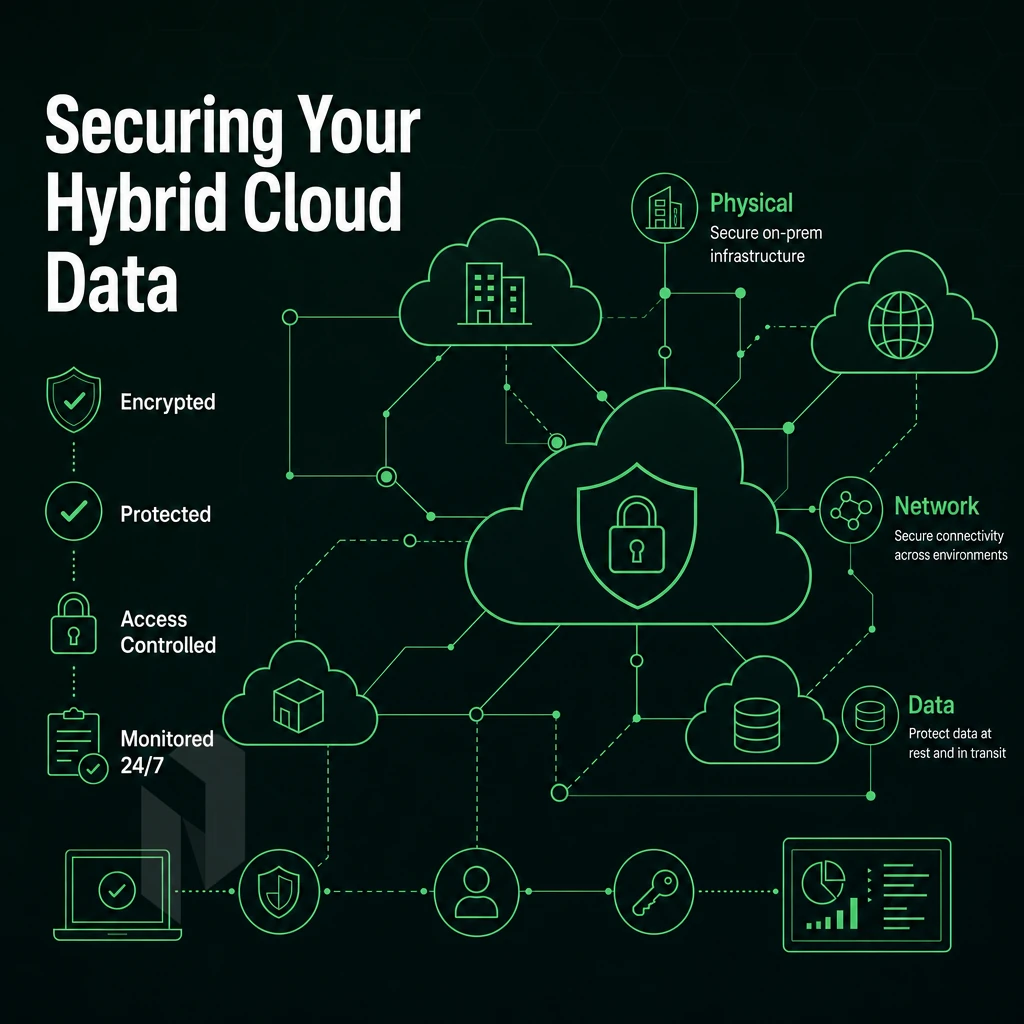
To protect hybrid cloud workloads, you need security controls at every level: physical, network and data. By locating your hybrid cloud workloads in a colocation facility, the physical and network security boundaries for those workloads can be far stronger than in public cloud alone. Implementing a comprehensive cloud security posture across both colocated and public tiers ensures consistent policy enforcement and visibility into threats that span your entire hybrid environment.
Physical Security and Facility Controls for Cloud Security
Physical security at a colocation data center means you get to keep physical control of your servers and other equipment. You lock them in a cage or rack and the colocation data center (facilities) locks down the perimeter to protect you from unauthorized access.
Network Segmentation in a Private and Public Cloud Environment
Keeping sensitive workloads on colocated bare metal and connecting them to the broader cloud infrastructure over private cross-connects keeps the blast radius contained. All traffic between private and public cloud goes over private cross-connects, never touching the open internet. Utilize VLANs, firewalls, and BGP route policies at the network edge of your cloud computing services infrastructure to create hard boundaries for traffic entering and leaving the environment.
Transit encryption (IPsec or MACsec) between the colo cage and cloud on-ramps fills the last gap of exposure.
Data Center DDoS Protection and Data Security
Security of your data is increased by having core services on your premises, as opposed to public cloud platforms that could be breached and then used to attack your on-premises servers. Colocating sensitive workloads reduces exposure to data breaches that commonly target multi-tenant cloud environments where lateral movement between customers becomes possible.
Even the best security controls introduce risk of increased complexity and increase in operational overhead. Managed Services are designed to take this burden from you, without removing control from you.
Why Choose Netrouting for Hybrid Cloud Colocation
Netrouting supports hybrid environments and data storage needs through carrier-neutral colocation across ten cities: Amsterdam, Frankfurt, Miami, Singapore, Hong Kong, New York, The Hague, Stockholm, Rotterdam, and Bucharest. Our own AS6206 backbone delivers 2.4 Tbps+ capacity with dense IX peering, giving your hybrid cloud infrastructure direct, low-latency paths to every major public cloud platform.
- Free private network up to 40 Gbps between your resources, seamless connectivity across your hybrid environment at no extra cost.
- Always-on DDoS protection included on every service, keeping critical workloads and sensitive data online.
- Managed Proxmox VE for teams that need managed virtualization without public cloud lock-in.
- Bare metal provisioned in under 60 minutes, colocation facilities ready when your hybrid cloud strategy demands speed.
- ISO 9001, ISO 27001, SOC 2 certified with a 24/7 NOC and one-hour ticket guarantee.
For enterprise hybrid cloud deployments that need direct hardware control, robust security measures, and a colocation provider with a genuine global backbone, explore our colocation services or contact our team to discuss your requirements.
Frequently Asked Questions About Cost Efficiency
How Hybrid Cloud Migration Differs From Colocation Private Environments
Colocation means housing your own physical servers inside a third-party data center, you own the hardware, the provider supplies power, cooling, and connectivity. Hybrid cloud combines private infrastructure (on-premises or colocated) with public cloud resources, letting workloads move between environments based on performance, compliance, or cost requirements. Colocation is an infrastructure model; hybrid cloud is an architectural strategy. The two overlap when colocated hardware becomes the private leg of a hybrid cloud deployment. Modern colocation facilities maintain enterprise-grade cooling systems that ensure optimal operating temperatures for high-density server deployments, preventing thermal throttling and extending hardware lifespan.
How Do Cloud Providers Differ Between Colocation and Cloud Services?
In a cloud computing context, colocation is the practice of placing your own dedicated servers or networking gear inside a carrier-neutral data center to serve as the private, on-premises-equivalent tier of a broader cloud architecture.
Your hardware connects to public cloud platforms' regions or other sites via direct cross-connects or private circuits, giving you low-latency, high-bandwidth access without routing traffic over the public internet. This approach is common in hybrid cloud designs where the colocation vs cloud decision is driven by data sovereignty, latency, or compliance requirements that rule out shared public infrastructure.
What Cloud Hosting and Hybrid Cloud Services Do Providers Offer?
A practical example: a financial services company builds a private cloud by colocating its database servers at a carrier-neutral facility, rather than relying on public cloud service providers, such as Netrouting's The Hague or Miami data centers, keeping sensitive customer data on dedicated hardware under its direct control. The company then extends compute capacity into AWS or Azure for analytics workloads, creating a hybrid architecture where the data center hosts the system of record while cloud handles variable processing demands. This architecture ensures that data storage remains subject to internal governance policies while compute elasticity scales on demand in the cloud tier.
The application tier and batch analytics jobs run on public cloud compute, scaling on demand. The result is a single logical infrastructure where sensitive data stays on-premises while variable workloads consume elastic cloud capacity.
What Are the Disadvantages of Hybrid Cloud Managed Services?
Hybrid cloud adds operational complexity: you must manage two distinct environments, private hardware and public cloud, with different APIs, monitoring tools, and security models. Skill requirements increase, since teams need expertise in both on-premises infrastructure and cloud platforms simultaneously.
Finally, cost visibility is more difficult, as predictable colocation spend sits alongside variable billing from public cloud services, making total cost of ownership harder to track without deliberate tooling.
Hybrid cloud colocation is ideal for workloads that require the most control and hybrid cloud colocation allows for the greatest flexibility. The architecture is simple in that colocation and cloud are two layers of infrastructure that are not mutually exclusive.
Instead, the private IT infrastructure hardware in a colocation facility, much like an own data center, can handle the latency sensitive, compliance driven or high-throughput workloads, while the cloud handles the burst capacity and global reach requirements of the organization. By reducing risk and lowering total cost of ownership, colocation paired with hybrid cloud storage integration is far superior to building out an entire infrastructure on a single platform.
With physical isolation, private cross-connects, and managed services for patching and monitoring, it is possible to run a hybrid cloud computing environment and meet very hard security requirements around data protection.
If you're scoping a hybrid architecture, start with the infrastructure layer. Netrouting operates carrier-neutral cloud infrastructure out of its own data center colocation and bare metal facilities spanning Europe, North America, and Asia, backed by a 2.4 Tbps+ backbone and 24/7 support. Talk to our team about building a hybrid environment around your workload requirements.