Every design decision for a colocation data center will compound or constrain your infrastructure over the next 5 to 10 years.
These are not edge cases. For more context, see colocation.
Power delivery and redundancy, cooling, physical security, network and more.
Blog contents
Designing Enterprise Colocation Facilities: a Guide. Whether you are new to colocation, a business scaling beyond cloud service providers, or looking to expand an existing data center facility, you need to understand what goes on inside the building.
What Is the Design of Colocation Solutions and Data Centers?
Colocation data center design refers to the physical, electrical, mechanical and network architecture of a shared facility where multiple tenants can house their own hardware and run their own services. Tenants rent space (such as rack space, cages or private rooms) as opposed to building or buying their own data center infrastructure. In technical terms, colocation refers to the practice of housing privately owned computing equipment within a professionally managed facility that provides shared infrastructure services.
How Colocation Data Centers Differ From the Alternatives
Single-tenant data center is a private data center where one organization, typically a single-tenant, owns a building, power and cooling. Such model typically requires significant upfront capital and ongoing facilities expertise. In contrast, a dedicated data center model offers organizations complete infrastructure autonomy but demands substantial operational expertise and long-term capital commitment that many enterprises find prohibitive. Organizations migrating from legacy systems often find the dedicated model particularly challenging due to the specialized infrastructure required to support aging equipment alongside modern architectures.
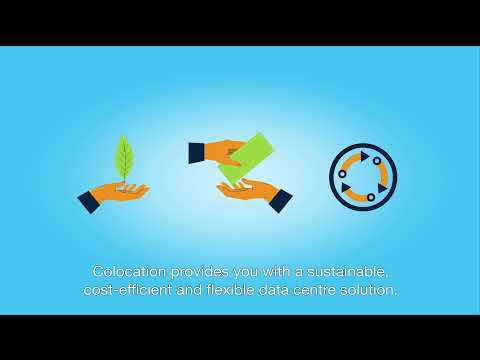
Cloud computing completely virtualizes resources and thus you as a customer can use as much computing power as you need, without having to buy any hardware. Colocating at a data center (a.k.a. Data center colocation (hosting a cage) is somewhere in between: you keep complete control of your physical servers, while the data center takes care of the underlying infrastructure.
What Tenants Actually Rent: Data Center Space and Deployment Options
Data center operators structure capacity into three tiers:
- Rack space, individual U slots within a shared cabinet.
- Caged suites, locked, dedicated enclosures within the shared floor space.
- Private suites, fully enclosed rooms for high-density or compliance-sensitive workloads.
This example illustrates the case of a retail e-commerce company. They would start with 4 rack units in a shared cabinet, then scale to a caged suite as traffic grows, all while staying within the same data center providers. This scalability model demonstrates how data center colocation enables businesses to match infrastructure costs directly to revenue growth without overprovisioning capacity.
Four Pillars of Colocation Data Center Design
Colocation data center facilities are typically engineered around four pillars. Each of these is discussed in more detail below.
- Power, redundant feeds, UPS systems, and generator backup.
- Cooling, precision airflow management to protect hardware at density.
- Physical security, Physical security measures such as layered access controls (perimeter, room, cabinet, etc.).
- Network connectivity, carrier-neutral interconnection and direct peering.
Our data center colocation offerings at Netrouting's own facilities are built around carrier-neutral design, N+1 power and cooling, and native connectivity to our AS6206 AS (among others).
How a Colocation Strategy Works in Data Centers
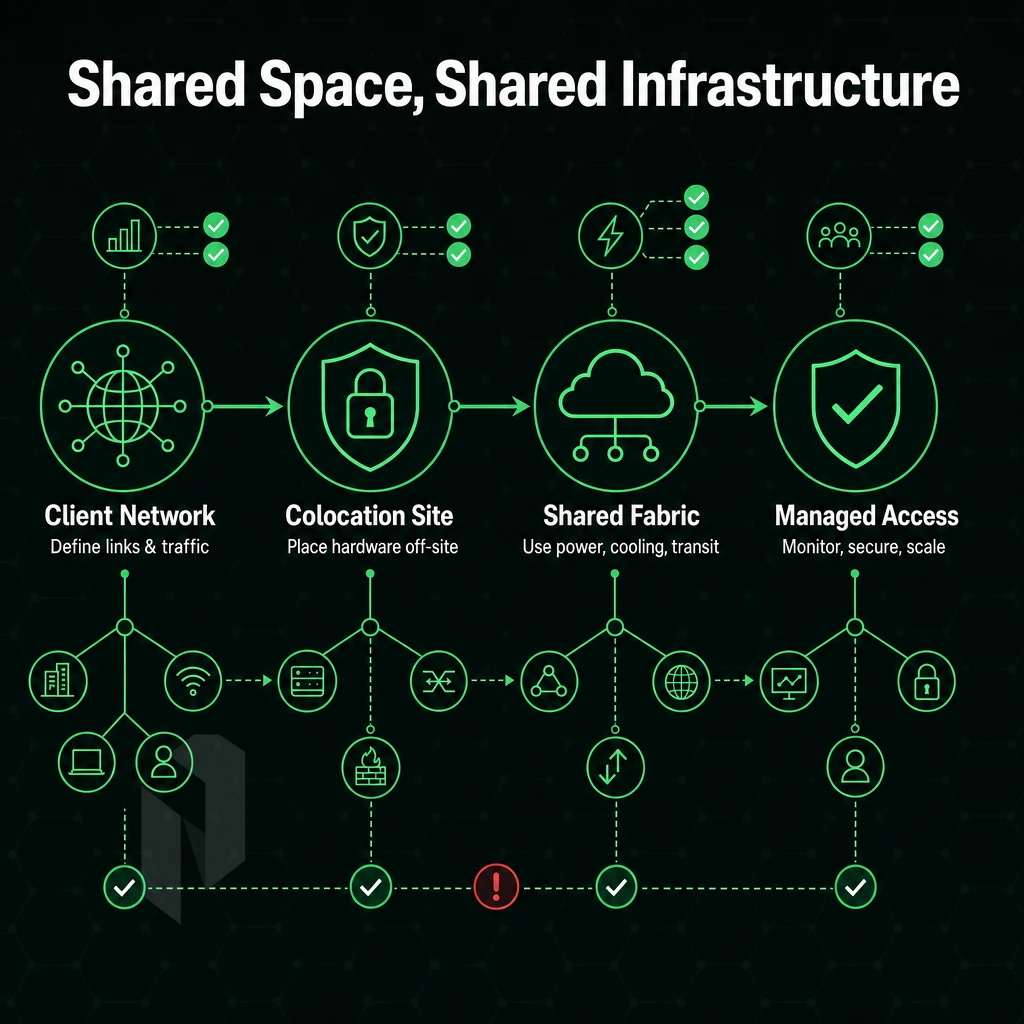
Colocation, Your Servers in a Third-Party Facility.
The Division of Responsibility
Customers bring their own servers and networking hardware. Space for customers’ own hardware is provided in the form of open racks, caged walls and private rooms, with redundant power, cabling and network connectivity to a variety of carriers. The colocation provider typically coordinates equipment installation logistics, including rack mounting, cable management, and initial power-up procedures to ensure proper integration with facility systems.
Customer retains control and management of data, processing, software and other information related to equipment and tenancy in the data center colocation facility.
Cooling Systems and Physical Infrastructure
A good colocation data center is designed with N+1 redundancy for power and cooling. This supports a 99.9% uptime SLA which is typical in the industry. This is achieved through a combination of uninterruptible power supplies (UPS), backup generators and precision air handling. Modern battery backup systems provide the critical bridge between utility power loss and generator startup, ensuring zero interruption to mission-critical workloads during transitions. These redundancy measures are essential for organizations operating critical infrastructure that cannot tolerate even brief service interruptions. Beyond electrical and cooling infrastructure, modern colocation facilities integrate advanced fire suppression systems that use clean agent technologies to protect equipment without causing water damage or leaving residue.
Thermal management becomes particularly challenging in high density environments where rack power loads exceed 10kW per cabinet, requiring specialized containment strategies and supplemental cooling infrastructure. Organizations deploying high performance computing clusters benefit particularly from these thermal management capabilities, as computational workloads generate sustained heat loads that standard cooling cannot adequately address. Facilities engineered for maximum availability often deploy multiple backup generators with automatic transfer switches to guarantee seamless failover during extended utility outages. Proper thermal containment strategies and airflow management techniques help organizations optimize performance while maintaining energy efficiency across diverse workload profiles.
Colocation Providers and Managed Extensions
In addition, Managed Colocation services also include the basic tasks as well as OS patching, security hardening, proactive monitoring, etc. You, the customer, will have full root access to your colocation infrastructure at all times. These managed services often incorporate enhanced security protocols including intrusion detection, vulnerability scanning, and compliance reporting tailored to your regulatory requirements.
We offer a range of colocation solutions from shared cabinets in high-density environments to private, high-density colocation in locations across Europe, North America and Asia. Our courtesy remote hands service is included in all accounts, and we offer fully managed services to those who require them. Not all data center facilities are created equal, and the type of colocation you choose will have a profound effect on issues such as power density, networking equipment compatibility, and service level agreement (SLA) terms.
Three Main Types of Colocation Data Centers
Models of colocation facilities can differ significantly.
Retail and Wholesale Models
- Retail colocation, partial rack to full rack, suited to SMBs and mid-market teams. You place your own computing hardware inside a shared, carrier-neutral facility. Power per rack typically runs 2-10 kW. Network solutions focus on redundant uplinks and cross-connects. Note: Density limits here can constrain GPU or high-core-count workloads, verify per-rack power before committing.
- Wholesale colocation, whole halls or suites of rooms, for big enterprise customers and for hyperscalers. A colocated data center of this scale can be provisioned with all manner of custom power and cooling as required. Very large SLAs can be constructed as required. Wholesale data center colocation is something that is negotiated directly with the facility operator, rather than being offered up on a price list.
Hybrid Colocation Data Centers and Cloud Computing
- A hybrid colocation environment, comprises your own dedicated hardware, located within a colocation cage in a datacenter, and cloud services offered by the same cloud provider or by a connected cloud provider. A colocation environment is well suited for organizations and departments in transition to running their workloads in the cloud. They can transition step by step and can also make use of cloud computing for peak workloads, in addition to their local servers. The critical design variable to be aware of in such an environment, is the latency between your physical servers and your virtual cloud servers.
Our colocation solutions, supported from 10 data center locations across Europe, North America and Asia, can fit into a single-rack deployment in The Hague or a high-density private suite in one of our locations. With N+1 power and 40 Gbps private interconnects, a data center colocation facility's real value depends on its physical engineering and whether it holds up under production load.
Network Connectivity and Interconnection in Colo Design
Carrier-neutral colocation facilities give their tenants a significant structural network advantage. By having all upstream carriers terminate at the same data center colocation facility, tenants can choose their best carrier or carriers on true merit rather than geographic restrictions. These direct connections between carriers and tenant equipment eliminate the latency and cost overhead associated with off-site circuit extensions while enabling true multi-homing architectures.
Carrier-neutral facilities typically provide comprehensive interconnection services that enable tenants to establish direct cross-connects to multiple network providers within the same building, reducing latency and improving redundancy. The comprehensive network solutions offered at carrier-neutral facilities include direct peering arrangements, private interconnects, and on-demand bandwidth scaling that adapt to evolving connectivity requirements.
How Carrier-Neutral Colocation Services Eliminate Lock-In
The single-carrier facility model locks you into the provider's pricing and redundancy model.
So how does BGP fit into this all.
Internet Exchange Peering Inside Colocation Data Centers
This results in lower latency, lower cost of transit and shorter paths to content networks and cloud services providers.
We peer locally at our Amsterdam location at AMS-IX, LSIX, FRYS-IX and GNM-IX. The dense peering fabric that is available to us is because our colocation providers are based within carrier-neutral facilities, as opposed to single-carrier buildings.
Wholesale Colocation Data Centers and Interconnection Options
Wholesale colocation services are suitable for larger deployments. These enterprises, where businesses rent space at wholesale colocation scale, require high-density, multi-rack footprints and direct, low-latency interconnection at scale. Wholesale colocation space typically consists of dedicated cage or suite space with private cross-connects to upstreams and to fabrics of Inter-Exchange (IX)’s.
- On-net cross-connects between tenants, sub-millisecond, no transit cost.
- Direct upstream termination, dedicated ports to carriers of your choice.
- IX membership, shared peering fabric for efficient traffic exchange.
With 2.4 Tbps+ network connectivity and dense IX peering, every colocation deployment immediately has a solid network foundation.
Colocation Data Centers vs. On-Premises: Key Trade-offs
Deciding between colocation data centers and managing in house servers comes down to three trade-offs: capital commitment, operational flexibility, and risk exposure.
Cost Efficiency in Structure and Staffing
On premises data centers, unlike data center colocation, are capital intensive and involve heavy upfront expenditures for hardware as well as for power, cooling and real estate.
Data center colocation converts the costly ongoing expenditures of owning a data center to operating expenditures that are predictable and continue on an ongoing basis. The data center facility handles power, cooling and physical security. Your hardware runs in the facility.
Colocation Data Centers vs. Own-Facility Scalability
Rack space at a colocation facility can be added in days.
| Dimension | Colocation | On-Premises |
|---|---|---|
| Uptime SLA | Up to 99.9%+ | Self-managed; variable |
| Scalability | Days to add capacity | Months to build out |
| Staffing | Facilities staff included | Full internal hire required |
| DR / Redundancy | Off site data center options | Requires second owned site |
Risk, Control, and the Colocation Data Centers Trade-off
Note that colocation facilities offer trade-offs.
The risk vs. benefit of colocation still seems to outbalance a move to own data center space for most organizations. Data center colocation in carrier-neutral facilities with N+1 power and cooling is generally more cost effective than what any internal IT department can provide.
Netrouting offers colocation in 10 locations around the world, including Amsterdam, Frankfurt and Miami.
Why Choose Netrouting for Carrier-Neutral Colocation
Netrouting operates carrier-neutral colocation across ten cities, Amsterdam, Frankfurt, The Hague, Rotterdam, Stockholm, Bucharest, Miami, New York, Hong Kong, and Singapore.
- Redundant power and cooling: N+1 power and cooling systems at our DFDC THG1 facility in The Hague support continuous operation, with up to 20 kW per footprint for high-density environments.
- Physical security: ISO 9001, ISO 27001, and SOC 2 certifications cover every colocation facility. Controlled access and 24/7 monitoring protect your IT equipment at every physical location.
- Diverse network connectivity: BYOIP and BGP support let you manage your own IP space. Our 2.4 Tbps+ backbone connects to major internet exchange s across all colocation centers.
- Always-on DDoS protection: L3/L4 mitigation is included on every colocation service, no add-on required.
- Free private interconnect: Connect your own servers across our colo facilities at no extra cost, up to 40 Gbps.
- 24/7 NOC and remote hands: A one-hour ticket guarantee and courtesy remote hands keep your colocation strategy on track without additional managed services fees.
Contact our sales team to discuss rack space, private suites, or a hybrid colocation design for your workload.
Frequently Asked Questions
How Does Data Center Colocation Actually Work?
A colocation facility provides the physical infrastructure, space, power, cooling, and network connectivity, reducing ongoing maintenance costs while you own and manage your own hardware and equipment.
What Are the Disadvantages of Using a Colocation Data Center?
You remain responsible for purchasing, maintaining, and eventually replacing your own hardware, capital expenditure doesn't disappear. Physical access to your equipment requires either a site visit or paid remote-hands support. Troubleshooting a failed component at 2 AM in a data center colocation setup means coordinating with the facility's on-site team rather than walking to a server room yourself. Colocation also requires internal expertise to manage bare-metal infrastructure; it's not a managed service by default.
What Are the Three Main Types of Colocation Facilities?
Retail colocation sells space by the rack unit or partial cabinet, suited to small and mid-sized deployments. Wholesale colocation leases entire halls or large private suites to enterprises with high-density footprints. Carrier-neutral colocation is defined by its connectivity model, multiple competing carriers and internet exchanges are present in the same facility, giving tenants direct access to diverse network providers without dependency on a single operator.
What Is the Difference Between Colocation Data Centers and Owned Facilities?
A data center is the physical building and infrastructure, power, cooling, cabling, and security. Colocation is a service model where that infrastructure is shared among multiple tenants, each bringing their own equipment. When a company builds a private data center, it owns both the facility and the hardware. In a colocation arrangement, the facility operator owns the building and you own the servers inside it.
What power and cooling standards should colocation data centers meet for my needs?
At minimum, require N+1 redundancy for both power and cooling, meaning one backup component exists for every active one.
Confirm dual utility feeds, on-site UPS systems, and diesel generator backup with tested runtime.
Why do carrier-neutral colocation data centers matter for network flexibility?
Carrier-neutral colocation means the data center facility has no commercial relationship with a single network provider, so multiple carriers, ISPs, and internet exchanges all have presence in the same building.
How do colocation data centers support business continuity and disaster recovery?
Colocation facilities are purpose-built for resilience, with redundant power, cooling, and network paths standard, eliminating the single points of failure common in on premises data centers. Placing production infrastructure in a professionally managed facility with 24/7 NOC monitoring reduces unplanned downtime significantly.
For disaster recovery specifically, a secondary colocation data center in a different city or region lets you replicate data and fail over quickly if your primary location goes offline. Netrouting supports this directly through its colocation data centers: Rotterdam serves as a DR location for clients with primary infrastructure at The Hague, and Stockholm provides a Nordic edge and backup site for both The Hague and Miami deployments.
At its core, colo facility architecture involves building three core systems: power, cooling and connectivity. Designing these three core data center systems effectively enables every other feature, physical security, scalability, and compliance, to become second nature to design and to operate. Data center design in terms of facility types (retail, wholesale, hyperscale) translates into core design trade-offs of flexibility vs. space.
Network architecture also merits equal consideration to the physical infrastructure of the data center.
If you're evaluating colocation options across Europe, North America, or Asia-Pacific, Netrouting operates carrier-neutral facilities in ten cities, from Amsterdam and Frankfurt to Miami, New York, Hong Kong, and Singapore. Explore Netrouting's colocation services or contact the team to discuss your specific requirements.