Managed IoT connectivity services have to balance competing requirements, such as the reliability of underlying networks, global coverage, security, and responsive customer support.
Ignore the bulk of web guides on this topic. For more context, see What's the best IoT platform? : r/hwstartups.
We will evaluate each of the iot connectivity platform providers listed above based on the factors that are most important to the typical IT Infrastructure/ IoT person (network/ uptime/geo(latency)/security/DDoS/mgmt/remote visibility/support/etc.
Blog contents
What Are Managed IoT Connectivity Services for IoT Devices?
Managed IoT connectivity services are bundles of SIMs, devices, connectivity and management of the ongoing connectivity in a single vendor operated service. Instead of having to assemble individual cellular access, routing, and monitoring tools to enable existing devices across your network, you can have a complete operational layer managed for you end-to-end. For more context, see KORE Wireless.
What an IoT Connectivity Platform Actually Does
Built above the ‘raw’ cellular networks (i.e. the underlying cellular network providers and their corresponding SIMs). A connectivity platform manages the SIMs throughout their entire lifecycle (i.e. activation and subsequent changes such as suspension and data plan changes) on behalf of its customers across various carriers. All from within a single interface.
The connectivity management platform, furthermore, enforces usage policies, sends alerts for unexpected consumption and routes traffic through alternative networks as necessary. This approach enables seamless failover across multiple networks, ensuring devices maintain connectivity even when individual carriers experience outages or coverage gaps in specific regions. Operators evaluate network coverage quality across regions to determine which carriers provide the most reliable connectivity for their specific deployment footprint.
Managed IoT connectivity platforms deliver the following key functions:
- Multi-carrier SIM provisioning and remote profile switching.
- Real-time device visibility and diagnostics.
- Automated failover between cellular, satellite, and fixed networks.
- Usage controls, rate-plan management, and cost guardrails.
- API-driven integration with device management and cloud back-ends.
DIY Stack vs. Managed IoT Devices Solutions
Whether a DIY IoT connectivity platform depends on a single carrier contract, a custom APN, or an in-house NOC, that approach realistically works for only dozens of own devices.
Managed IoT services simplify the complexity of managing your IoT services across platforms, support and data. Whether your devices are based in Stockholm, Singapore or Miami, you only need to deal with one platform, one support organization and one data feed. This unified approach eliminates the complexity of juggling multiple vendor relationships and ensures consistent service quality across all deployment locations using the same platform.
What Are the Best Managed IoT Connectivity Services for IoT Devices?
The top managed IoT connectivity platforms are powered by global multi-carrier connectivity. A robust and feature-rich IoT connectivity platform with Open APIs and scalable network infrastructure that keeps latency under control even at very large scale.
Netrouting’s global backbone, for example, spans ten cities in Europe, North America and Asia. IoT applications benefit from low latency and high availability. Our global network with 2.4 Tbps+ has always-on DDoS protection.
Thus, the connectivity layer for IoT on top of our backbone of global servers is stable under increased traffic as well as under attack. Now, it’s time to assess the providers on top of this backbone. This distributed architecture ensures that IoT traffic routes efficiently across the global internet while maintaining consistent performance for mission-critical applications.
How to Evaluate IoT Solutions Providers and Platforms
| Provider / Option | Performance | Support | Uptime SLA | Network & Global Coverage | Best For |
|---|---|---|---|---|---|
| Netrouting | Bare metal and cloud compute across 10 cities; unmetered 10 Gbps per server; free private network up to 40 Gbps | 24/7 NOC; 1-hour ticket guarantee | 99.9% SLA | 2.4 Tbps+ backbone (AS6206); Stockholm, Amsterdam, Frankfurt, Miami, New York, Hong Kong, Singapore, true global IoT deployments | Enterprise deployments needing dedicated infrastructure, carrier-neutral colocation, and always-on DDoS protection |
| Hyperscaler IoT Platform | Managed device messaging; auto-scaling; shared infrastructure | Tiered support plans; slower response on lower tiers | 99.9% (varies by service) | Broad global coverage via owned regions; limited carrier management flexibility | Teams already invested in a single cloud ecosystem |
| Cellular IoT Connectivity Provider | Multi-network SIM management; LTE-M / NB-IoT support; variable throughput | Business-hours support standard; 24/7 on enterprise plans | Carrier-dependent; typically 99.5-99.9% | Global roaming via partner carriers; strong for mobile IoT connectivity providers | Mobile or remote assets requiring cellular SIM management |
| Private Network / SD-WAN IoT Provider | Low-latency private links; deterministic throughput; hardware-dependent | Varies by vendor; often managed-service add-on | 99.9% on managed circuits | Regional coverage; limited reach for global IoT deployments without additional carriers | Fixed-site industrial IoT with strict latency requirements |
Our highly scalable platform supports dedicated hardware , carrier-neutral colocation and the highest performance for large enterprises. Our global network has a capacity of 2.4 Tbps+ and spans Europe, North America and Asia. IoT connectivity providers also offer the underlying infrastructure, however Netrouting is the leading provider in this regard.
In cases where you are looking for cellular IoT connectivity providers and SIM management platforms, these will likely be better suited to managing mobile / remote assets. For server-side assets, Netrouting is the more suitable option. Once you have determined the appropriate provider category, you will also want to determine what functions and features to demand from the platform. Many logistics companies rely on cellular connectivity for tracking shipments and managing fleet operations across multiple regions.
Cellular connectivity remains essential for mobile computing applications where devices operate in vehicles, on personnel, or in field locations without fixed network access. Cellular platforms excel at maintaining persistent connections to remote devices that operate beyond the reach of traditional wired infrastructure, particularly in agricultural, mining, and utility monitoring applications.
Key Features Every IoT Connectivity Platform Should Include
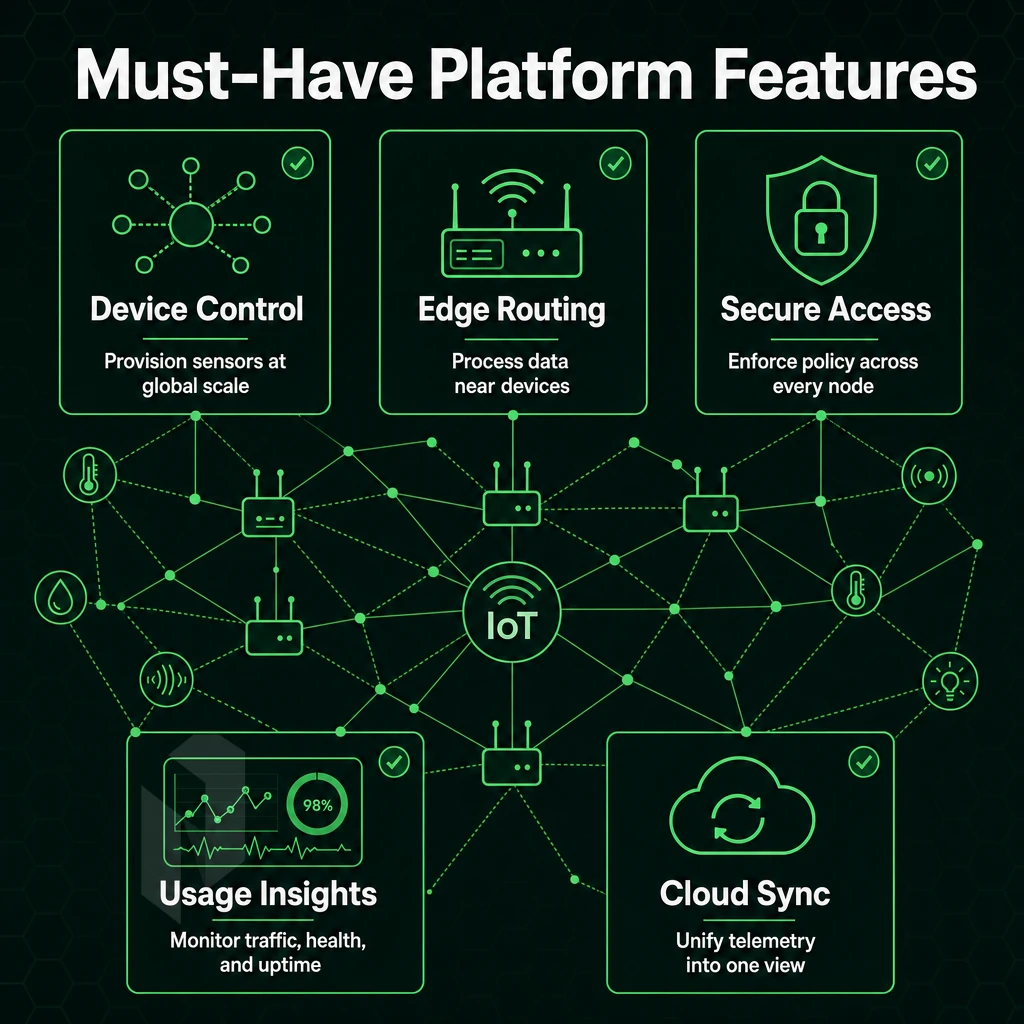
All IoT connectivity platforms are not created equal. Basic platforms can set up SIM cards for your devices. Enterprise-class platforms provide a single layer for managing connectivity, monitoring devices, securing data, and more. Here's what to look for. Enterprise-grade device management platforms integrate seamlessly with connectivity layers to provide unified control over provisioning, firmware updates, and remote diagnostics across your entire fleet.
These platforms enable devices to communicate reliably across diverse network conditions while providing centralized visibility into connection status and performance metrics. An iot platform with comprehensive API access allows developers to build custom integrations that extend device management capabilities beyond standard dashboard interfaces.
Foundation Features of Connectivity Providers and Their Platforms
- Centralized management dashboard. A single pane of glass for every connected device. Operators would otherwise be forced to juggle multiple consoles to avoid missing events of importance.
- Real-time device data and usage monitoring. Live visibility into real-time device data consumption, signal quality and device status. Avoids overages and other anomalies in real-time.
- An integrated SIM with multi-network access, removes the need for manual provisioning and is at the core of global IoT connectivity, across regions and carriers, using a global SIM.
Note: Basic platforms often cap SIM management at a single carrier. That is a hard ceiling for any deployment that crosses borders.
Operational Controls
- Remote monitoring and device control. Remote monitoring enables an engineer to diagnose problems and even reboot a device remotely. Useful for very dispersed fleets across different countries.
- Failover for Cellular Connectivity. A managed IoT connectivity platform must support failover between different networks for a secondary network in case of a failure of the primary carrier with degradation.
- Global cellular connectivity via multi-network roaming. Seamless roaming across carriers, providing the highest level of uptime, and suited for a wide variety of industries such as logistics, energy, and industrial.
Do IoT Devices Have a Future?
There is also a huge potential problem. The only constraint is the quality of the supporting infrastructure. In other words, strong network access, good security and applications will determine which of these deployments actually scale and which fizzle out. Deploying devices in a secure and scalable iot environment requires careful attention to network architecture, authentication protocols, and the ability to handle exponential growth in connected endpoints.
Data Security and Enablement
- Data security / IoT security controls. Here encryption in transit, private APNs and per-SIM firewall rules are non-negotiable. If connectivity security is weak then all devices riding above it will be compromised.
- The Application enablement layer. Here APIs and event triggers allow for your application to act upon connectivity events. Basic platforms only support up to the Network edge.
Netrouting’s IoT-focused infrastructure, with a presence of ten data centers in Europe, North America and Asia, provides the necessary backbone for low-latency and around-the-clock monitoring and support for related features. While this provides insight into the features, including device management capabilities, that one should look for when choosing a connectivity platform, it is also important to see how the various categories of major providers stack up against each other.
Comparing the Best Managed IoT Solutions and Connectivity Services in 2026
Managed IoT connectivity services are not created equal.
| Provider Type | Coverage Model | SIM / eSIM | Device Management Depth | Security Capabilities | Global Deployment Support | Permanent Roaming Handling | Pricing Model Type |
|---|---|---|---|---|---|---|---|
| Cellular-first provider | Single-MNO with roaming agreements | Physical SIM; limited eSIM | Basic APN, data usage controls | Network-layer firewall; VPN optional | Roaming-dependent; coverage gaps in APAC | Restricted; local breakout required | Per-MB or pooled data |
| Multi-carrier platform | Aggregated across 500+ networks | eUICC / multi-IMSI global SIM | Remote SIM provisioning, OTA updates | Private APN, end-to-end encryption | Strong; designed for global IoT connectivity | eUICC profile switching mitigates restrictions | Pooled or per-device subscription |
| Enterprise-grade managed connectivity provider | Owned + partner network with SLA-backed uptime | Full eUICC; GSMA SGP.02 / SGP.22 compliant | Full lifecycle, provisioning to decommission | Zero-trust segmentation, anomaly detection | Dedicated regional breakout; low latency | Local profile activation; no regulatory risk | Flat-rate or committed-use contract |
IoT Platform for Connectivity vs Application Enablement
Connectivity management platforms manage the network layer. They can provision SIMs, enforce policies on cellular networks and monitor the connectivity of devices. They do not manage any application data. Effective connectivity management requires real-time visibility into network performance metrics and the ability to respond quickly to anomalies across distributed device fleets.
Real-time monitoring of data speed across cellular connections helps identify network congestion or throttling issues before they impact device performance. Platforms with granular data usage tracking enable organizations to set thresholds and automate alerts when devices exceed expected consumption patterns. Devices rely on stable cellular connections to transmit data consistently, making network reliability a foundational requirement for any connectivity management solution.
This layer is complementary to the layers above, not a substitute for them.
Buying an IoT platform that contains your application logic does not mean that you have also acquired a suitable connectivity management layer for your applications underneath. This is a common procurement mistake.
Key Differentiators Worth Scrutinising
Permanent roaming restrictions are possibly the biggest risk for global deployments. Already in the EU as well as in some countries in APAC local SIMs have to be registered after a certain period of roaming. Switching of eUICC profiles is the usual fix.
Deploying a global sim strategy requires careful consideration of regional regulatory frameworks and the technical capabilities to switch connectivity profiles without physical device access. Modern integrated sim solutions with eUICC technology enable remote profile switching, eliminating the need for physical SIM replacement when regulatory compliance demands local network registration.
For retrofit projects, consider both device compatibility, smart meters, industrial sensors, and legacy M2M hardware, and how the chosen SIM solution will address permanent roaming restrictions.
Where Netrouting Fits
Communications service providers need more than SIM management when deploying IoT at scale.
The infrastructure of the enterprise IoT services is based on this layer underneath the SIMs. Enterprise platforms on top of this set the benchmark for what this infrastructure has to support.
How Vodafone IoT and Similar Enterprise Platforms Handle Global IoT Deployments
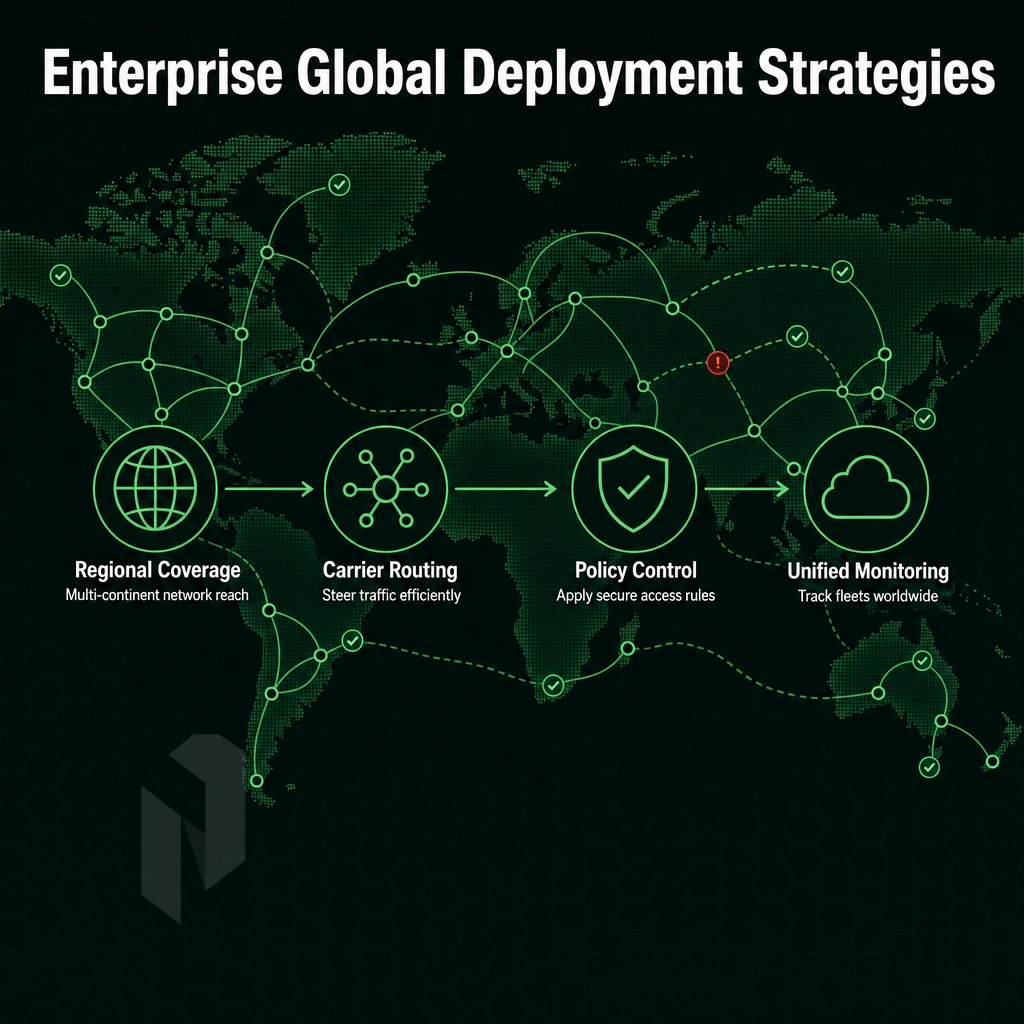
A high-end IoT connectivity platform can scale globally. Vodafone IoT is one of the largest IoT connectivity platforms and often is the example of best practice. The platform provides multi network access to hundreds of carriers and supports SIMs as well as eSIMs for easy central provisioning to cloud-based operation systems.
How Vodafone Approaches Global IoT Connectivity
International deployments of large numbers of units create a core problem: when devices connect via cellular technologies abroad, they are permanently roaming on foreign networks, thus incurring carrier restrictions. Large platforms supporting international deployments of connected devices have found ways to address permanent roaming restrictions by issuing locally-anchored SIM profiles which in turn change the home network registration for each region. Thus effectively removing the 90-day roaming cutoff that would otherwise also render all standard SIMs useless.
Single SIM SKU supports multiple cellular technologies like 2G to 5G, LTE-M, and NB-IoT for supporting multiple device classes without hardware change.
How Device Management Platforms Handle IoT Device Lifecycle and SIM Management
Enterprise iot connectivity platforms handle the full customer lifecycle through a single portal.
- Activate, suspend, or switch SIM profiles over-the-air with eSIM remote management.
- Set data caps and alerts per device or group.
- Audit usage and trigger automated policy responses.
By removing the manual provisioning of large amounts of sensors at scale, managed connectivity from iot providers means a fleet of 50,000 sensors, spread over 10 countries, can be handled in exactly the same way as a 10 device pilot. The same dashboard, API calls and integration with application enablement platforms are used.
Where Complexity Becomes a Constraint
Cost and lock-in are the main friction points.
Enterprises with latency-sensitive or high-throughput IoT workloads will often combine the best carrier connectivity with dedicated infrastructure. To support these workloads, our bare metal servers and private network infrastructure in Amsterdam, Frankfurt and Miami can act as a low-latency backend. This same latency and reliability requirements also apply to industrial IoT workloads which typically include complex hardware.
Industrial IoT Devices and Connected Systems: Choosing the Right Connectivity Model
All connected devices are not created equal. For example, Industrial IoT (IIoT) device management use cases, smart meters, remote monitoring sensors and fleet trackers, require deterministic latency and high uptime in geographically remote locations. They also require support for existing connected devices, which can be of legacy design and even be from past generations.
How IoT Devices Differ From Consumer Hardware
While occasional dropouts may be tolerated in consumer gadgets, such behavior is unacceptable in industrial equipment. Without the right iot connectivity platform, the smart meter that fails to transmit IoT data during a billing cycle or the remote asset that loses communication mid-shift will create significant operational risks. However, the risk is further exacerbated by the need for the equipment to be compatible across very heterogeneous fleets of remote devices.
IoT Connectivity Platform Models Compared
| Model | Best For | Latency | Coverage |
|---|---|---|---|
| Cellular IoT (LTE-M / NB-IoT) | Mobile assets, remote sensors | 50-100 ms | Wide area, including rural |
| Fixed IP Transit | High-throughput IoT applications, edge gateways | <10 ms | Fixed-site only |
| Hybrid (cellular + fixed) | Mixed fleets, failover-critical sites | Varies by path | Broadest reach |
Reducing Operational Complexity
An ideal IoT connectivity platform handles how devices connect to the Internet, how data generated by the IoT travels to applications, and surfaces faults in the system all through a single management platform. It greatly reduces complexity of operation and no need to set up individual contracts at individual sites or with individual carriers.
For high-density fixed locations requiring sub-10 ms latency, Fixed IP transit is the most suitable solution. For mobile or geographically dispersed IoT projects, Cellular connectivity is the better option. Hybrid models can cover both scenarios. Netrouting's global backbone, comprising ten locations in Europe, North America and Asia, supports all three models across device management platforms with 99.9% uptime and always-on DDoS protection as standard. This backbone is the basis for reliable IoT connectivity.
Why Choose Netrouting for IoT Connectivity Infrastructure
Reliable IoT connectivity depends on the network layer beneath it. IoT connectivity providers, platform operators, and enterprises running their own IoT deployments need carrier-neutral infrastructure with predictable throughput, low latency, and built-in resilience. That's where Netrouting fits.
- 2.4 Tbps+ backbone on AS6206, purpose-built for high-volume IoT connectivity platform traffic, with unmetered 10 Gbps on dedicated servers and port utilization consistently below 40%.
- Always-on L3/L4 DDoS protection, included on every service. No add-on required for IoT security at the network layer.
- BYOIP and full BGP support, essential for IoT providers managing their own address space across worldwide IoT deployments.
- Carrier-neutral colocation across Amsterdam, Frankfurt, Miami, Singapore, Hong Kong, New York, Stockholm, and The Hague, global coverage for international deployments without vendor lock-in.
- ISO 27001 and SOC 2 certified, meets data security compliance requirements for enterprise deployments and industrial IoT environments.
We operate the connectivity platform infrastructure, IP transit, managed connectivity, and carrier-neutral colocation, that connected devices and IoT solutions depend on at scale. Explore our network or contact sales to discuss your requirements.
Choosing the right connected device connectivity service comes down to three factors: worldwide reach, network reliability, and platform flexibility. A provider that combines robust SIM management, real-time diagnostics, carrier-grade uptime, and seamless integration with cloud platforms eliminates the operational overhead that stalls IoT deployments at scale. Security and scalability matter just as much, your connectivity layer needs to grow with your device fleet without introducing new attack surfaces.
The infrastructure underneath your IoT platform is equally critical. Low-latency, high-availability connectivity depends on the servers and network fabric your data pipelines run on. Netrouting's connectivity and device management platform, built on bare metal servers and a 2.4 Tbps+ backbone spanning Stockholm, Amsterdam, Frankfurt, Miami, New York, Hong Kong, and Singapore, gives connected devices the dedicated compute and global reach they need. Always-on DDoS protection is included on every service, with 24/7 NOC monitoring and a 1-hour support response guarantee.
Contact the Netrouting team to discuss the right infrastructure layer for your IoT deployment.