A bandwidth bottleneck can render the best api integration performance useless at the worst time: launch day, a live video stream or an unexpected spike in traffic that you weren't prepared for.
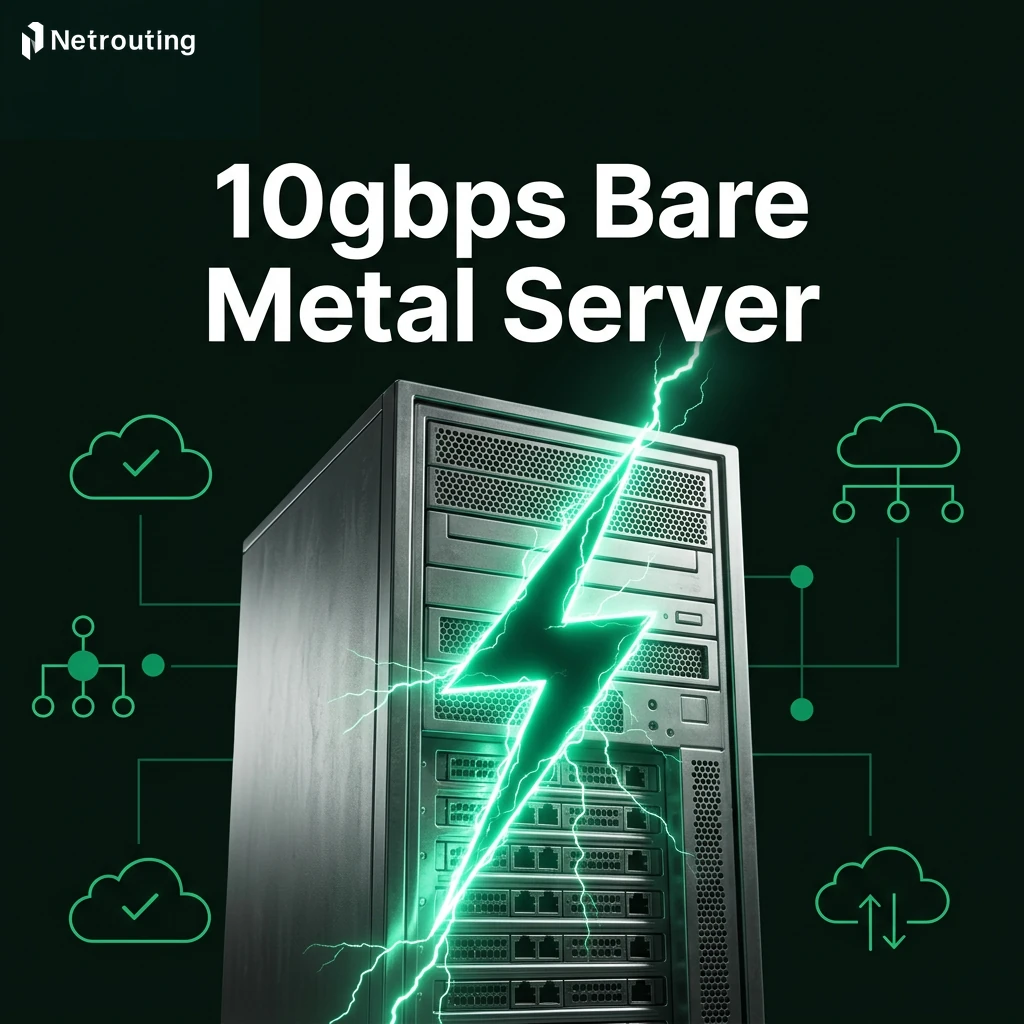
Our 10Gbps bare metal servers give your application a dedicated 10-gigabit pipe and full physical host power, with no virtualization overhead.
While the number of ports on a connection and their bandwidth (e.g. 10Gbps) are factors in selecting a server, the underlying infrastructure and how it performs under load are much more important. Also, the time it takes to provision new servers and where in the world your users are located in relation to your servers are very important.
Blog contents
Understanding where users connect from helps optimize routing paths and reduce latency across geographic regions. Selecting a server means balancing specifications against real-world performance characteristics that emerge only when infrastructure operates at scale.
This guide will explore what truly makes a 10Gbps dedicated server and help you understand which workloads benefit from the upgrade. We will also go over what to look for when selecting a provider for your servers: the network architecture, peering density, hardware generations and the Service Level Agreements (SLAs) they offer. Evaluating a provider means examining not only advertised specifications but also how their infrastructure performs when traffic patterns shift unexpectedly.
What Is a 10Gbps Bare Metal Server for Big Data?
Bare metal servers are dedicated physical servers, 100% assigned to a single user. No hypervisor is intervening between the user’s applications and physical servers’ hardware. No sharing of resources, no noisy neighbors, just pure computing power assigned to you. This architecture ensures that fully dedicated hardware remains isolated from the performance variability introduced by multi-tenant environments. This single tenant architecture eliminates the performance unpredictability that arises when multiple workloads compete for the same underlying hardware resources.

What a 10Gbps Bare Metal Server Actually Delivers
The 10Gbps figure refers to the network port speed on your server.
Bare metal infrastructure is provisioned without any virtualization layer, so all CPU cycles, RAM and storage are 100% dedicated physical resources, not partitions or slices that have to compete with other users for resources. What you can measure and guarantee in terms of performance is what you get.
How Bare Metal Hosting Differs from Cloud VMs
Bare metal avoids the overhead of hypervisors, the variability of shared CPU scheduling and I/O. Allowing consistent and high performance for services such as video streaming, high volume data processing services and real time game servers. This architecture makes bare metal the preferred choice when high performance must remain predictable under sustained load.
- No virtualization tax: full CPU clock cycles available to your workload.
- No I/O contention: dedicated NVMe or SAS lanes, not shared storage fabric.
- No noisy neighbors: RAM and cache are yours alone.
Bare Metal Direct Access at Netrouting
We offer bare metal servers in 10 locations: Amsterdam, Frankfurt, San Jose, CA, USA, Miami, FL, USA, New York, NY, USA, Hong Kong, Singapore and 3 locations in Europe. All servers are delivered with unlimited 10Gbps network traffic.
Our bare metal hosting solutions are offered on Dell and Supermicro hardware with Intel Xeon and AMD EPYC CPU’s. The biggest difference with virtual servers is that you have full control over the hardware and the complete server stack. This level of control enables direct hardware configuration and automation of deployment workflows tailored to your specific requirements.
Full control means you can manage the entire infrastructure stack, from firmware updates to operating system configurations, without relying on abstraction layers. This control extends to infrastructure management, allowing operators to configure monitoring, security policies, and resource allocation without vendor-imposed constraints.
Why 10Gbps Bandwidth Matters for Intensive Workloads
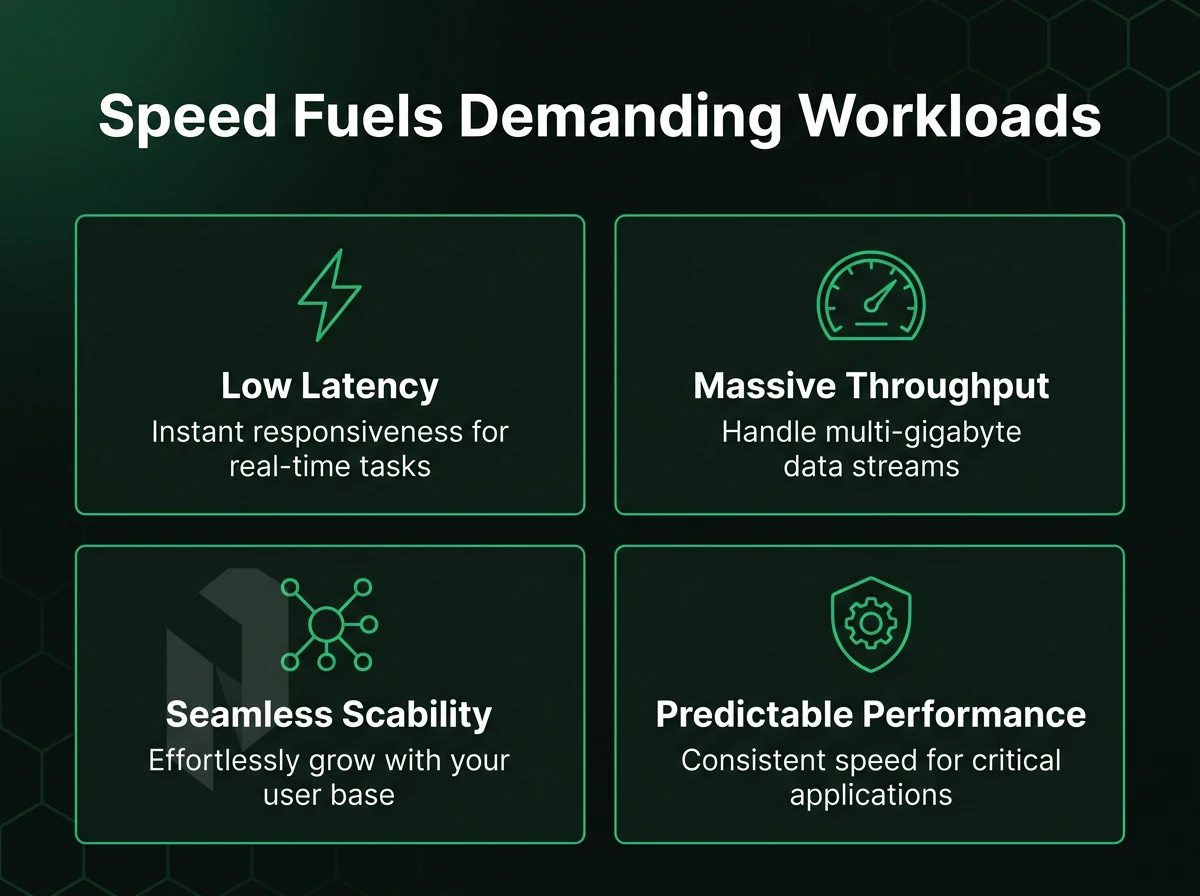
The speed of networks has often been an unknown constraint for very demanding services. For a 1 Gbps link this would typically limit to around 125 MB/s, and with the server's CPU overhead factored in, that's fine for occasional usage but not for things like AI training, live video streams or database replication. 10 Gbps removes this limit entirely.
Workloads That Demand Dedicated Resources
Workloads immediately expose the gap between architectures for specific use cases.
- Video streaming: High-definition multi-stream delivery saturates 1 Gbps fast. Unmetered 10 Gbps sustains concurrent streams without buffering or quality drops.
- AI workloads and big data pipelines: Shuffling training datasets and feeding object storage requires sustained throughput. Throttled bandwidth stalls GPU utilization and extends job times.
- Database replication: Replica lag spikes under a constrained link. Full bandwidth keeps primary and replica in tight sync.
- Online gaming: Packet delivery relies on reliable infrastructure. Bandwidth headroom prevents congestion-driven jitter under player-count spikes.
Consistent Performance vs. Burstable Cloud Bandwidth
Cloud instances advertise their burst speeds but later throttle them when running at sustained loads for too long. In contrast, dedicated servers on flat (unmetered) ports deliver the same amount of bandwidth at 3 AM as at peak hours. For SLA-bound pipelines, this is an important differentiator.
Note: Burstable bandwidth looks fast in benchmarks but degrades under real, sustained workloads, often without warning.
Scaling With Bare Metal Dedicated Hardware Servers
Our dedicated servers come with unmetered 10 Gbps bandwidth as standard. High-throughput servers like those used for big data ingest and multi-site replication can be scaled up to 40 Gbps. Fast server provisioning and instant full root access and full bandwidth, within minutes, not days, helps to explain why bare metal servers differ fundamentally from cloud servers. This rapid deployment capability supports modern infrastructure patterns where automation orchestrates server lifecycle management at scale.
Choose how much of the machine you need.
Pick the starting point that fits the workload: the whole server, a virtual one, or room for your own hardware.
Take the whole machine.
Choose bare metal when the workload needs a single-tenant server with full IPMI access and control over the operating system and stack.
Start the conversation with
- Workload
- CPU, memory and storage
- Stack
- Operating system
- Location
- Where your users are
Start with a VM. Scale it when needed.
Use cloud compute for workloads that do not need a full machine. Compare vCPU, memory and storage per plan.
Start the conversation with
- Compute
- vCPU and memory
- Storage
- Disk size
- Location
- Preferred region
Bring the servers. Choose the location.
Compare colocation for the equipment you already own. Start with footprint, power and the markets you need to reach.
Start the conversation with
- Equipment
- Rack footprint
- Power
- Expected draw
- Network
- Port and traffic needs
Bare Metal vs. Cloud: Performance, Isolation, and TCO
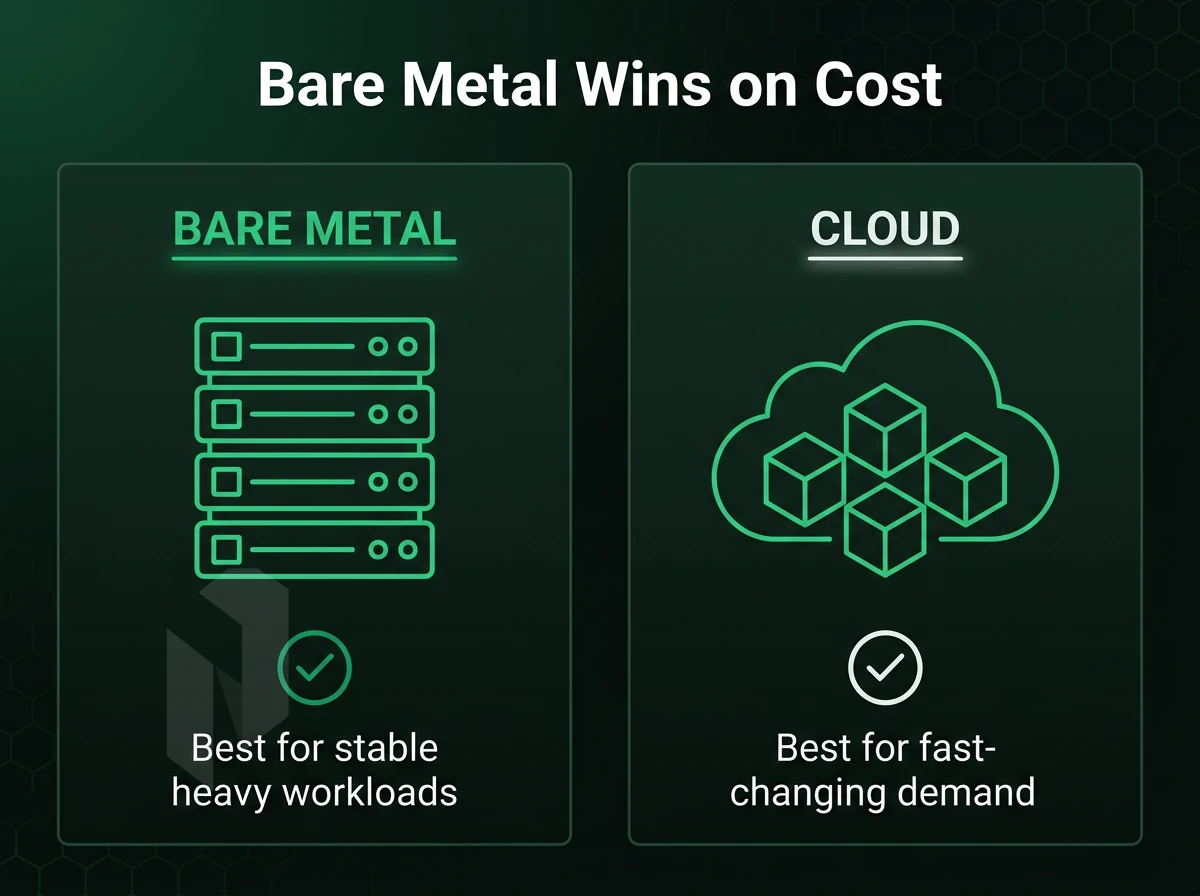
Deciding between bare metal servers and cloud VMs as a deployment option is more of a TCO vs. performance decision and has real implications to how you run your engineering infrastructure. The underlying architecture of each option can impact everything from the natural variability in latency to your overall cost of ownership over time.
Bare Metal Servers: Dedicated Physical Infrastructure and Single-Tenant Isolation
Bare metal servers deliver dedicated physical machines with workloads running as single tenants with no Hypervisor and no shared resources. Unlike multi-tenant virtualization environments, bare metal servers are not affected by noisy-neighbor-related CPU contention and memory bandwidth saturation. Bare metal dedicated servers eliminate the performance variability that comes from resource contention in shared environments. This isolation also simplifies monitoring, as performance metrics reflect only your workload without interference from neighboring tenants.
This architecture allows operators to manage performance baselines with confidence, knowing that resource allocation remains stable and predictable throughout the billing cycle. This single tenant architecture ensures that performance remains consistent because no other workload can compete for the same physical resources. This single tenant architecture ensures that performance remains consistent because no other workload can compete for the same physical resources, simplifying capacity planning and resource management.
Physical isolation means that your I/O, CPU and network capacity are not contested by other workloads. For sustained, high-throughput workloads such as databases, rendering and real-time analytics, this translates into maximum performance and consistent latency. When applications require consistent throughput without degradation, high performance isolation becomes the foundation for predictable service delivery.
Virtualization and Shared Storage Resources in Cloud Services
Cloud VMs run on shared physical servers with other tenants. Even though a cloud provider uses a hypervisor to give each VM dedicated resources, the underlying physical hardware (memory buses, network interfaces, storage controllers) is shared with other VMs. Burst performance is great, but sustained performance suffers under load. Selecting the right hosting provider requires understanding how resource sharing affects application performance under sustained load conditions.
This architectural ceiling is well-documented. Inherent to multi-tenant virtualization are CPU steal time, network jitter, and storage latency spikes.
TCO: Dedicated Servers vs. Hyperscaler Egress
Bare metal servers are typically charged monthly for fixed amounts of resources. This pricing model simplifies budgeting because the server cost remains constant regardless of traffic volume or usage patterns.

Netrouting bare metal servers include unmetered 10 Gbps network connections at no extra charge.
Common Use Cases for a 10Gbps Bare Metal Server
10Gbps bare metal servers can handle very high levels of load that would crush shared infrastructure running on virtual servers. CPU, storage throughputs, network throughputs.
High-Throughput Streaming and Gaming With Low Latency
Streaming high definition video requires constant, high volume throughput that must not encounter any delays. Using dedicated hardware for this type of application eliminates the noisy neighbor problem, by not competing with other bandwidth hogs for available bandwidth, and thus delivers consistent bitrates even under peak loads of concurrent users.
Online gaming demands low latency, requiring exclusive CPU access on the server, it cannot run under a hypervisor or share a scheduling queue.
AI/ML Training and Inference With Full Control
The most intensive workloads today are AI workloads, and they benefit most from a dedicated GPU server.
VPN Providers, Databases, and Game Hosting
When selecting a VPN provider you need bandwidth and IP transit. This should be un-metered 10Gbps with DDoS protection as standard.
Large databases and big data pipelines benefit from dedicated NVMe storage and predictable I/O. No other tenants will be competing for I/O on disk.
Start with a simple Minecraft game server or other similar services. Even a bare metal server can host dozens of isolated server instances with guaranteed RAM and CPU allocation.
Why Choose Netrouting for Your 10Gbps Bare Metal Server
Netrouting delivers bare metal servers built for workloads where shared resources and virtualization overhead aren't acceptable.
- Rapid provisioning: Bare metal infrastructure is live in under 60 minutes. Additional servers scale just as fast.
- Unmetered 10Gbps network speed: Included at no extra cost on every dedicated bare metal server, with 40Gbps available for high-throughput workloads.
- Always-on DDoS protection: L3/L4 mitigation is built into every bare metal offering, no add-on required.
- Latest-gen dedicated hardware: Dell and Supermicro platforms running Intel Xeon and AMD EPYC, with dedicated GPU options for AI workloads and AI training pipelines.
- Global reach, 10 locations: Amsterdam, Frankfurt, The Hague, Rotterdam, Stockholm, Bucharest, Miami, New York, Hong Kong, and Singapore, low latency wherever your users are.
- Certified reliable infrastructure: ISO 9001, ISO 27001, and SOC 2 certified, backed by a 24/7 NOC with a one-hour ticket guarantee.
Explore our bare metal servers or contact sales to discuss the right configuration for your workloads.
Frequently Asked Questions About Your Operating System
How Do Dedicated Servers With NVMe Storage and 10Gbps Bare Metal Differ From a VPS?
A 10Gbps physical server is a single-tenant physical machine connected to the network at 10 gigabits per second. You get the full CPU, RAM, and storage, no hypervisor overhead, no noisy neighbours. A VPS shares physical resources across multiple virtual machines, which introduces contention at the CPU, memory, and network layers. Bare metal eliminates that contention entirely, making it the right choice for latency-sensitive or resource-intensive workloads.
Does direct access to 10Gbps Unmetered Bandwidth mean truly unlimited on dedicated servers?
Unmetered means you are not billed per gigabyte transferred, there is no data cap that triggers overage charges. At Netrouting, dedicated servers ship with unmetered 10Gbps as standard, with options up to 40Gbps for high-throughput workloads. Sustained usage at or near line rate is fully supported; the network is engineered to keep port utilisation consistently below 40%.
Can I install any operating system on a bare metal server?
Yes. Bare metal gives you full hardware access, so you can install any OS your workload requires, Linux distributions, FreeBSD, Windows Server, or a custom image.
What Workloads Benefit Most From 10Gbps Dedicated Servers?
High-definition video streaming, online gaming, VPN infrastructure, and large-scale web hosting all extract immediate value from 10Gbps connectivity. AI and ML inference workloads benefit from the combination of high memory bandwidth and uncontested CPU or GPU access. Any application that moves large data sets, backups, CDN origin pulls, financial tick data, also sees a direct performance gain. The common thread is sustained throughput or strict latency requirements that shared environments cannot reliably meet.
How quickly can a bare metal server be provisioned?
Netrouting provisions bare metal servers in under 60 minutes. That covers hardware assignment, OS deployment, and network configuration. For custom builds, specific drive counts, high-memory configs, or GPU nodes, whole machine lead times vary, so contact sales to confirm availability before you commit.
Does a 10Gbps bare metal server include DDoS protection?
Yes. Every Netrouting service includes always-on Layer 3 and Layer 4 DDoS mitigation at no additional charge. It detects and blocks volumetric and network-layer attacks automatically, with no configuration required on your end. For high-risk or mission-critical workloads where teams need full root control over their defenses, advanced protection adds application-layer (L7) mitigation, granular custom policies, and higher scrubbing capacity on top of the included baseline. The network carries more than 1Tbps of mitigation capacity across the global infrastructure.
How does bare metal TCO compare to cloud compute for sustained workloads?
For workloads that run continuously, bare metal consistently delivers lower total cost of ownership than major cloud platforms. Cloud compute bills by the hour and adds charges for egress, IOPS, and premium support tiers, costs that compound quickly at scale. Bare metal gives you a predictable monthly cost with no egress surprises and no resource contention. The crossover point typically comes earlier than most teams expect: sustained compute-heavy workloads almost always favour dedicated hardware on a cost-per-core and cost-per-GB basis.
A 10G bare metal machine provides the power of dedicated hardware, guaranteed bandwidth and root access all day long, every day. Unlike shared and virtualized servers, this is what a scaling, bandwidth-hungry application such as streaming, online gaming, backup/database replicate, VPN provider needs to scale successfully, and not collapse under load.
Similarly, the TCO case for dedicated hardware is straightforward: No resource contention, and no unexpected charges for additional resources on popular cloud platforms. You pay for a server, you get a server.
Netrouting’s bare metal servers are provided with unmetered 10Gbps connectivity in 10 locations across Europe, North America and Asia. The servers are connected to a 2.4Tbps+ network on AS6206 and are managed by a 24/7 NOC with a one-hour ticket guarantee. Please contact sales to have a server configuration made for your specific workload.
Put the workload on bare metal.
Share the workload, the location and the network needs. We help you match a configuration.