Bottlenecks in performance don’t announce themselves.
Deciding between virtualized cloud servers and bare metal servers is not entirely a technical decision. It also includes aspects of capacity planning, compliance, total cost of ownership and speed of deployment and de-provisioning of servers. Organizations must also evaluate whether their workloads require dedicated resources or can tolerate the resource contention inherent in multi-tenant environments.
A detailed explainer of bare metal cloud computing , including areas in which it outperforms virtualized cloud offerings and specific use cases (high frequency database work, GPU inference pipelines, etc.) that see substantial performance gains.
Blog contents
What Are Bare Metal Cloud Computing Instances?
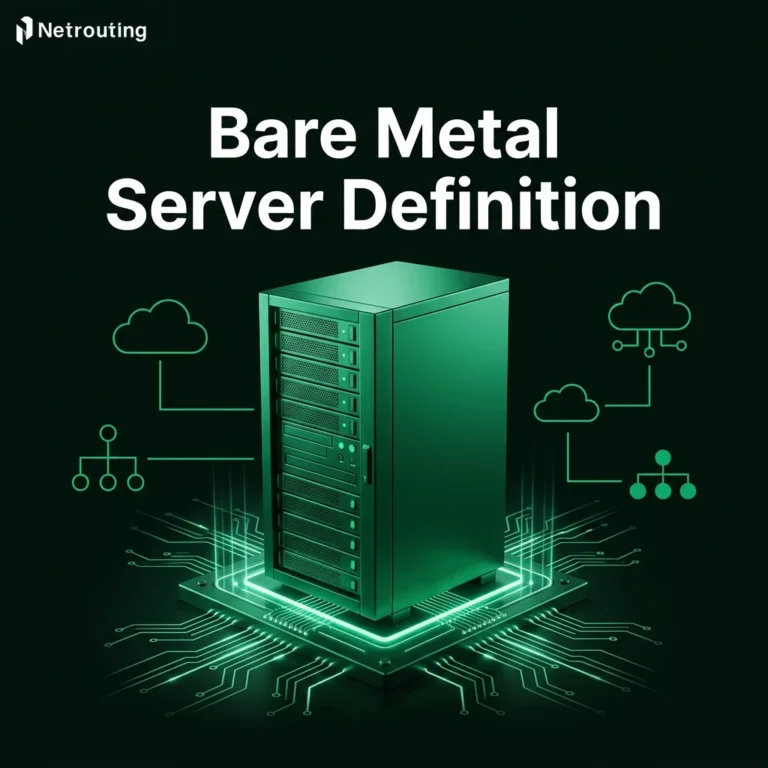
physical server cloud computing lets you provision and instantly begin using dedicated physical servers in the cloud. Meanwhile, Providing direct access to the server, meaning no shared resources, no hypervisor overhead and no interference from neighboring workloads competing for CPU or RAM.

How Bare Metal Cloud Computing Providers Deliver Power
Traditional cloud platforms run applications inside virtual machines on top of physical servers sharing resources. Bare metal hosting removes a layer of abstraction and lets you use 100% of all CPU cycles, memory slots and I/O channels on a physical server. This architectural difference distinguishes bare metal hosting from traditional cloud services that rely on virtualization to share physical infrastructure among multiple tenants.
We don’t have a virtualization layer between your application and the hardware. So, there’s no hypervisor tax, no chance of noisy neighbors and predictable performance under sustained load. This architecture ensures your workloads interact directly with the server hardware, eliminating the performance penalties that virtualization introduces between applications and physical components.
Bare Metal Cloud Servers vs. Multi-Tenant Environments
Multi-tenant environments host dozens of workloads on a single server. Bare metal cloud servers are completely opposite to that model: one tenant + one physical server. Complete resource isolation is the design of bare metal cloud servers. This single tenant server model prevents resource contention by ensuring no other workloads can access or compete for the underlying hardware components.
Shared infrastructure has the greatest impact on latency-sensitive workloads, such as high-frequency databases, real-time games and machine learning AI inference, as variance is unpredictable.
Bare Metal Cloud Servers: Cloud Speed, Physical Control
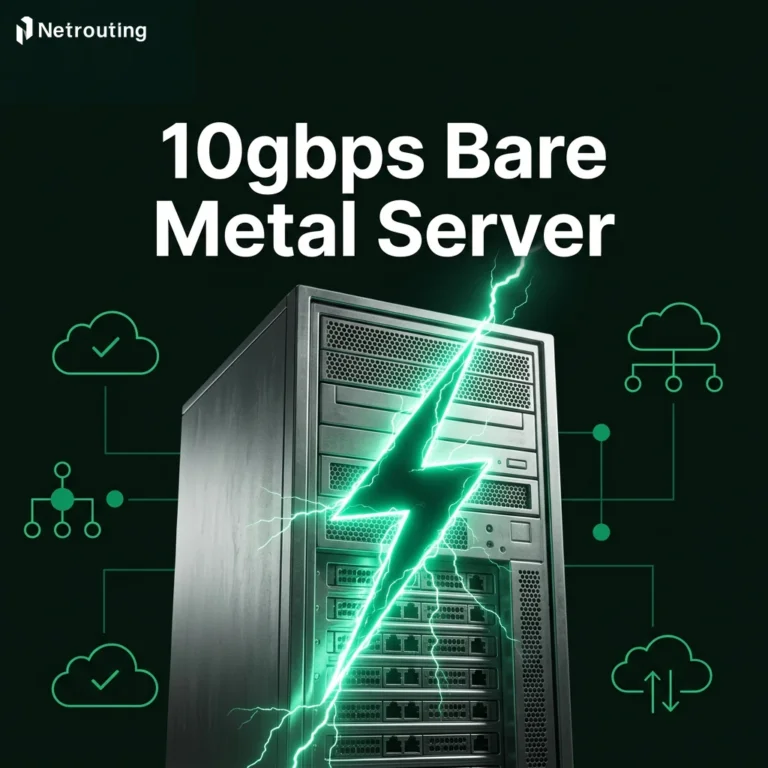
Dedicated bare metal servers combine the speed of provisioning of cloud servers with the raw power of dedicated hardware. We deploy our bare metal servers within 60 minutes and they come with unmetered 10 Gbps connectivity, 100% dedicated resources and root access. This model is fast to provision and in the following sections we will explain in more detail how it actually works.
How Bare Metal Cloud Providers Host Your Workloads
Dedicated bare metal hosting combines the power of physical dedicated servers with cloud provisioning flexibility.
Bare Metal Cloud Hosting: How Provisioning Works
With our automated tool, you select your desired server configuration and order it.
Bare Metal Cloud vs. Virtual Instances vs. Colocation
| Dimension | Bare Metal | Virtual Instance | Colocation |
|---|---|---|---|
| Tenancy | Single-tenant | Multi-tenant | Single-tenant |
| Provisioning | Automated, rapid | Automated, instant | Manual, days-weeks |
| Hardware control | Full direct access | Abstracted | Full, self-managed |
| Security posture | Enhanced security, no noisy neighbours | Shared kernel risk | Physical isolation only |
Choosing the Right Tier
For software that requires constant CPU power and I/O (e.g. databases, game servers, AI inference), renting a dedicated physical server (bare metal) is the best option, as it does not incur the hypervisor tax. This direct hardware access allows your software stack to operate without the performance penalties introduced by virtualization layers.
Colocation makes sense for companies that already own servers and need a carrier neutral data center. For most performance-critical applications, bare metal is the way to go. When evaluating infrastructure options, bare metal cloud offers the performance characteristics of owned hardware without the capital expenditure or long-term commitment of colocation. Organizations evaluating server infrastructure options must weigh the trade-offs between ownership models and performance requirements when selecting their deployment strategy.
Bare Metal vs. Virtual Machines: Key Differences
Both bare metal server provisioning and virtual machines solve the problem of deploying servers on the Internet, but they solve it in very different ways.
Architecture and Physical Hardware Isolation
- The Hypervisor Layer, the overhead of running virtual servers on your shared servers to enable multiple tenants to use the same physical servers. This layer consumes CPU cycles and memory, leaving less for your actual application.
- Also assess the risk of noisy neighbors. A virtualized environment can experience resource contentions. A tenant could peak the CPU or I/O of resources for a short period of time and negatively affect another tenant on the same host. This can affect performance in a variable way. Bare metal resources do not have these types of risks.
Performance and Control in High Performance Computing
- Dedicated resources, evaluate bare metal. With bare metal dedicated hardware (i.e. all cores and all RAM is dedicated to your use) is allocated to your use, no sharing or contention with other users.
- Review access to hardware resources. On bare metal you can modify BIOS settings, kernel parameters and storage configuration. In a VM all of this is abstracted away from you.
Note: Dedicated resources matter most for latency-sensitive or compliance-driven workloads. If your application cannot tolerate variable performance, a VM is the wrong choice.
Comparison at a Glance
| Dimension | Bare Metal | Virtual Machine |
|---|---|---|
| Isolation | Full, single tenant | Shared, multiple tenants |
| Performance | Consistent, no overhead | Variable, hypervisor tax |
| Provisioning | Minutes (Netrouting: under 60 min) | Seconds to minutes |
| Control | Full hardware access | Hypervisor-limited |
| Use case fit | HPC, databases, AI/ML, gaming | Dev/test, burstable web workloads |
The differences in the architecture for these services translate into a number of operational advantages, which are outlined in the following section.
Choose how much of the machine you need.
Pick the starting point that fits the workload: the whole server, a virtual one, or room for your own hardware.
Take the whole machine.
Choose bare metal when the workload needs a single-tenant server with full IPMI access and control over the operating system and stack.
Start the conversation with
- Workload
- CPU, memory and storage
- Stack
- Operating system
- Location
- Where your users are
Start with a VM. Scale it when needed.
Use cloud compute for workloads that do not need a full machine. Compare vCPU, memory and storage per plan.
Start the conversation with
- Compute
- vCPU and memory
- Storage
- Disk size
- Location
- Preferred region
Bring the servers. Choose the location.
Compare colocation for the equipment you already own. Start with footprint, power and the markets you need to reach.
Start the conversation with
- Equipment
- Rack footprint
- Power
- Expected draw
- Network
- Port and traffic needs
Primary Benefits of Bare Metal Dedicated Servers in the Cloud
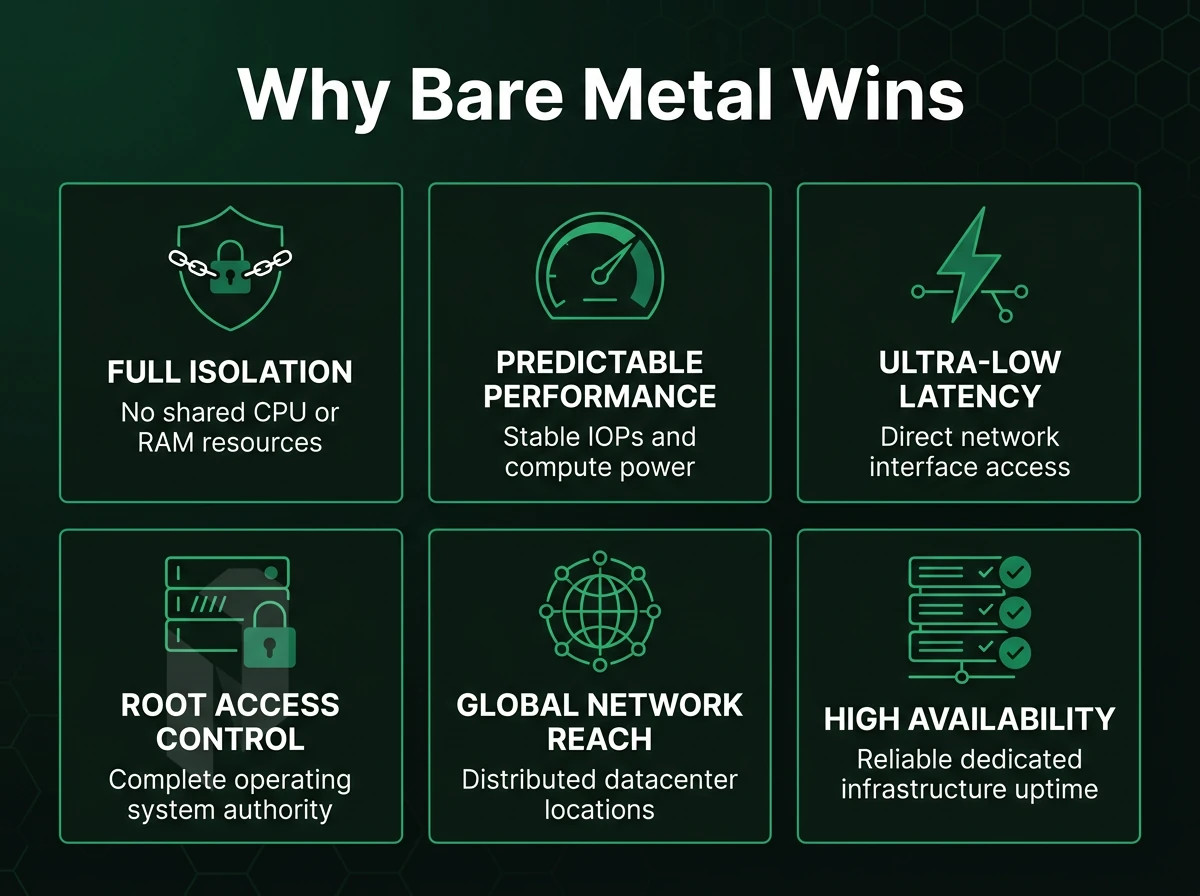
Our bare metal cloud servers are cloud-hosted servers that are 100% dedicated to your use. They are not shared with other users and therefore you get to utilize 100% of the servers CPU, RAM and storage. This single-tenant architecture is at the heart of all the benefits listed below. This architecture grants complete control over the server environment, allowing you to configure hardware settings and optimize system parameters without restrictions imposed by shared infrastructure. This single-tenant model ensures that all hardware resources remain exclusively allocated to your workloads, preventing any contention or performance degradation.
This exclusive allocation of memory resources and processing capacity eliminates the performance variability that occurs when multiple tenants compete for the same underlying hardware. The architecture also provides complete control over storage solutions, allowing you to configure disk arrays and optimize I/O patterns specific to your application requirements. This architecture gives user complete control over system configurations, enabling customization of hardware parameters to match specific workload requirements.
Performance and Latency on Bare Metal Servers in the Cloud
As you move to shared virtual environments, you encounter the noise from neighbors. On bare metal, unlike a private cloud setup, you have no overhead of the hypervisor, and thus workloads run closer to real hardware speed, especially important for compute intensive workloads like databases, real-time analytics and high-frequency transaction processing. Real-time analytics and high-frequency transaction processing often involve big data workloads that benefit from the consistent performance characteristics of single-tenant architecture.
These performance advantages become particularly evident in scenarios where millisecond-level latency variations can impact business outcomes. The architecture proves especially valuable when processing large volumes of data where consistent throughput directly affects operational efficiency. The elimination of virtualization overhead proves particularly beneficial for scientific simulations that demand sustained computational throughput across extended processing periods.
Minimal latency: With no virtualization layers between your application and the physical NIC, network and storage I/O is deterministic. Workloads running on bare metal cloud servers that require consistent sub-millisecond response times will find this architecture to be optimal. This direct hardware access ensures that network performance remains stable and predictable even during peak traffic periods.
Security and Isolation on Single-Tenant Cloud Servers
A single-tenant server is dedicated to a customer and their sensitive information. Single-tenant servers are delivered as bare metal servers and meet the isolation requirements of highly regulated industries like financial services, healthcare and government, without the need for additional layers of hardening.
The bare metal market is growing because more and more companies need to prove physical separation of data in order to comply with mandates. Hosting sensitive data in a dedicated data center environment and proving it to the auditors is much harder when it is shared in a multi-tenant cloud environment.

Control, Flexibility, and Hybrid Infrastructure
You own the software stack. Install the OS, kernel modules, and even a Hypervisor / Private Cloud layer of your choice without restriction. This means no lock-in with a vendor from day one.
Netrouting’s free private network enables you to connect bare metal and cloud servers up to 40 Gbps for hybrid hosting .
Common Use Cases for Bare Metal Cloud Workloads
Unlike virtual instances, which suffer from noisy-neighbor behavior and hypervisor overhead, dedicated physical servers in a bare metal cloud environment deliver consistent, reliable performance.
High Performance Computing and Performance-Intensive Workloads
Workloads like scientific simulations, fluid dynamics and genomics require the highest levels of CPU performance and memory access in terms of low latency.
Inference and training large models use the same logic: sustained GPU throughput. Our GPU servers (with options for NVIDIA A10, A40, A100 GPUs) have the processing power to handle large models without sharing resources with other users.
Big Data and Mission-Critical Applications
Big data pipelines are notorious for hogging shared network resources as they move structured and unstructured data around.
Mission critical applications like financial transaction systems, healthcare systems and real-time analytics applications require guaranteed uptime.
What Cloud Providers Often Overlook: Gaming, Streaming, and VPN
Online gaming requires low-latency, high-CPU dedicated servers.
Our network spans 10 locations across Europe, North America, and Asia, built to serve high-demand applications.
Why Choose Netrouting for Bare Metal Cloud Infrastructure
Netrouting delivers bare metal dedicated servers and cloud compute across 10 data center locations, Amsterdam, Frankfurt, Miami, Singapore, Hong Kong, New York, The Hague, Stockholm, Rotterdam, and Bucharest. Every bare metal server runs on dedicated hardware with no virtualization layer, no noisy neighbors, and no shared resources.
- Fast provisioning. Bare metal servers go live in under 60 minutes.
- High-performance connectivity. Unmetered 10 Gbps standard, up to 40 Gbps available, on our own AS6206 backbone with 2.4 Tbps+ capacity.
- Built-in DDoS protection. Always-on L3/L4 mitigation is included on every service, no add-on required.
- Enterprise server hardware. Dell and Supermicro on Intel Xeon and AMD EPYC platforms, including GPU servers for AI/ML workloads.
- Certified and compliant. ISO 9001, ISO 27001, and SOC 2 across our infrastructure.
- 24/7 NOC support. One-hour ticket guarantee and a free private network between your resources.
Contact our sales team to discuss your bare metal cloud workloads and find the right configuration.
Frequently Asked Questions
What AWS Bare Metal Options Give Full Operating System Control Beyond Virtual Servers?
Yes. AWS offers bare metal instances, such as the.metal instance types, that give you native access to the underlying host hardware without a hypervisor layer. They are designed for workloads that require hardware feature access, licensing tied to physical cores, or non-virtualized environments.
However, they still run inside AWS's broader infrastructure, so you share the facility and accept the platform's pricing model and egress costs. For teams that need true dedicated hardware with predictable billing and no shared-tenancy concerns, purpose-built bare metal providers are a stronger fit.
Which Cloud Providers Offer Bare Metal With Full operating system Control Over Virtual Servers?
Several categories of provider offer bare metal cloud offers: major cloud platforms with metal instance types, specialist IaaS providers, and carrier-neutral colocation operators with dedicated server fleets. Netrouting is a strong option for teams that need genuine bare metal, single-tenant dedicated servers on Dell and Supermicro hardware with Intel Xeon and AMD EPYC processors, deployed across ten locations in Europe, North America, and Asia-Pacific.
Every server ships with unmetered 10 Gbps connectivity, always-on DDoS protection , and provisioning in under 60 minutes. For workloads where TCO matters, dedicated bare metal from a specialist provider consistently undercuts hyperscaler compute on a per-core, per-GB basis.
What is a disadvantage of a bare metal hypervisor that lacks an operating system?
A Type-1 (bare metal) hypervisor runs directly on hardware, which eliminates the host OS overhead, but it introduces its own management complexity.
Hardware failures beneath the hypervisor affect every VM running on that host simultaneously, meaning no single team has complete control over redundancy planning unless technical expertise is applied at the infrastructure level, not just the software level.
What is the difference between a VM and bare metal?
A virtual machine (VM) runs on top of a hypervisor that abstracts the underlying hardware, sharing physical resources with other VMs on the same host. Bare metal gives you a dedicated physical server, no hypervisor, no shared tenancy, no resource contention.
The practical difference shows up in performance-sensitive workloads that rely on local compute rather than cloud storage: bare metal delivers consistent CPU, memory, and I/O throughput because no other tenant can consume those resources. VMs offer faster provisioning and easier scaling with just a few clicks, while bare metal is the right choice when you need raw performance, hardware-level security isolation, or specific CPU feature access.
single-tenant cloud computing provides physical servers and flexible provisioning for modern workloads. No hypervisor overhead means only constant and reliable compute.
Choosing between bare metal and virtual machines is a practical decision. For example, highly variable workloads might be better suited to virtualization, while workloads that require consistency, high control, and high guarantees of resources are best run on bare metal infrastructure.
Netrouting deploys bare metal servers across ten locations in Europe, North America, and Asia, provisioned in under 60 minutes, backed by a 2.4 Tbps+ network, and protected by always-on DDoS mitigation. If your workload has outgrown shared or virtualized infrastructure, contact the Netrouting sales team to spec the right configuration.
Put the workload on bare metal.
Share the workload, the location and the network needs. We help you match a configuration.