The consequences of an incorrect abstraction decision for an infrastructure component can be severe.
The distinction here is far more significant than it appears at first. Virtualized systems trade off raw performance for flexibility. Bare metal systems reverse that equation and deliver full CPU cycles, direct memory access and consistent I/O throughput on dedicated hardware. The difference is critical for latency-sensitive applications, high-throughput databases, and other compute-intensive workloads where running on a metal server makes the performance gap genuinely tangible.
Bare metal, in terms of hardware and network, is covered. A comparison to virtualized servers and cloud hosting is provided, along with scenarios in which bare metal has a clear advantage over virtual servers. Key things to look for when selecting a provider of bare metal servers, such as network capacity, provisioning speed.
Blog contents
Server hardware model, cloud service quality, and support are outlined so you can make an informed decision based on details and not sales hype. Understanding these advantages helps teams evaluate whether bare metal fits their technical requirements and cost model. Organizations evaluating bare metal for their business should prioritize technical specifications over marketing claims when comparing providers.
Bare Metal Server Definition: A Plain-Language Guide
A bare metal server is a dedicated server rented out to a single customer and the customer gets to run operating systems directly on the server’s dedicated hardware.

Physical Server, Single Tenant
Unlike a virtual machine, where you share a bare-metal machine with other users, bare metal leases entire physical servers to single customers.
Operating System Runs on the Metal
There's no Type 1 hypervisor layer between your OS and dedicated machine, your OS boots directly on physical infrastructure.
Bare Metal Server vs. Dedicated Server
Dedicated server and bare metal server are terms that are usually used interchangeably. The term Dedicated server is used more in the commercial world whereas bare metal places more emphasis on the architecture itself and refers to a server that has direct server equipment access with nothing in between. With that established it would be good to explore the bare metal architecture down to the components.
How Multiple Bare Metal Servers Work Without the Abstraction Layer
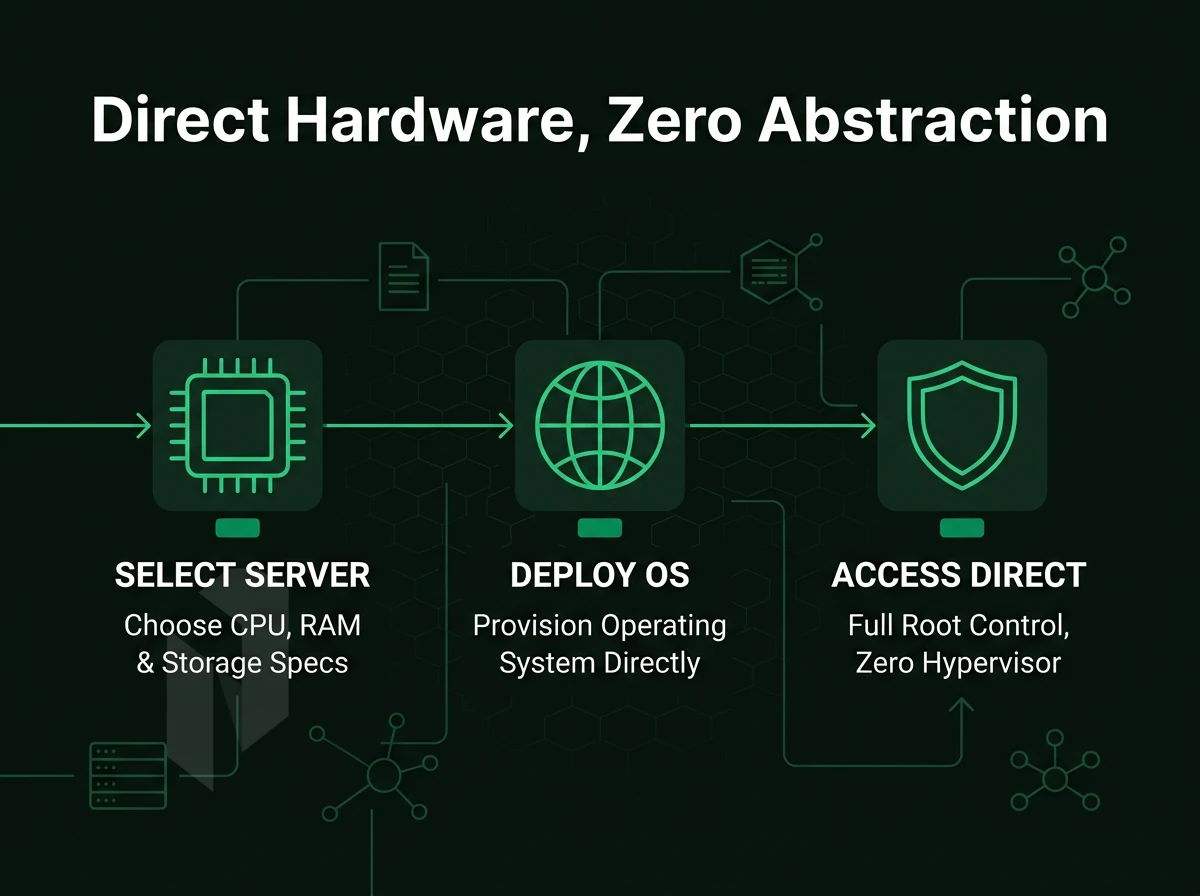
Bare metal servers are dedicated servers where the customer has complete control over the physical components resources such as CPU, RAM, storage and network interface card (NIC) etc. There is no Hypervisor involved and the OS runs directly on the physical computing equipment. There are numerous benefits of bare metal servers over shared servers.
These advantages stem from the elimination of resource contention and the direct relationship between software and physical computing equipment. Customers can directly configure and manage these resources without intermediary abstraction layers that would otherwise introduce complexity.
Direct Access to Hardware Resources
Without a virtualization layer, the OS runs directly on the physical apparatus. It gives the user complete control with no contention from other users, no OS scheduler overhead, and no noisy neighbors stealing cycles or bandwidth. Databases, high frequency computing, real-time analytics and other low-latency I/O intensive workloads are examples of applications that are best run on a metal server in this manner.
Bare Metal Server vs. Virtual Machines
| Dimension | Bare Metal | Virtual Machine |
|---|---|---|
| Hypervisor | None | KVM, VMware, or similar |
| Isolation | Full hardware isolation | Shared physical host |
| Billing model | Monthly commitment | Often hourly billing |
| Compliance fit | Meets strict regulatory requirements | Depends on provider controls |
The Private Cloud Providers Variant
A Type-1 hypervisor installed directly on bare metal creates a private cloud.
Bare Metal Server vs. Cloud: When Dedicated Hardware Wins
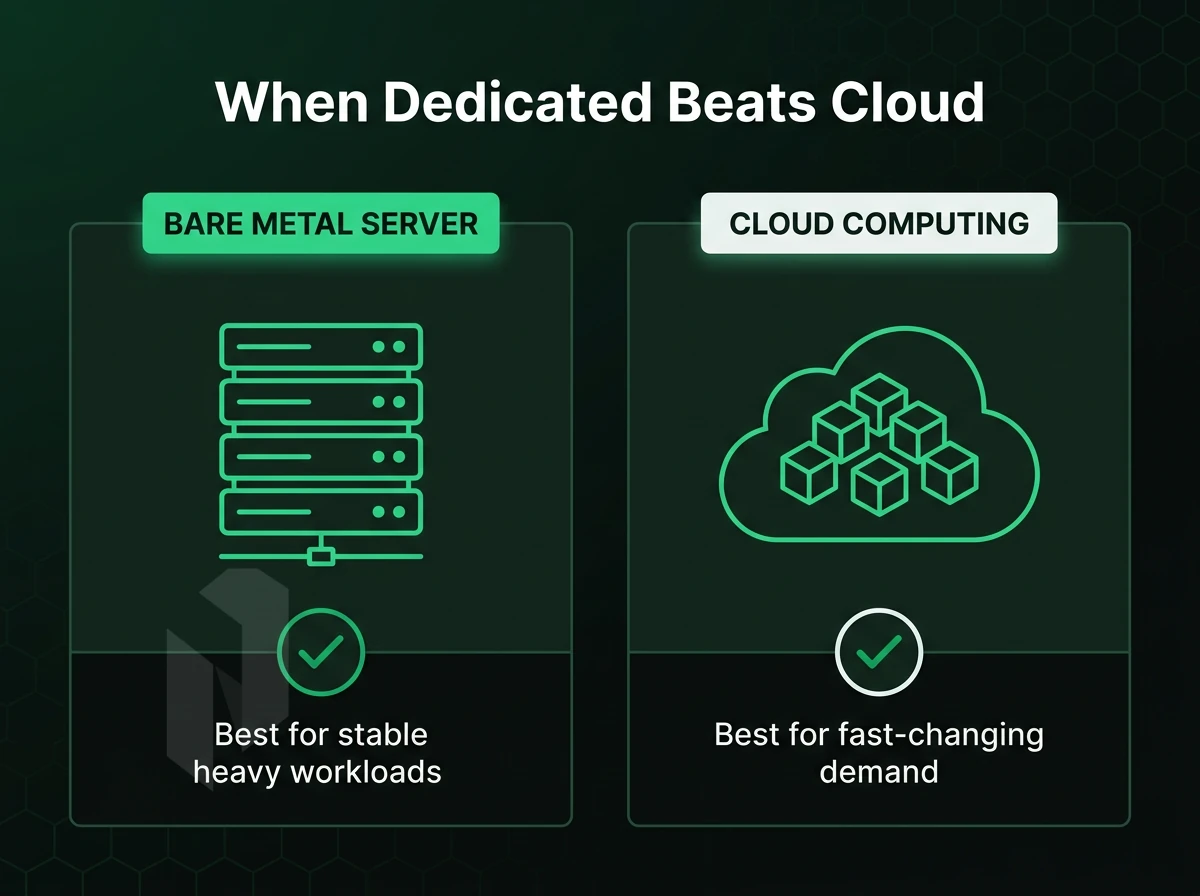
While cloud computing enables teams to set up and provision infrastructure in the cloud, not all workloads are best suited for shared virtual machines. Bare metal infrastructure offers an alternative to cloud servers when consistent performance and resource isolation become critical requirements. Choosing the right deployment model requires evaluating whether a virtualized or single-tenant solution aligns with your application's resource profile.
Dedicated Servers vs. Virtual Servers: The Multi-Tenancy Problem
Most public cloud providers multiplex many customers on a single dedicated hardware. As a result of this shared environment, a co-tenant’s CPU spike or I/Os can impact performance of co-tenants on the same server. With bare metal, you are running on a fully dedicated physical server. There is no hypervisor to consume resources and no contention with neighboring workloads for CPU or I/O on the physical machine.
For latency-sensitive workloads such as real-time databases, high-frequency processing or game servers consistency is non-negotiable.
Data Centers Security and Regulatory Requirements
Multi-tenancy introduces a host of compliance issues, which vary by industry but typically require companies to be able to ensure isolation of customer workloads. A single-tenant bare metal server satisfies all such requirements without further qualification: no shared kernel, no shared memory bus.
No ambiguity about what you can audited in order to prove compliance with PCI DSS, HIPAA or even GDPR. Organizations subject to strict audit frameworks often find that single-tenant architectures simplify their security posture by eliminating shared-resource vulnerabilities. The architecture eliminates shared-resource attack surfaces that would otherwise require additional layers of monitoring to secure.
Bare metal servers can be spread across geographical regions and strict data-residency rules enforced by organizations with multiple servers, as opposed to shared cloud environments that make this very difficult to implement. This geographic distribution is particularly valuable for organizations serving global users who require low-latency connectivity across the internet.
Organizations subject to compliance frameworks often choose bare metal to maintain stricter isolation and audit trails that simplify security posture management. Bare metal deployments allow organizations to implement secure configurations that meet stringent compliance standards without the complexity of shared environments.
Bare Metal Server Cloud: On-Demand Provisioning Without the Compromise
The bare metal market has evolved in recent years and the Bare Metal Cloud offers a middle ground between hosting dedicated servers and cloud hosting. Bare Metal Cloud offers dedicated standalone server components, ordered on demand and charged by the hour. Netrouting deploys Bare Metal servers within 60 minutes or less, which is far more in line with cloud hosting than traditional dedicated server deployment times.
This model combines the performance characteristics of traditional bare metal with the provisioning speed and flexibility typically associated with cloud service platforms. Customers can provision these resources through a web portal accessible over the internet, enabling rapid deployment without traditional datacenter visits. Organizations can scale their deployments up or down as requirements change, maintaining full control over their computing environment. Organizations can manage their deployments through a web portal accessible over the internet, enabling rapid deployment without traditional datacenter visits.
The elastic nature of variable workloads on standard VMs makes hourly billing rates ideal.

Using single-tenant physical nodes is typically more suitable than using shared cloud services when high performance, highest security or even compliance requirements are more important than elasticity.
Knowing when bare metal is better than virtualization is only half the story.
Choose how much of the machine you need.
Pick the starting point that fits the workload: the whole server, a virtual one, or room for your own hardware.
Take the whole machine.
Choose bare metal when the workload needs a single-tenant server with full IPMI access and control over the operating system and stack.
Start the conversation with
- Workload
- CPU, memory and storage
- Stack
- Operating system
- Location
- Where your users are
Start with a VM. Scale it when needed.
Use cloud compute for workloads that do not need a full machine. Compare vCPU, memory and storage per plan.
Start the conversation with
- Compute
- vCPU and memory
- Storage
- Disk size
- Location
- Preferred region
Bring the servers. Choose the location.
Compare colocation for the equipment you already own. Start with footprint, power and the markets you need to reach.
Start the conversation with
- Equipment
- Rack footprint
- Power
- Expected draw
- Network
- Port and traffic needs
Common Use Cases for a Bare Metal Server
Bare metal servers outperform shared hosting infrastructure when dedicated, consistent resources are needed for a specific workload, in those cases, the performance hit from a hypervisor is unnecessary and simply not introduced.
High Performance Computing and Database Workloads
High performance computing, memory-intensive databases, and real-time analytics all benefit from direct access to physical systems, enabling low latency I/O and dedicated CPU cycles, unlike virtualized servers, where resource contention can be a serious problem.
Video Streaming, Gaming, and AI/ML
Bare metal servers are a good fit for high-throughput video delivery, online gaming and GPU-enabled AI/ML workloads. These use cases require large amounts of sustained bandwidth, deterministic compute and complete control of the physical resources. Our GPU server configurations are well-suited to support both inference and training workloads without the risk of interference from other noisy neighbors.
Organizations that need to scale their AI training pipelines or expand video processing capacity can do so by adding additional bare metal nodes without introducing the performance variability that comes from shared environments. Organizations running AI training pipelines or video processing at scale often choose this architecture to support their business operations reliably.
Edge Computing and Hybrid Infrastructure
By dedicating local edge computing nodes near end users as metal servers at regional PoPs for latency sensitive workloads, round-trip times are minimized. Combining these with cloud compute for burst capacities, allows for an optimal hybrid of cost efficiency and superior performance.
- When demand is variable or unpredictable, the cloud compute scales faster.
- Short-lived dev/test environments, the provisioning overhead far exceeds the lifespan of the environment and does not merit a dedicated bare metal setup.
The above use cases map directly to the needs to be serviced by purpose-built dedicated hardware infrastructure.
Why Netrouting Bare Metal Servers Deliver on the Definition
Our bare metal server definition: single-tenant physical computing systems with no shared resources and no hypervisor.
- Our objective is for predictable performance, one customer per server, no noisy neighbors, no contention with other tenants.
- Unmetered 10 Gbps bandwidth on all dedicated servers. Utilized bandwidth is backed by our 2.4 Tbps+ AS6206 connectivity.
- Always-on DDoS protection, our L3/L4 DDoS mitigation service is included with every service.
- Ten data centers are located in Europe, North America and Asia. Our European data centers are located in Amsterdam, Frankfurt, The Hague, and Rotterdam. In Scandinavia, we have a data center in Stockholm. In the East of Europe we have a data center in Bucharest. Our American data centers are located in Miami and New York. In Asia we have data centers in Hong Kong and in Singapore.
- This certified IT infrastructure is specifically designed to meet the requirements of workloads with strict and heavy regulatory requirements. ISO 9001, ISO 27001, SOC 2.
- 24/7 NOC with a one-hour ticket guarantee.
If your workloads demand complete control over dedicated node platform, explore our bare metal servers or contact sales to discuss the right configuration.
Frequently Asked Questions
What many advantages come from deploying multiple physical servers across a cloud environment?
dedicated server refers to a hardware server dedicated entirely to one tenant, with no hypervisor or virtualization layer between the physical devices and the platform OS. Every CPU cycle, every gigabyte of RAM, and every storage I/O operation belongs exclusively to your workload. In a data center context, bare-metal node servers are provisioned as standalone machines in a rack, connected directly to the facility's network fabric. There is no shared compute, no noisy neighbors, and no virtualization overhead.
What is the difference between a bare metal server and a VM?
A virtual machine (VM), a core component of modern lifecycle management, runs on top of a hypervisor that carves a physical host into multiple isolated instances, each sharing the underlying physical computing resources.
What Is a Bare Metal Server Operating System?
A raw hardware host OS is any OS installed and running directly on physical computing nodes, without a virtualization layer underneath it. Common examples used in server infrastructure include Linux distributions such as Ubuntu, Debian, and Rocky Linux, as well as Windows Server. Because the OS communicates directly with the server resources drivers, it achieves lower latency and higher throughput than the same OS running inside virtual servers or a VM. You retain total control over kernel parameters, networking stack, and storage configuration.
How does serverless computing work, and how does it compare to bare metal?
Serverless computing executes discrete functions for multiple users in ephemeral, provider-managed containers that spin up on demand and disappear after the task completes. You write code; the provider handles all infrastructure, scaling, and runtime management. A physical machine is the ultimate single tenant setup, you own the full server, configure every layer, and run workloads continuously. Serverless suits short-lived, event-driven tasks with unpredictable traffic. non-virtualized server suits sustained, high-throughput, or latency-sensitive workloads where infrastructure control and consistent performance are non-negotiable.
What Is a Bare Metal Cloud Server?
A hardware server cloud server is a dedicated single-tenant server provisioned and managed through a cloud-style interface, on-demand ordering, API access, and rapid deployment, but without any shared virtualization layer. You get the performance and isolation of traditional dedicated physical compute combined with the operational convenience of cloud provisioning.
Netrouting's physical host servers, for example, deploy in under 60 minutes and connect to a 2.4 Tbps+ network with unmetered 10 Gbps ports. It is the right model when you need cloud agility without sacrificing single-tenant performance.
When Should You Choose a Bare Metal Server Over a Virtual Server?
Choose dedicated host when your workload demands consistent, predictable performance with no risk of resource contention from other tenants. High-frequency databases, real-time video streaming, online gaming infrastructure, and AI/ML training jobs all benefit from direct physical gear access.
single-tenant hardware is also the right call when you need custom kernel configurations, server gear RAID, or specific network drivers that a hypervisor would block. If your workload runs continuously at high utilization, physical compute is well suited to delivering a lower total cost of ownership than an equivalent VM footprint.
What Is a Bare Metal Server Hypervisor?
A dedicated compute hypervisor, also called a Type 1 hypervisor, runs directly on the dedicated host equipment rather than on top of a host system software. It manages physical infrastructure resources and allocates them to guest virtual machines without an intermediary OS layer.
raw server hypervisors deliver better performance and security isolation than Type 2 hypervisors, which run as applications inside a conventional OS. Managed Proxmox VE, which Netrouting offers as a fully managed service, is built on KVM and operates as a physical node hypervisor.
We deliver dedicated node servers because shared and virtualized servers can’t. They can’t provide dedicated hardware access to physical servers. Hypervisor overhead, noisy neighbors and random performance spikes are the norm. But there are workloads that require constant CPU cycles, low latency I/O and total isolation of data.
Choosing hardware-level server, virtual machines or cloud compute depends on your specific workload. Database clusters, real-time games, video streaming pipelines and AI/ML training cycles are all best run on dedicated servers. Most other workloads are general purpose or vary from cycle to cycle.
Our native hardware servers are being offered from 10 locations world wide: Amsterdam, Frankfurt, Miami, New York, Hong Kong and Singapore. All locations are equipped with unmetered 10 Gbps connectivity. All our locations are protected from DDoS attacks 24/7/365. When you are ready to specify a server, we will help you find the right configuration for your application. Contact our sales department to get started.
Put the workload on bare metal.
Share the workload, the location and the network needs. We help you match a configuration.