Your bare metal server provider can greatly affect the key performance, cost and reliability metrics for your infrastructure. Select a poor provider and you will be locked into unsuitable hardware with unexpected charges for excessive bandwidth, all whilst receiving unsatisfactory support, that disappears when things start to go wrong.
Select a good provider and you will get dedicated, high-performance computing with fixed costs and a first-class network designed to support high-grade production workloads. When evaluating providers, you should expect transparent pricing structures and clearly defined service level agreements that protect your infrastructure investment.
Netrouting has been building bare metal servers since 2007 and operates AS6206 from 10 datacenters spread over Europe, North America and Asia. The company’s vast amount of experience is reflected in the ratings provided in this review.
Blog contents
We'll cover the factors that separate serious providers from the rest: hardware generation and configuration flexibility, network capacity and peering quality, DDoS protection, provisioning speed, support responsiveness, and data center footprint. Each criterion is weighted for the workloads that push bare metal hardest, high-throughput applications, latency-sensitive platforms, and compute-intensive deployments where shared infrastructure simply won't hold.
We'll build a framework to evaluate high performance cloud providers and create a short list based on actual specifications as opposed to marketing jargon. We start with the fundamentals: a definition of bare metal servers and why they are used for production workloads.
What Is Bare Metal Hosting and Why It Matters
Bare metal servers are single-tenant physical servers running directly on the server’s hardware (no hypervisor involved). Access to the entire server (100% of all CPU cores, all RAM installed, all I/O paths) is unshared and without virtualization overhead. This direct access to the cpu means your processes execute without the scheduling delays and context-switching overhead introduced by hypervisor layers.
Bare Metal Servers vs. Virtualised Alternatives
Most VPS and cloud servers are hosted on shared servers and are affected by noisy neighbors competing for same CPU cycles and memory bandwidth. Our bare metal servers are affected by none of these issues. Your workloads run as the only workloads on your machines.
Dedicated servers are often positioned in the infrastructure stack between VPS and colocation. They allow you to own the servers and compute layer without having to manage the facility, power and cabling. A good middle ground for projects that require raw power but no physical space. Dedicated hosting bridges this gap by offering the performance isolation of physical infrastructure with the operational simplicity of managed facilities. Organizations running mission critical applications often select this model to balance performance isolation with reduced operational overhead.
Dedicated Servers and Full Root Access
Dedicated hosting is provisioned with full root access from the word go. You can choose the OS, kernel params, storage and even network config. This level of control extends to selecting specific configurations that match your application's resource profile and performance requirements.
Most providers ship their servers with a preconfigured operating system as the default, though you retain the ability to replace it immediately upon provisioning. Many providers also offer cpanel as an optional control panel interface for those who prefer graphical server management alongside command-line access.
For mission-critical applications (e.g. databases under high write load, real-time game servers, high-frequency trading systems), predictable and uncontested hardware performance is critical to ensure correct operation. When a process requires immediate cpu cycles without contention, shared virtualization introduces unpredictable latency that can break time-sensitive logic.
Transactional workloads such as relational databases benefit from this consistency because unpredictable delays can cause lock contention and query timeouts. Development teams building these applications rely on bare metal to eliminate the performance variability that can disrupt critical operations. Development teams building these applications rely on bare metal to eliminate the performance variability that can disrupt critical operations and ensure users experience consistent response times.
Dedicated Server Hosting for Sensitive Workloads
For highly regulated and data sensitive environments, such as healthcare, fintech and legal, the preferred hosting model is bare metal hosting. Often these workloads require single-tenant hosting in order to comply with regulations and bare metal hosting provides isolation at the hardware level as opposed to just the software level. Single-tenant bare metal ensures that your application's data remains physically isolated from other tenants' workloads throughout the entire processing pipeline. This makes bare metal hosting the preferred choice across multiple industry verticals where compliance and isolation cannot be compromised.
Bare metal hosting also provides the performance characteristics required by transactional databases that demand consistent I/O latency and predictable query response times. Organizations handling compliance-driven workloads rely on bare metal to maintain secure infrastructure boundaries that meet strict regulatory requirements. Development teams working on compliance-driven projects benefit from the physical isolation that prevents cross-tenant resource contention during critical processing windows.
Netrouting's Dedicated Server Hosting is offered from 10 data center locations worldwide (Europe, North America and Asia-Pacific). The bare metal infrastructure is powered by top-of-the-line Dell and Supermicro servers and can be deployed within 60 minutes. We compare this to Cloud and VPS hosting to show where Dedicated Server Hosting is useful for your infrastructure decision.
Key Criteria for Evaluating a Physical Server Provider
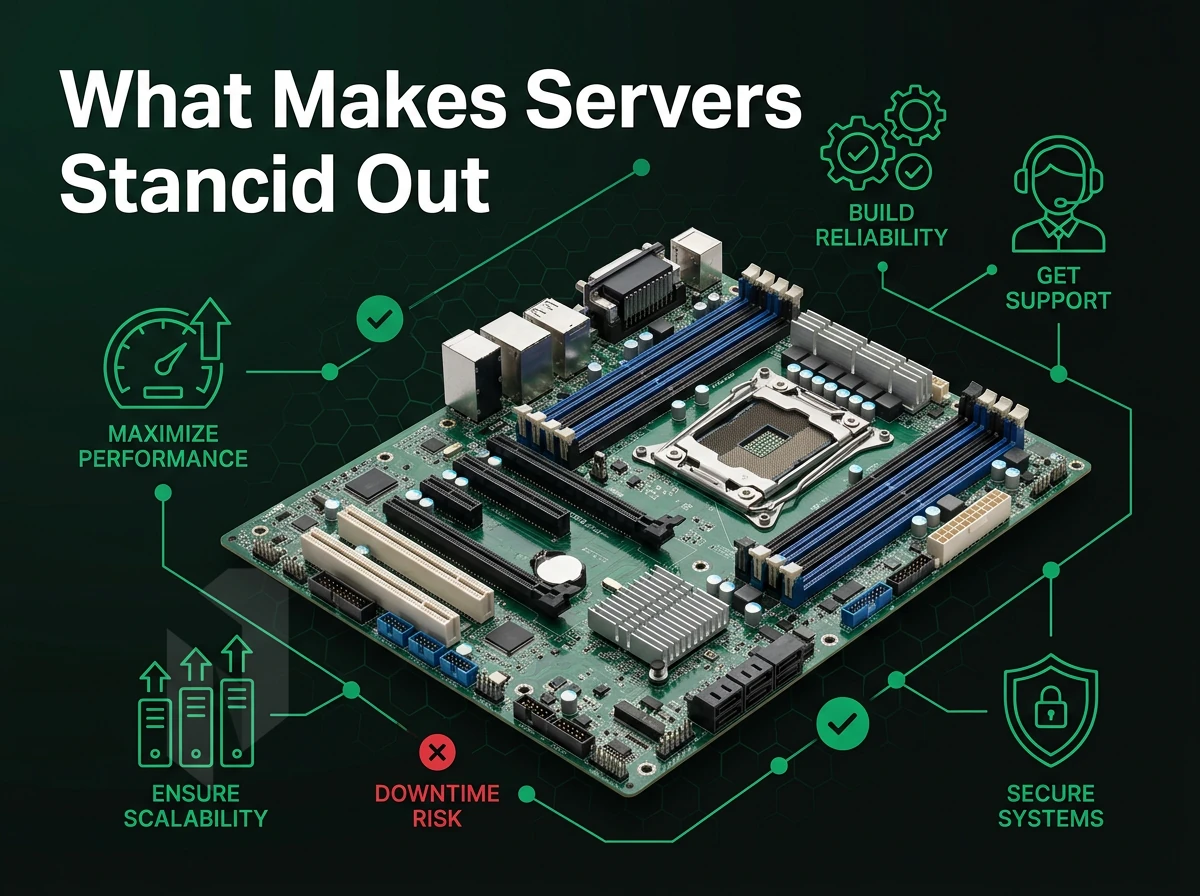
Carefully evaluating six different criteria will help you choose the right bare metal server provider for your needs. By carefully reviewing each of the phases below, you can avoid costly mistakes that can arise from high performance workloads not matching up well with a particular cloud server. Understanding which factors matter most for your specific use case will help you decide which provider aligns with your infrastructure goals.
Hardware and Network Fundamentals of Dedicated Servers
-
Assess hardware generation and configuration flexibility. Confirm the provider offers current Intel Xeon and AMD EPYC platforms with meaningful memory and storage configurations. Outdated silicon caps performance regardless of network quality.
Note: Providers who list only a handful of fixed configurations may not scale with your business as requirements grow. - Assess the network quality. Look for a Tier 1 upstream, plenty of peering at Internet Exchanges and unmetered bandwidth. Companies running latency sensitive services (gaming, video streaming, financial online services) need a proven backbone and not just resold transit.
- Verify DDoS protection. Check that DDoS protection is included with all services as a default and not as an optional feature. Always-on, network-layer mitigation should be the normal production offering for any workload.
Dedicated Servers Operations and Compliance
- Check how fast your instances can be provisioned. Resources are wasted and launch dates delayed by slow provisioning. Companies with a launch to make within very tight time frames need bare metal infrastructure deployed within less than one hour.
- Check out the support model. Need 24/7 NOC coverage, a formal SLA and a guaranteed time to respond to tickets. A poor support model ends up increasing total cost of ownership when they’re down for an extended period of time.
- Verify any certifications the provider has obtained, such as compliance with ISO 9001, ISO 27001, and SOC 2 auditing for security and quality. For heavily regulated industries and large enterprises, these certifications are non-negotiable.
Where Netrouting Fits With Dedicated Servers
The table below serves as a checklist for the criteria mentioned above. All six points are answered by Netrouting for dedicated server hosting. Dedicated servers run on current hardware by Dell and Supermicro and are equipped with processors by Intel (Xeon) and AMD (EPYC). The hosting provider has locations in 10 different countries in Europe, North America and Asia and is connected with AS6206 with a capacity of 2.4 Tbps+.
There is unmetered 10 Gbps connectivity on all bare metal servers. Provisioning of bare metal servers takes less than 60 minutes. 24/7 NOC support is available. Within one hour a ticket will be answered by the hosting provider. This level of support ensures that technical issues are addressed promptly, minimizing downtime for production workloads. When provisioning a new server, you can expect consistent deployment times regardless of configuration complexity or geographic location.
Choose how much of the machine you need.
Pick the starting point that fits the workload: the whole server, a virtual one, or room for your own hardware.
Take the whole machine.
Choose bare metal when the workload needs a single-tenant server with full IPMI access and control over the operating system and stack.
Start the conversation with
- Workload
- CPU, memory and storage
- Stack
- Operating system
- Location
- Where your users are
Start with a VM. Scale it when needed.
Use cloud compute for workloads that do not need a full machine. Compare vCPU, memory and storage per plan.
Start the conversation with
- Compute
- vCPU and memory
- Storage
- Disk size
- Location
- Preferred region
Bring the servers. Choose the location.
Compare colocation for the equipment you already own. Start with footprint, power and the markets you need to reach.
Start the conversation with
- Equipment
- Rack footprint
- Power
- Expected draw
- Network
- Port and traffic needs
Comparison Table: What to Look for Across Bare Metal Providers
Just because something is bare metal doesn’t mean every bare metal provider is built equally. Below is a chart of what good providers do and how they contrast with the red flags of suboptimal (read: awful) dedicated hosting providers. Use as a reference when shopping for dedicated hosting providers. Understanding how your provider stacks up against competitors in these areas will determine whether your infrastructure thrives or struggles under load.
| Criteria | What strong providers offer | Red flags to avoid |
|---|---|---|
| Hardware platforms | Dell and Supermicro chassis; Intel Xeon and AMD EPYC processors; hardware RAID | Unlisted or aging hardware; no RAID option; vague "enterprise-grade" claims |
| Network capacity | 2.4 Tbps+ backbone; unmetered bandwidth on 10 Gbps ports; Tier 1 upstreams | Shared, oversubscribed ports; metered bandwidth with opaque overage fees |
| Provisioning speed | Bare metal servers live in under 60 minutes; automated setup workflows | Multi-day manual provisioning; no SLA on delivery time |
| DDoS protection | Always-on L3/L4 mitigation included on every service; no extra fee for baseline | Protection sold as a paid add-on; no scrubbing capacity stated |
| Root access | Full root access on every bare metal server; no hypervisor overhead | Restricted OS access; mandatory managed layer you can't opt out of |
| Managed options | OS patching, automated backups, and control panel support available; optional, not forced | No managed tier; or managed-only with no self-service path |
| Certifications | ISO 9001, ISO 27001, SOC 2, independently audited security and quality frameworks | Self-certified only; no third-party audit; compliance claims without documentation |
| Support hours | 24/7/365 helpdesk; 1-hour ticket response guarantee; 24/7 NOC maintaining the network | Business-hours-only support; no stated response SLA; no dedicated NOC |
Hardware, Network Depth, and Bandwidth Caps
The term enterprise-grade refers to a list of specific components, including servers, and their corresponding configurations. Typical enterprise-grade server chassis built for high performance computing are manufactured by companies like Dell and Supermicro and are populated with processors from Intel's Xeon product line and AMD's EPYC line. Using anything less than these industry standard components for production bare metal servers can harbor hidden reliability risks that are not uncovered until it is too late.
Direct Access and Managed Flexibility
For custom stacks full root access on bare metal servers is a matter of course. For those who need it, Netrouting also offers a variety of managed services. These can include OS patching and backups on the servers, for example, but do not restrict access to the server. Maintaining full control over your server environment allows you to implement custom security policies and performance tuning without vendor restrictions. Real-time monitoring capabilities ensure you can track server health and application metrics while retaining complete administrative control.
For users preferring graphical interfaces, cpanel can be installed to simplify routine server administration tasks while preserving underlying root privileges. This flexibility in service delivery allows organizations to tailor their infrastructure management approach based on internal expertise and operational requirements. Organizations can implement their own encryption protocols and access controls to secure their server environment according to industry-specific compliance requirements.
Compliance and Protection as Defaults
Always-on DDoS protection and independent auditing of security controls (e.g. ISO 27001 / SOC 2) should be included as core features rather than add-ons that increase cost.
Now that we have the framework for evaluation in place, we should also look at some representative workloads and what it is about them that drives bare metal over cloud adoption, and why.
Network Quality: Why Peering and Connectivity Define Bare Metal Performance
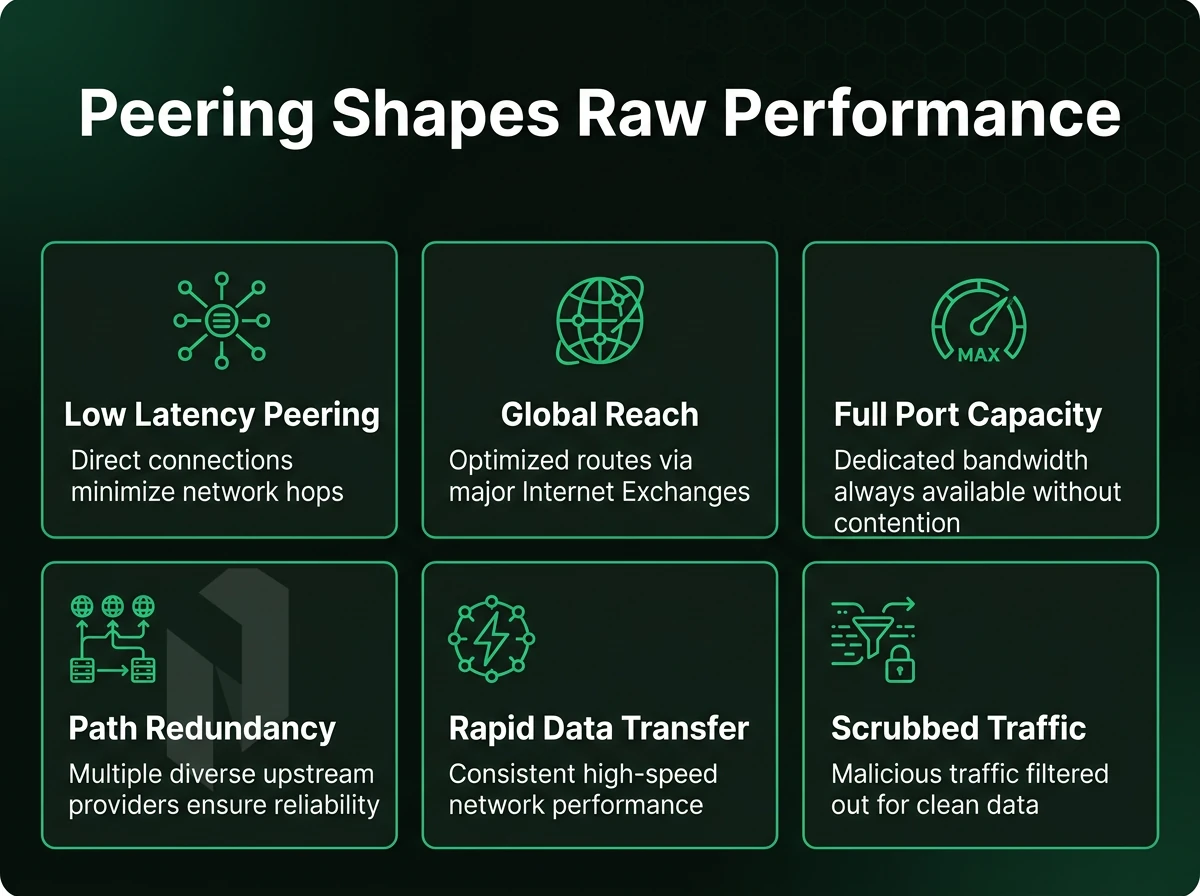
Looking at raw server specs doesn’t tell you the whole story. Managing network quality for latency sensitive workloads like gaming, streaming or even financial APIs is what makes hosting expensive for a reason.
Tier 1 Upstreams and IX Peering
Tier 1 carriers provide global reachability while dense IX peering reduces latency by routing traffic closer to end users. By having separate diversity for upstream connections and a presence on major Internet Exchanges, we can ensure that there are no single points of congestion or bandwidth caps for your cloud application. Latency sensitive applications are particularly suited to this combination of connectivity over simple bandwidth.
Port Utilisation and Headroom
Tracking port utilization is one of the best indicators of available bandwidth capacity. The Netrouting AS6206 backbone runs with sub-40% average utilization on its 2.4 Tbps+ cloud infrastructure, with the majority of connections operating at 100 Gbps or larger. This buffer capacity effectively reduces jitter and packet loss during high traffic.
| Location | Key Exchange | Primary Use Case |
|---|---|---|
| Amsterdam | AMS-IX | European web traffic hub |
| Frankfurt | DE-CIX | DACH and CEE reach |
| Miami | FL-IX | Latin America gateway |
| New York | DE-CIX New York | US East Coast management |
| Stockholm | NetNod | Nordic edge and DR |
BGP Routing and BYOIP
Power users with their own IP space appreciate the advanced BGP management and BYOIP capabilities. Advanced traffic management and failover for multinode setups is also very relevant. Dedicated servers with unmetered 10 Gbps connectivity eliminate capacity planning concerns altogether. This is the kind of serious production hosting on dedicated servers that Netrouting has been perfecting for years.
Why Choose Netrouting for Bare Metal Server Hosting
Netrouting delivers bare metal servers built for mission critical applications, with the network, hardware, and support to back them up. Every dedicated server ships on Dell or Supermicro hardware running Intel Xeon or AMD EPYC, with up to 2 TB RAM and up to 24 drives. Custom configurations are available on request.
- Full root access, no shared resources. Bare metal hosting means your workload owns the physical server, no noisy neighbours, no hypervisor overhead.
- Always-on DDoS mitigation. L3/L4 mitigation is included free on every dedicated hosting plan. Advanced L7 scrubbing is available for high-risk workloads.
- Provisioned in under 60 minutes. Our rapid deployment pipeline gets bare metal infrastructure live fast.
- 10 locations across three continents. Amsterdam, Frankfurt, Miami, New York, Hong Kong, Singapore, and more, all on our own AS6206 backbone with 2.4 Tbps+ capacity.
- Managed options available. Choose Managed Hosting, Managed Proxmox VE, or Managed Control Panel Servers if your team prefers to hand off OS and platform management.
- ISO 9001, ISO 27001, and SOC 2 certified. The right foundation for sensitive data and compliance-driven enterprises.
Ready to find the right fit? Explore our bare metal servers or contact sales to discuss your specific needs. If you're still working through the decision, the step-by-step framework below will help you match your cloud workload to the right configuration.
How to Choose the Best Bare Metal Server Provider for Your Workload
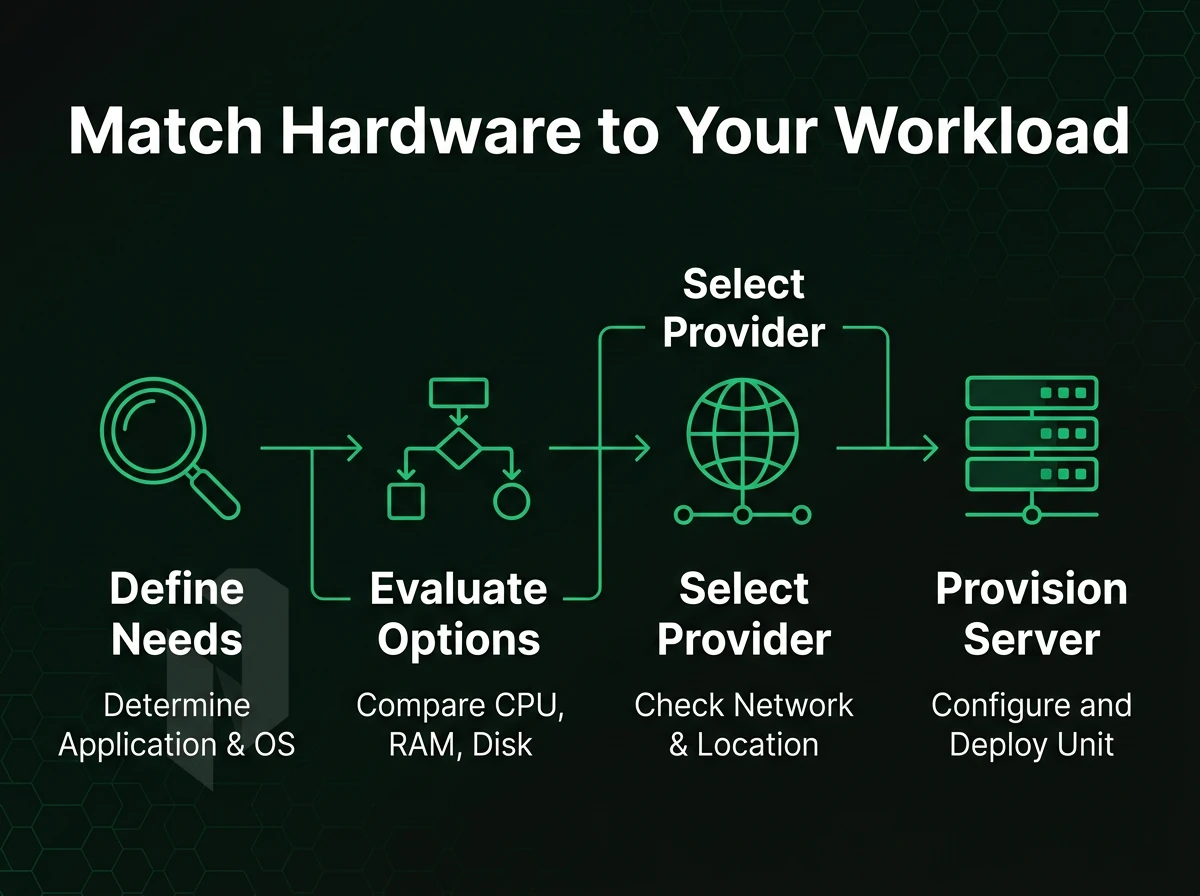
When selecting the best bare metal server provider for your needs, it is best to approach with a strategy. Match your specific needs to the best server hardware, datacenter location, and server management model. Don’t just pick the cheapest option.
Step 1, Define Workload Requirements
Start with CPU, RAM and storage. When deploying compute-intensive applications such as game servers, video encoding or AI-inference, high core counts in conjunction with fast NVMe storage are required. Database applications on the other hand require a lot of RAM and high IOPS on storage. Also define a bandwidth floor for yourself. With dedicated server hosting and unmetered 10 Gbps bandwidth you can handle traffic spikes without incurring any surprise charges.
Design in headroom. As traffic escalates, scalability is key. With bare metal hosting you can add storage or up RAM as required without ever having to move to a different platform.
Step 2, Map Latency to Location
Where your audience is geographically located is often where you need to host your server. If your audience is in Southeast Asia, hosting your cloud server in Singapore or Hong Kong would be ideal as the round trip time is so much better than hosting elsewhere in the world.
Users in Europe would typically benefit from a Frankfurt, Amsterdam or Stockholm server. Netrouting offers dedicated hosting in 10 datacenter locations around the world: Stockholm, Amsterdam, Rotterdam, The Hague, Frankfurt, Bucharest, Miami, New York, Hong Kong and Singapore.
Step 3, Managed vs. Unmanaged
For the lean team with in-house Linux experts, unmanaged bare metal hosting is the way to go. For others, managed hosting or even our Managed Proxmox VE offering shifts the tasks of OS patching, monitoring, etc. to the hosting provider. Yet root access is fully preserved and all operational layers are handled by the provider. In the end, this is what decides the total cost of ownership much more than the individual hardware specs.
Step 4, Verify Compliance Certifications
Organizations in highly regulated industries such as health, finance and government that handle sensitive data and are looking for a data center or hosting provider for their workloads with strict compliance requirements. Must verify whether a provider's servers and operations hold the required certifications such as ISO 27001, ISO 9001 and SOC 2. Netrouting is ISO 27001, ISO 9001 and SOC 2 certified and thus fulfills the required audit criteria for security measures, change management and incident response.
When choosing a dedicated server hosting service, key factors to consider are the workload required. There, Users are from around the world, the capabilities of the team managing servers and last but not least, any regulations that need to be adhered to. Price is a consideration but not a framework.
Key Takeaways: Picking the Right Dedicated Hosting Provider
Bare metal servers deliver what shared and virtual platforms cannot: dedicated hardware, full root access, and zero resource contention. The right dedicated hosting provider matches your workload on four axes, hardware generation, network quality, provisioning speed, and attack mitigation. Align your bare metal infrastructure to your audience's geography to keep latency low.
Managed dedicated servers reduce operational overhead for teams without deep Linux expertise. Certifications like ISO 27001 and SOC 2 signal a provider takes security seriously. Netrouting's bare metal hosting spans ten locations across Europe, North America, and Asia, backed by a 2.4 Tbps+ network, always-on volumetric attack protection, and a 24/7 NOC. Explore bare metal server options here.
Bare metal delivers what shared and virtualized infrastructure cannot: dedicated hardware, predictable performance, and full control over your environment. The right provider comes down to three things, network quality, deployment speed, and the flexibility to match hardware to your actual workload.
Not every provider can offer carrier-neutral colocation, a 2.4 Tbps+ backbone, and bare metal provisioned in under 60 minutes from locations across Europe, North America, and Asia. Netrouting does. Whether you're running latency-sensitive applications, high-throughput workloads, or GPU compute for AI/ML, the infrastructure is engineered to spec, not retrofitted from a generic catalog.
If you know what servers you need, contact the Netrouting sales team to discuss configurations, locations, and availability. If you're still evaluating, the dedicated server pages at netrouting.com are a good next step.
Put the workload on bare metal.
Share the workload, the location and the network needs. We help you match a configuration.