When selecting a colocation provider, initial pricing and usable power may seem like the key deciding factors; however, hidden charges can double the total cost of ownership quickly. A close examination of fees associated with rack density, power usage, cross-connects, bandwidth overage, and private cage options is essential to creating an accurate comparison of costs in the market.
Netrouting has been operating carrier-neutral colocation facilities in Europe, North America and Asia since 2007. We operate our own AS6206 Backbone with over 2.4 Tbps of network capacity. Our vast operational experience across every physical space imaginable has been the basis for constructing this guide, not as a list of features but as a framework for the Total Cost of Ownership.
This guide sets out the key criteria by which infrastructure decision-makers evaluate colocation providers. It covers power and density tiers, network quality and peering, the physical space and Service Level Agreements (SLAs), support response, and the often unseen per month charges and penalties. We outline a method for evaluating colocation providers on an even footing, with a set of benchmarks against which individual providers can be measured.
Blog contents
What Is Colocation and How Is It Priced?
Colocation (or hosted) servers are located in professional high density data centers where you bring your own servers, the facility provides the space, power, cooling and connectivity while you are responsible for your servers. It is a midway point between self hosted servers and fully managed hosted cloud servers.

How the High Density Pricing Model Works
Colocation pricing typically consists of three elements: the space you require to house your servers, the amount of power you require to run them, and the connectivity you require to get to them. Each of these elements is typically billed separately based on the amount of resources that your particular deployment uses.
- Space: Sold in rack units (U), half-racks, full cabinets, cages, or private suites. A single 1U server occupies the smallest billable unit; a full 42U cabinet is the standard next tier.
- Power: Billed by kilowatt draw or amperage. Providers distinguish between allocated power space and usable power, what's reserved versus what your hardware actually draws under load.
- Connectivity: Priced by port speed, committed bandwidth, or burstable throughput. Power cooling infrastructure is engineered to match, high-density racks demand more robust cooling circuits, which affects cost.
Typically a provider would quote an entry level deployment of a single rack space, average power consumption, and 1 Gbps uplink connectivity. Highly dense GPU or storage configurations will scale in cost. It is worth understanding the cost of colocation and comparing it to other options.
Is High Density Colocation Cheaper Than Cloud?
Yes, for very stable workloads, such as batch jobs, cloud compute can be less expensive than maintaining a pool of idle compute resources. However, cloud compute charges for every CPU cycle, GB transferred, and API call, so costs can add up very quickly at scale.
Colocation fixes your monthly spend for a fixed footprint of servers, versus variable spend in the cloud. Providing your utilization remains constant, your Total Cost of Ownership over 24-36 months is likely to be less than equivalent cloud capacity.
We design and engineer the space for deployment of your servers at our colocation facility in The Hague as well as at our other 9 locations. We offer a single 1U slot up to multi-cabinet private suites and charge against a variable tier cost curve determined by your actual workload.
Colocation Facility vs. On-Premises Ownership
Setting up a server room costs a lot of upfront money for the necessary infrastructure (power, cooling, security etc.) and the contracts with carriers, unless you go carrier neutral from the start. Most people won’t be able to afford this for smaller setups. Establishing on-premises infrastructure also lacks the geographic redundancy and carrier diversity that professional colocation facilities provide through their established ecosystems.
A carrier neutral facility eliminates vendor lock-in by allowing you to choose from multiple network providers without incurring expensive contract penalties or migration costs. Professional colocation facilities invest heavily in physical security measures including biometric access controls, 24/7 surveillance systems, and multi-layer perimeter defenses that would be prohibitively expensive for most organizations to replicate on-premises.
By moving colocation out of capital expenses, you get to enjoy carrier neutral connectivity, N+1 designed power and cooling, and 24/7/365 physical security of your hardware. The hardware is yours, the risk of the facility is not. With the above cleared up, the key cost drivers and how they affect your monthly invoice are next.
This carrier neutral approach ensures you retain flexibility to select from multiple network providers without vendor lock-in constraints. Facilities invest heavily in biometric access controls, surveillance systems, and on-site personnel to maintain robust physical security protocols that protect client hardware from unauthorized access and tampering.
The Five Factors That Drive Colocation Costs
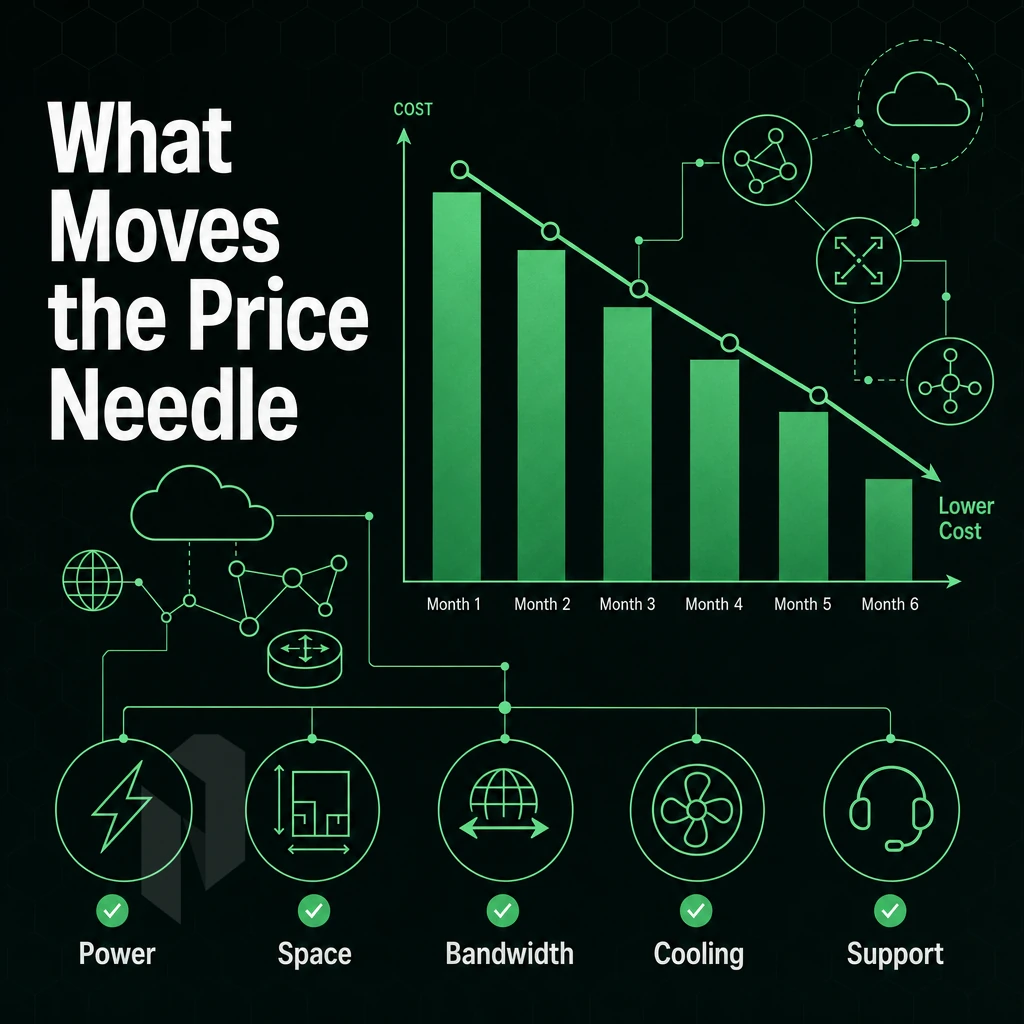
There are 5 key cost levers that dictate how much you will pay for the space you need in a colocation facility. Get a handle on power capacity, private cage options, and these other factors before you issue an RFQ so you can avoid surprises down the line and compare offers from different providers more effectively.
Space, Power, and High Density
The physical footprint of the space required to house your colocation equipment is typically the base unit of measure in quotes for datacenter space. The cost of a single 1U of space can be many times less than a half-rack.
A full cabinet or even a private cage of space but the differential quickly disappears as power becomes more expensive than space, especially for high-density deployments operating at 10 kW per rack or greater. Beyond space economics, physical security measures such as biometric access controls and 24/7 surveillance become increasingly important as deployments scale from single racks to dedicated suites.
The other important decision criterion for dual power feeds supply is N+1 versus 2N design. While an N+1 design protects against failure of a single component, a 2N design completely mirrors all power paths in the data center. While expensive to implement on a per-rack basis, a 2N design is critical for ensuring that no downtime is experienced for particular workloads.
Bandwidth, Connectivity, and High Density Location
Metered bandwidth: Bill by Gigabytes transferred. Metered ports typically offer 1 Gbps or 10 Gbps connectivity on a fixed monthly cost, regardless of usage. Cross connects to on-site carriers carry a recurring fee but offer low latency as opposed to routing traffic over the public Internet. Facilities with carrier neutral infrastructure enable customers to select from multiple competing bandwidth providers without vendor lock-in, often resulting in better pricing and service terms.
The location of facilities affects both latency and power economics. Carrier neutral locations in major high density interconnection hubs like Amsterdam, Frankfurt and Miami have higher rent than secondary locations but deliver far denser peering and lower average round trip time to end users worldwide.
Selecting colocation facilities in these strategic markets ensures access to diverse fiber routes and reduces the need for expensive long-haul transit arrangements. Beyond peering density, carrier neutral facilities eliminate vendor lock-in by allowing tenants to negotiate directly with multiple competing providers for optimal pricing and service terms.
Managed Add-Ons and Physical Security
Most remote hands, OS patching and monitoring services are charged on top of the base colocation price. Physical security such as access control, CCTV and cage locks are usually included by datacenter operators but can vary quite significantly. Facilities with robust physical security protocols including biometric access controls and 24/7 surveillance typically command premium pricing but protect against unauthorized hardware access and theft.
Carrier neutral data centers of Netrouting are located in Europe, North America and Asia. The basic remote hands service is included in the price for courtesy. Our data centers have N+1 power and cooling and always-on DDoS protection. Being carrier neutral allows customers to negotiate directly with multiple network providers and avoid vendor lock-in across all our facilities. All locations feature 24/7 on-site staff, biometric access controls, and video surveillance to ensure comprehensive physical security for customer equipment.
For customers looking for a low total cost of ownership and many peering points, this is a cost efficient way to get the services you need. The cost drivers for these services vary greatly depending on the retail, wholesale or hybrid pricing model that your provider is using.
Colocation Pricing Models: Retail, Wholesale, and Hybrid
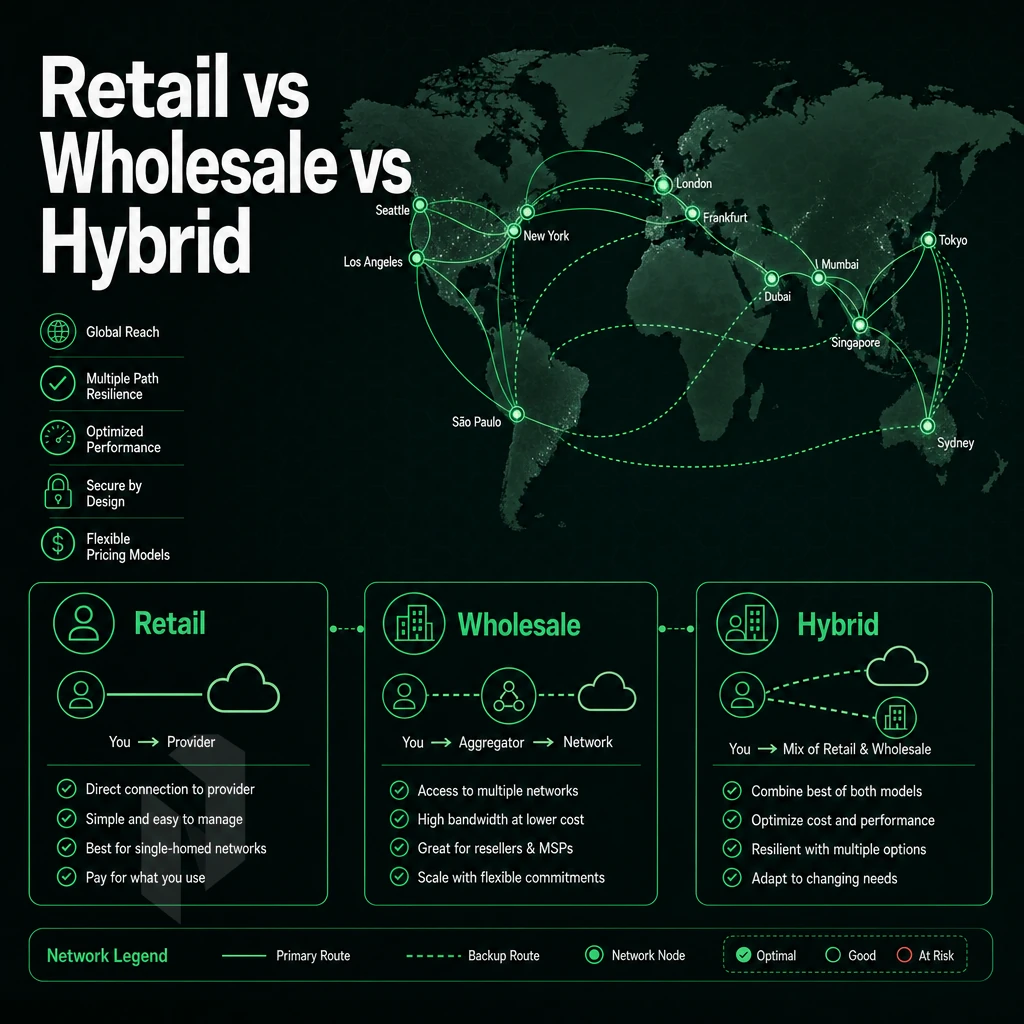
Colocation pricing models fall into three basic structures. Understanding which of the three models, shared hosting, a private cage, or a dedicated setup, best aligns with your use case helps avoid paying per month for unused flexibility and avoid entering into a contract that will not grow with you.
Choosing the Right Retail Colocation Facility
Retail colo is priced per rack unit or per full rack. Retail colo provides customers with the ability to control their colocation space and monthly costs in granular increments, usually with short contract terms and shared infrastructure. The space is typically priced higher per unit than wholesale space but with lower commitment per unit.
The Tiered Power model is particularly suited to the SME and mid-market organization operating within a private cage, buying only the power cooling and space required today with scope to increase in small increments as required.
Note: Retail contracts often bundle bandwidth and remote hands. Audit what's included, unbundled add-ons can push monthly costs above your initial estimate.
Wholesale Colocation Facility
Wholesale colo typically sells large power blocks (100s kW or more) at lower per kW rates. Contracts are often multi-year in nature. Even as cost per kW goes down at scale, you pay for capacity that you may not need for long.
This model is targeted at hyperscale sites and large enterprises with predictable long-term growth. A full cabinet or partial suite of equipment is the minimum entry point and often multiple halls of equipment are required.
Hybrid and High Density Partial-Cabinet Models
A Hybrid Offer divides a full secured cabinet amongst several tenants. You pay only for the number of Us you require in a locked cabinet. Only the facility overhead is shared and therefore very cost effective for smaller introductory sized offerings that don’t require a full rack.
Netrouting’s colocation services are offered in three tiers of shared/secured cabinets as well as private/secured suites with up to 20 kW/suite and are hosted in 10 different locations throughout Europe, North America and Asia.
How Much Does a 200 MW Data Center Cost?
The capital cost for a 200 MW hyperscale campus is in hundreds of millions to low billions of dollars. The construction, power, cooling and land cost at current build rates is c.$8m/ MW to c.$12m/ MW.
This figure is relevant to colocation buyers. The costs of building out wholesale data centers are amortized over the term of primary customers. Wholesale colocation cost per kW is therefore lower than private cage contracts because it reflects shared risk of capital expenditures, as opposed to some discount off the underlying hardware and space. This figure alone does not paint a complete picture. There are many fees that are not reflected in the advertised price.
Hidden and Variable Costs to Watch in Any Colocation Quote
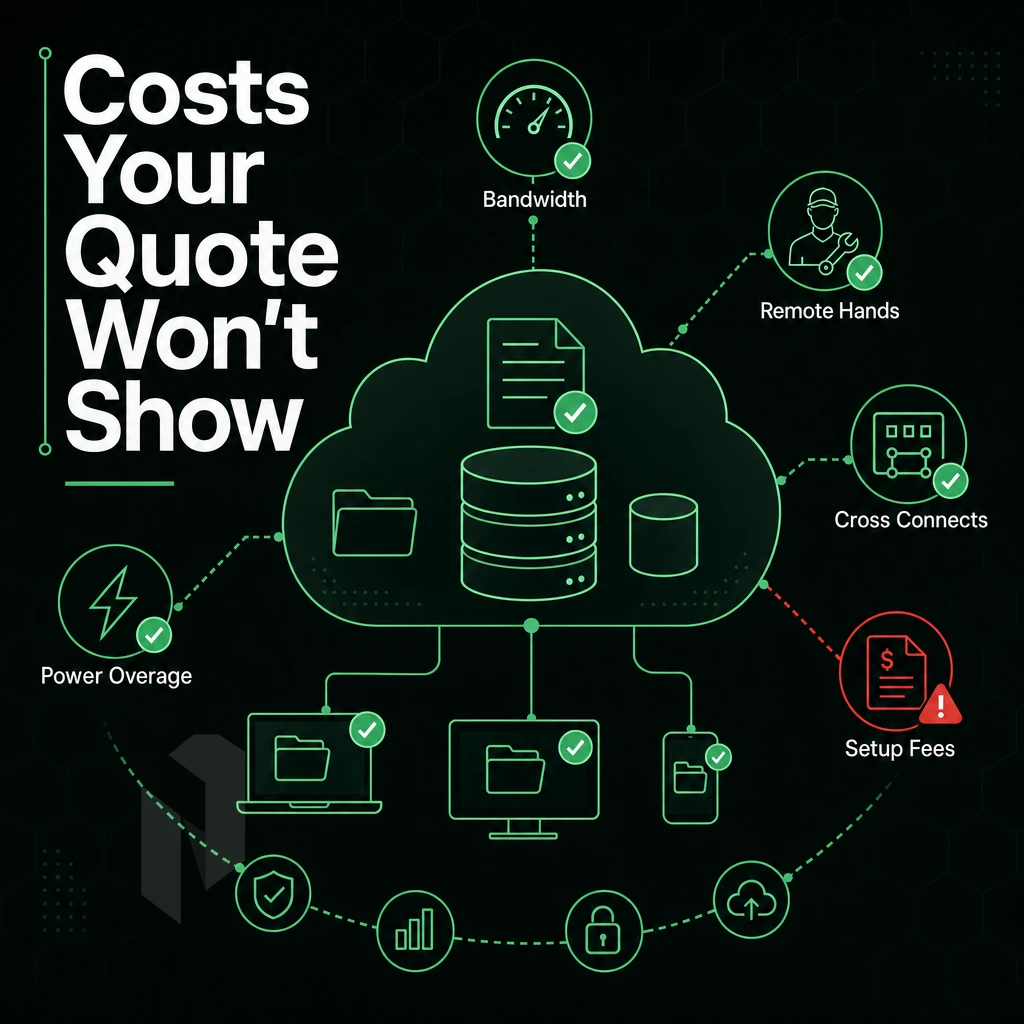
Colocation quotes are often not what they seem. The headline rack rate for the space and basic power is only the start of the total cost to deploy. With a dozen or so more hidden line items that only surface in the contract’s appendices or after the contract has gone live.
One-Time and Recurring Fees Per Month
Setup and installation fees are common. The circuit provisioning fee for cross connects may be charged on a per connect basis, a one-off build fee plus a on-going monthly port fee. Annual fees for IP address allocation also exist, particularly for large blocks of IPv4 addresses.
Most data center facilities charge remote hands labor separately from the regular service level agreement (SLA) hours. The price for remote hands labor varies by the type of task required. A simple task like re-cabling a server is less expensive than completing a full hardware swap while under time pressure. Be sure to confirm whether or not your carrier neutral SLA includes any free remote hands hours and if all hours thereafter are billable from the time the ticket is opened.
High Density Power and Bandwidth Overages
In a carrier neutral facility, this typically is committed in the form of a guaranteed draw per cabinet occupying physical space (for example 2 kW per cabinet), and may include high rates for overage above that level. Burstable bandwidth, whether in a shared environment or a full rack private cage, is often billed at a base rate until a high percentile (95th percentile being very common) is reached, then additional bandwidth is charged at a high per-Mbps overage rate.
Bandwidth may be included in the rack rate or be listed as a separate charge. It’s wise to verify with the provider before you sign any contracts.
How Much Does Colo Cost?
Costs of colocation vary by market, by density and by contract length. A single 1U slot that providers offer in a carrier neutral datacenter can be much cheaper than a full private cabinet in a Tier III datacenter located in the heart of a financial district. On top of the monthly costs for the colocation also have to be paid the managed services like OS-patching, monitoring and control-panel licensing.
We offer competitive pricing for our colocation services starting from $85.96/year. All services include N+1 power and cooling, carrier neutral connectivity, and courtesy remote hands. We will provide you with a line-item quote from our sales team including all fees and charges.
Private Cage Contract Exit and SLA Penalties
Read the Early termination clauses (ETCs) to understand the penalties for the remaining months of contract value. Also read the SLA to understand hardware replacement times and uptime guarantees (eg 99.9% SLA allows 43 minutes of downtime per month). Find out what each remedy is for each guarantee that is breached. After reading all of this, read the article on colocation vs cloud at scale.
Colocation vs. Cloud: Which Costs Less at Scale?
| Provider Type | Performance | Support | Uptime SLA | Network | Best For |
|---|---|---|---|---|---|
| Netrouting | N+1 power and cooling; high-density data centers up to 20 kW per footprint; Dell and Supermicro hardware | 24/7 NOC; 1-hour ticket guarantee; courtesy remote hands included | 99.9% SLA; same-business-day hardware replacement | 2.4 Tbps+ backbone (AS6206); unmetered 10 Gbps; AMS-IX, DE-CIX, FL-IX peering; always-on DDoS protection | Businesses needing carrier-neutral colocation across Europe, North America, and Asia with a strong network backbone |
| Hyperscaler-adjacent colocation | Standardized power densities; limited custom configurations | Tiered support; premium response times cost extra | 99.9% typical; higher tiers available at added cost | Dense IX presence in major metros; proprietary cross-connects | Enterprises already committed to a single cloud ecosystem |
| Regional carrier-neutral colo | Variable density; facility quality varies by market | Business-hours support common; 24/7 varies by provider | 99.9% standard; terms vary widely | Single-region IX peering; limited global reach | Local businesses with no multi-region requirements |
| Wholesale colocation | High-density capable; built for large footprints | Minimal managed services; self-sufficient teams required | 99.9%-99.99% depending on contract size | Connectivity sourced separately; no bundled transit | Large enterprises leasing entire halls or suites |
For the vast majority of customers with latency sensitive services, and those with high density distributed systems of servers across multiple locations, Netrouting's carrier neutral datacenter facilities combined with the large 2.4 Tbps+ network. Additionally, Included DDoS protection, 24/7 support team and dense peering make for the ideal hosting solution. Mapping the provider options to space tiers and detailing what each tier includes will be the next step in this series.
Colocation Pricing Comparison Table: Space Tiers and What's Included
The cost of colocation can vary by quite a large amount between the various space tiers on offer. When comparing carrier neutral spaces, it's also important to understand what is included in each tier, and where the cost is actually being spent for your hardware.
Space Tiers at a Glance
| Space Tier | Typical Power Draw | Connectivity Included | Best For | Relative Cost |
|---|---|---|---|---|
| 1U rack space | Up to 230W | Shared uplinks, redundant power | Single-server deployments, testing | Low |
| Half-rack | 1-3 kW | Dedicated uplinks, redundant power | Growing workloads, SMB infrastructure | Mid |
| Full cabinet | 3-10 kW | Dedicated uplinks, carrier neutral cross-connects | Enterprise workloads, high-density compute | Mid-High |
| Private cage | 10-20 kW per rack | Custom uplinks, dedicated cross-connects, carrier neutral | Compliance-driven, multi-cabinet deployments | High |
The primary cost driver above 1U power density is Power density. As you scale from a single enclosure to a full cabinet. The cost per rack of shared power infrastructure rises but falls as a cost per server as the shared infrastructure is amortized across more servers.
What Is the Difference Between a Full Cabinet and a Private Cage?
A full cabinet refers to a single locked rack installed in a shared row of equipment. You are responsible for the hardware contained within that cabinet, but the surrounding space is shared with other tenants. A private cage is a locked physical perimeter within the data center that can contain one or many cabinets.
Private cages are well suited to workloads that have strict compliance requirements and require physical access segregation. Full cabinets deliver same network performance at much lower physical overhead to most enterprise workloads.
Colocation vs. Dedicated Server vs. Cloud
| Dimension | Colocation | Dedicated Server | Cloud Compute |
|---|---|---|---|
| Hardware ownership | You own it | Provider owns it | Provider owns it |
| Uptime control | High, your hardware, N+1 facility | High, 99.9% SLA | Shared infrastructure dependency |
| Scalability | Manual, planned | Moderate, new servers on request | Rapid, on-demand |
| Predictable billing | High | High | Variable, usage-based |
| Managed overhead | You manage hardware and OS | Optional managed add-on | Provider manages infrastructure layer |
For organizations with existing hardware, colocation offers predictable power space spending and carrier neutral connectivity while maintaining full ownership of your hardware. We offer colocation services from our data centers in The Hague, Amsterdam and Rotterdam. Our dedicated colocation space comes with N+1 power and high density options up to 20kW per floor.
As part of our standard offering, we offer free on-site support for basic moves, adds and changes. We recommend evaluating potential providers against your specific needs after you have determined which tier of service is best for your workload.
How to Evaluate and Compare Colocation Providers
While price is an important factor when choosing a colocation service, it is not the only factor to consider. You should also review the colocation provider’s infrastructure, terms and conditions, and level of service and support before you make a decision. Use this checklist to help you compare the options available.
Preparation: Define Your High Density Requirements
- Determine your required power density. Calculate your kW per rack before speaking with individuals. High density environments, such as GPU clusters and other dense compute deployments, will require facilities with power ratings of 10 kW per rack or greater. The most common and costly surprise is under-sized power.
- Confirm carrier-neutral status. A carrier-neutral data center allows you to bring your own upstreams and negotiate cross connect fees with carriers independently. Single-carrier data center buildings, on the other hand, negotiate on your behalf and typically lock you into the provider’s pricing. In addition, single-carrier data centers create a single point of failure for crossconnects.
Evaluation: What to Check on Every Shortlist
- Review the power and cooling Service Level Agreements (SLAs) for N+1 versus 2N configurations for mission critical workloads. Also, ask if committed power or metered power is provided, and the additional costs of metered power that can fluctuate.
- Certifications and physical security. ISO 27001, SOC 2 and ISO 9001 controls audited. Access procedures for facilities walked through (biometric entry, CCTV, cage locks, visitor logs etc).
- The hands-on support model is used by some colocation centers and is often offered as an add-on service to their managed services offerings. Others charge per incident and you should clarify the scope of work and response time before agreeing to the service.
- Network quality: request the IX peering lists, the Tier 1 upstream count and the port utilization figures. The backbone of Netrouting (AS6206) runs continuously under 40% port utilization which you can use as a benchmark when comparing your shortlist of potential colocation facilities.
What Hidden Fees Should I Watch for in a Colocation Contract?
Most surprises are hidden in the terms and conditions of a contract. Watch out for these.
- Cross connect fees. These are typically charged on a per cable per month basis and can be an optional line item on a provider’s price list until you actually try to connect up a system in a data room and then find out that they are non optional.
- Excessive power usage above the committed kW level will result in overage charges. Usage that exceeds committed kW is charged at the metered power density rate. This can more than double the effective rate during periods of high usage.
- Minimums for on-site assistance access vary between sites. Some even charge a minimum of one hour for each access for what might be a two minute task.
- Exit fees (contract termination fees), typically charged as part of annual or multi-year contracts. Try to negotiate for month-to-month payment terms or set contract end dates and clear exit terms in advance.
Note: High density colocation contracts are especially prone to hidden power and cooling surcharges. Request an itemised quote covering every recurring and one-time fee before you sign. Armed with that checklist, here is how Netrouting measures up against each criterion.
Why Choose Netrouting for Colocation
When you compare colocation providers, the differences that matter most show up in the details: power density, network quality, and what's actually included in your monthly cost. Our colocation facilities are built for workloads that demand more than a basic rack space allocation.
- Carrier-neutral across 10 cities. We operate carrier-neutral data centers in Amsterdam, Frankfurt, The Hague, Rotterdam, Stockholm, Bucharest, Miami, New York, Hong Kong, and Singapore. Bring your own upstreams, use ours, or mix both, no lock-in.
- High-density power per footprint. Up to 20 kW per rack with N+1 dual power feeds and cooling. Our colocation facilities are high-density ready for GPU clusters, storage arrays, and compute-intensive deployments.
- Free private interconnect. A free private network up to 40 Gbps between your resources eliminates surprise cross-connect fees that inflate colocation costs at most colocation providers.
- Always-on DDoS protection included. Every colocation service ships with L3/L4 DDoS mitigation at no extra charge, not a paid add-on.
- Courtesy physical support, 24/7 NOC. Basic on-site technician support at no extra cost. Our NOC monitors your infrastructure around the clock with a one-hour ticket response guarantee.
- Certified and audited. ISO 9001, ISO 27001, and SOC 2, the compliance baseline enterprise procurement teams require.
The total cost of colocation services is rarely just the per-month rack fee. Factor in cross connects, data center hands, and DDoS mitigation, and our all-in model consistently lowers your actual monthly costs. Explore our colocation options or contact our sales team to discuss your power capacity, footprint, and deployment timeline.
Key Takeaways: Comparing Colocation Costs the Right Way
Colocation pricing is never just rack space. The real monthly cost stacks physical space, usable power, cross-connect fees, on-site intervention, and managed services on top of the headline rate. Retail colocation suits most enterprise buyers, full cabinet and private cage options scale without the unpredictable overhead of cloud. Always audit cross-connect and power usage charges before signing; those line items routinely dwarf the base colocation cost.
Carrier-neutral colocation facilities give you connectivity flexibility no single-carrier data center can match. evaluate colocation providers on total cost, power density, power redundancy, and SLA tiers, not just the per-rack figure. Certifications like ISO 27001 and SOC 2 signal operational discipline that protects you long after contract day one. Netrouting's colocation services are carrier neutral, spanning ten cities across Europe, North America, and Asia, with 24/7 support and a one-hour ticket guarantee.
Colocation pricing is rarely what it appears at first glance. The rack rate is just the starting point, power density, cross-connects, physical assistance, and bandwidth overages are where quotes quietly diverge. Understanding those variables before you sign is the single most important step in any colocation evaluation.
At scale, colocation consistently delivers lower overall cost of ownership than cloud compute for stable, predictable workloads. The math only works in your favor, though, when you choose a facility that matches your power, connectivity, managed services, and redundancy requirements, not just the cheapest private cage or cabinet available.
Netrouting operates carrier-neutral colocation across Europe, North America, and Asia, with N+1 power and cooling, unmetered 10 Gbps connectivity, and always-on DDoS protection included on every deployment per month of service. Review our colocation options or contact our team to get a quote built around your actual footprint.