Choosing between cloud hosting versus dedicated server is not just about infrastructure. It shapes how your business performs, how it scales, and how much control you actually have over your systems.
Pick the wrong setup and you will feel it quickly. Slower response times. Unpredictable costs. Systems that struggle under pressure. Pick the right one and things simply work. Better speed. More flexibility. Less friction as you grow.
Both options are powerful. They just solve different problems.
Blog contents
Cloud Hosting versus Dedicated Server in Simple Terms
At a glance, the difference is simple.
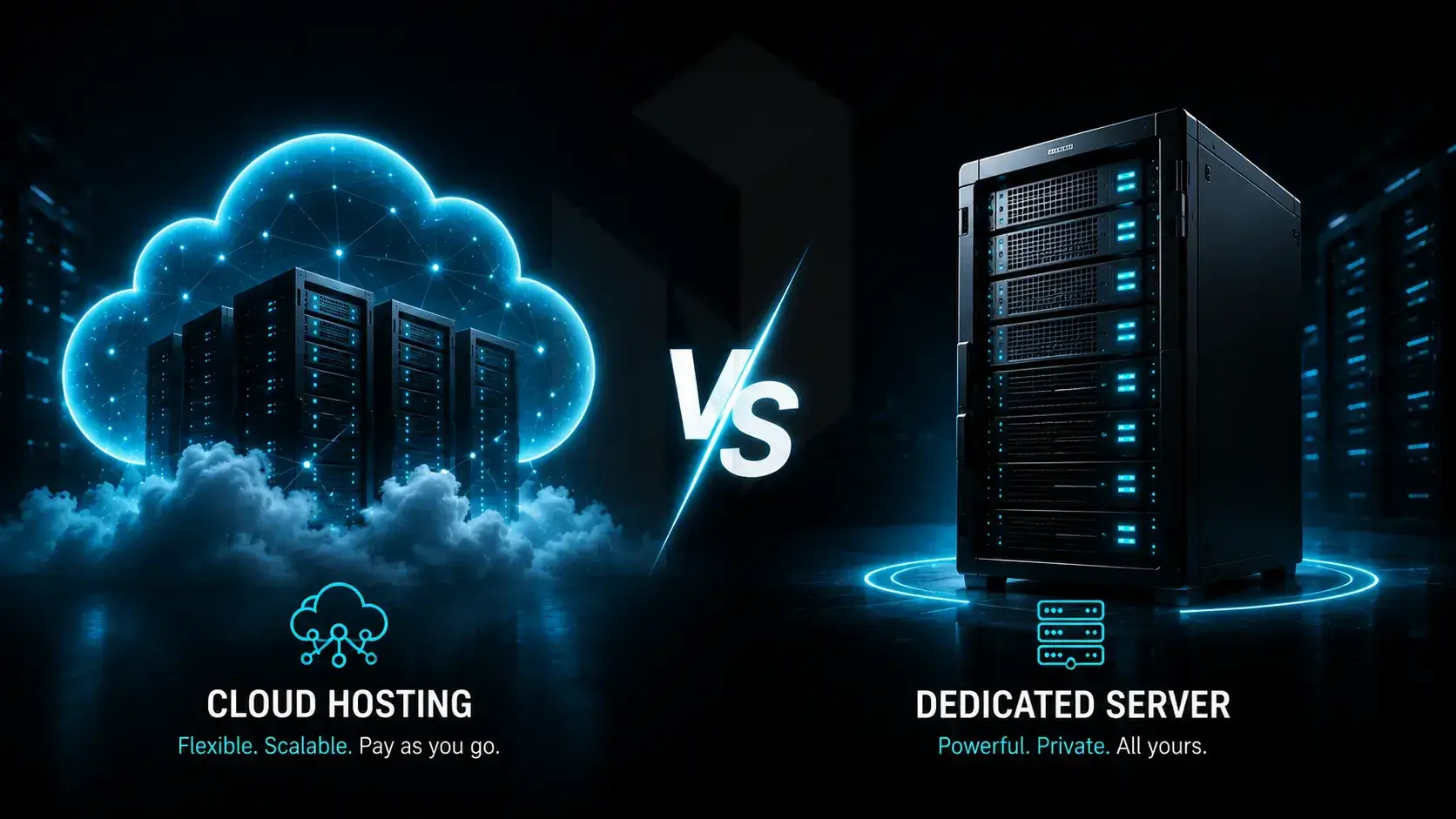
A cloud server runs on a network of multiple servers. Your data and workloads are spread across a cloud infrastructure. That means flexibility. It also means you are sharing underlying hardware resources with other users.
A dedicated server is the opposite. You get an entire physical server for your own use. No sharing. No competition. Just dedicated resources and full access to all computing power available.
So the real comparison is this. Flexibility versus control. Shared systems versus isolated environments.
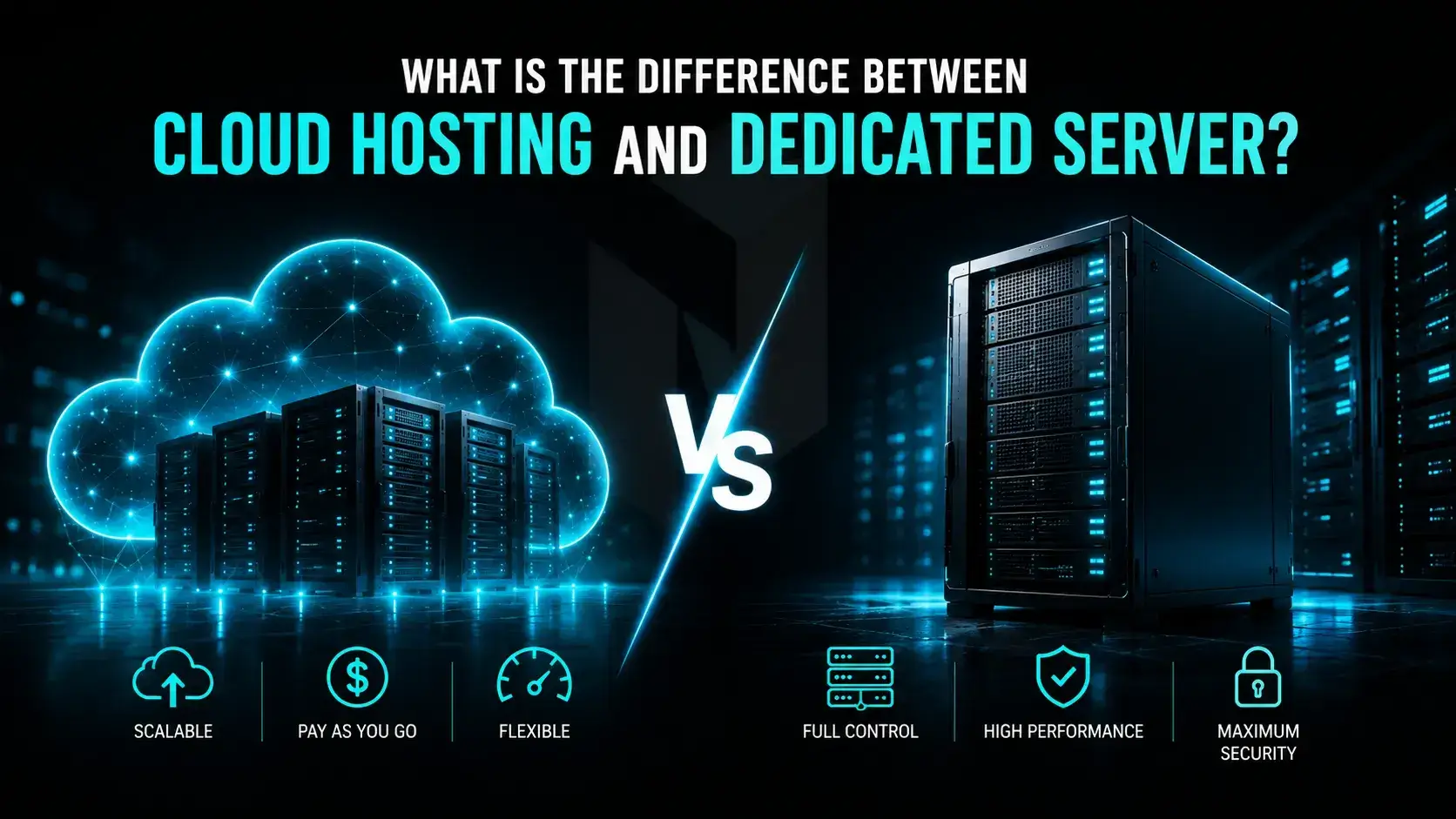
What Is the Difference Between Cloud Hosting and Dedicated Server?
The difference comes down to how server resources are handled and how much authority you have over them.
Core Differences at a Glance
In cloud hosting, workloads run inside virtual servers powered by virtualization technology. These environments pull computing resources from a shared pool across multiple servers.
With dedicated hosting, everything sits on one physical server. All hardware resources are exclusively allocated to you.
That alone changes how performance, cost, and scalability behave.
How Resource Allocation Works
In cloud environments, allocation is dynamic. If your application needs more capacity, the system can scale resources almost instantly. It happens behind the scenes.
With dedicated physical servers, allocation is fixed. You have access to all the resources, but they do not automatically expand. If you need more, it usually involves physical hardware changes or migration.
Key Trade-offs You Need to Know
Cloud gives you flexibility and cost efficiency. It adapts well to dynamic workloads.
Dedicated gives you consistent performance, complete control, and predictable behavior.
There is no universal winner. It depends on what your workload demands.
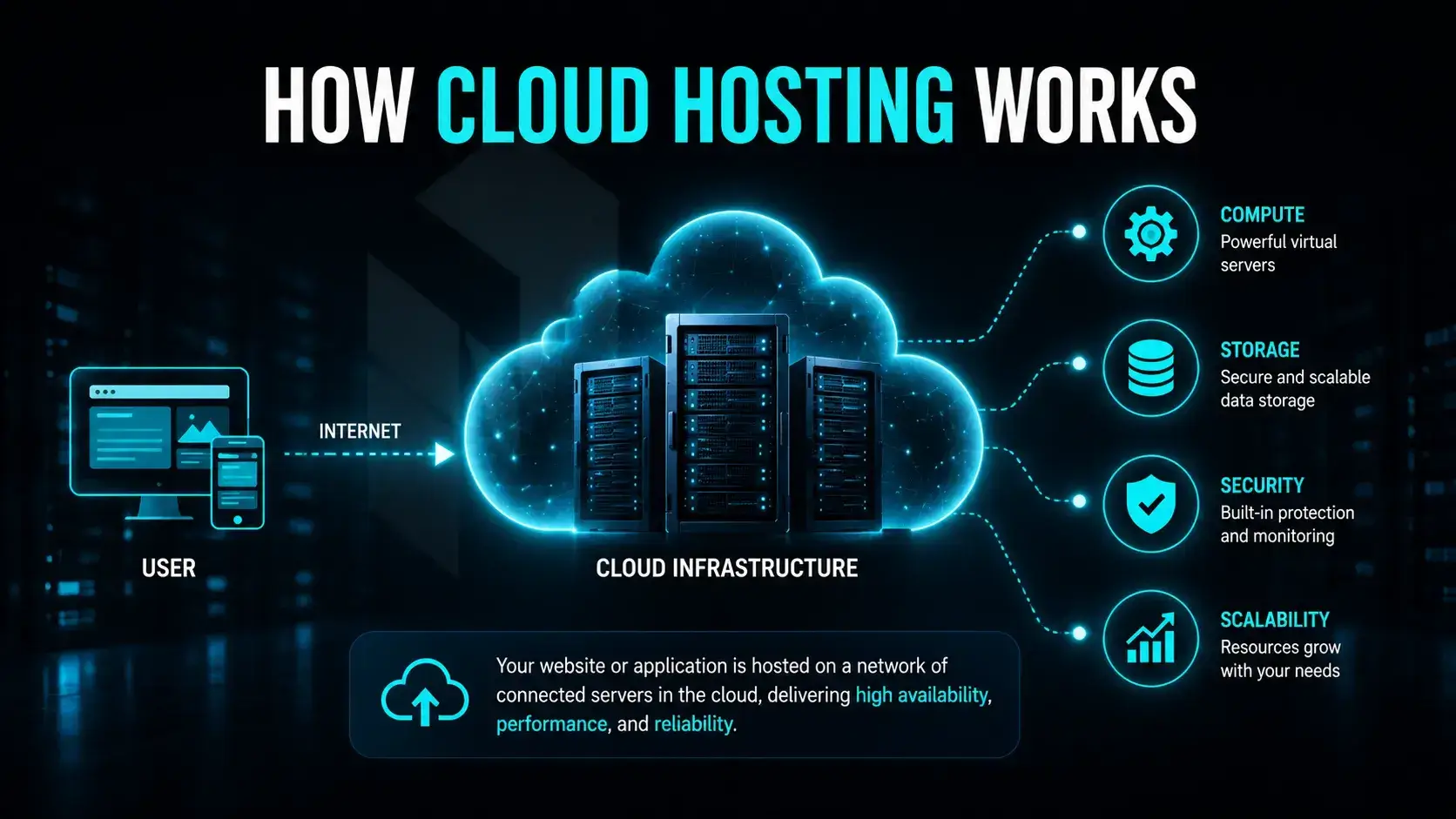
How Cloud Hosting Works
To understand why cloud is flexible, you need to see how it operates.
What Is Cloud Hosting?
Cloud hosting is a model where applications run on a network of servers instead of a single machine. These systems are managed by cloud providers and delivered as scalable cloud services.
Instead of one machine doing all the work, the load is distributed.
How Cloud Infrastructure Distributes Resources
Inside a data center, cloud servers rely on clusters of machines. Each virtual machine draws from shared computing resources.
If one node fails, another takes over. This is how cloud systems maintain high availability and business continuity.
It is also what makes them resilient.
Benefits of Cloud Hosting
There are several compelling advantages.
- First, flexibility. You can scale resources instantly.
- Second, availability. Systems stay online even if one server fails.
- Third, cost. Many setups are cost effective because you only pay for what you use.
For businesses dealing with traffic spikes or rapid growth, this matters.
Limitations of Cloud Hosting
Cloud is not perfect.
Because it operates across multiple users, performance can fluctuate slightly. Not always noticeable, but it exists.
You also have less full control over the underlying physical hardware. Some server configuration options are restricted depending on the provider.
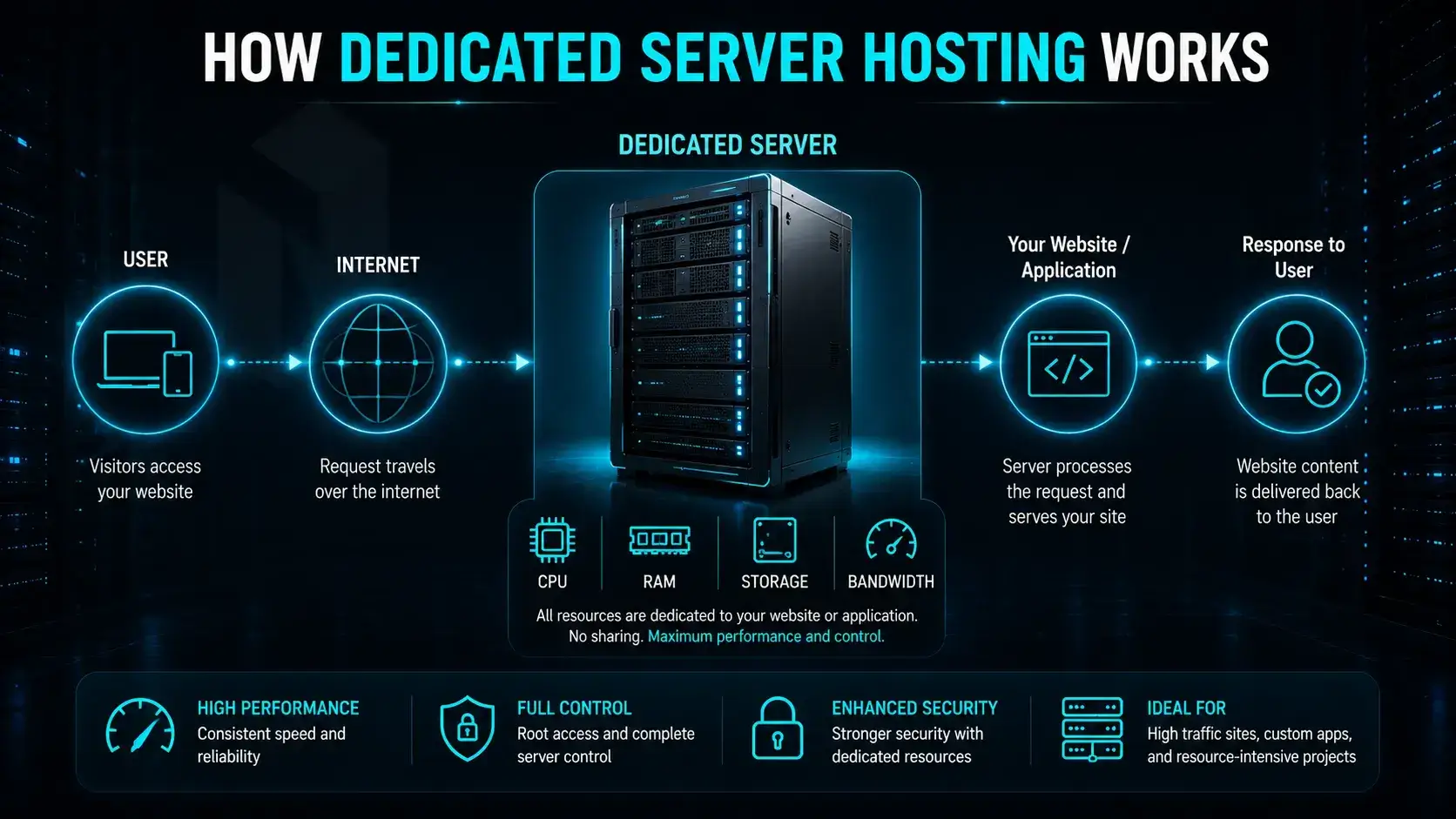
How Dedicated Server Hosting Works
Dedicated infrastructure takes a very different approach.
What Is a Dedicated Server?
A dedicated server is a single physical server assigned to one client. No sharing. No resource pooling.
Everything is yours. CPU, RAM, storage, network bandwidth.
How Dedicated Infrastructure Operates
All workloads run directly on dedicated hardware. There is no abstraction layer unless you add one yourself.
This means you have direct access to high performance hardware and complete authority over the operating system.
Benefits of Dedicated Hosting
Dedicated servers offer stability.
- You get consistent performance because no one else is using the machine.
- You also get complete hardware isolation, which improves data security.
- Another major benefit is customization. You can install custom software, tune the system, and optimize for specific workloads.
Limitations of Dedicated Servers
The trade off is flexibility.
Scaling requires planning. You may need new hardware or migration. It also demands more technical expertise, especially without managed hosting services.
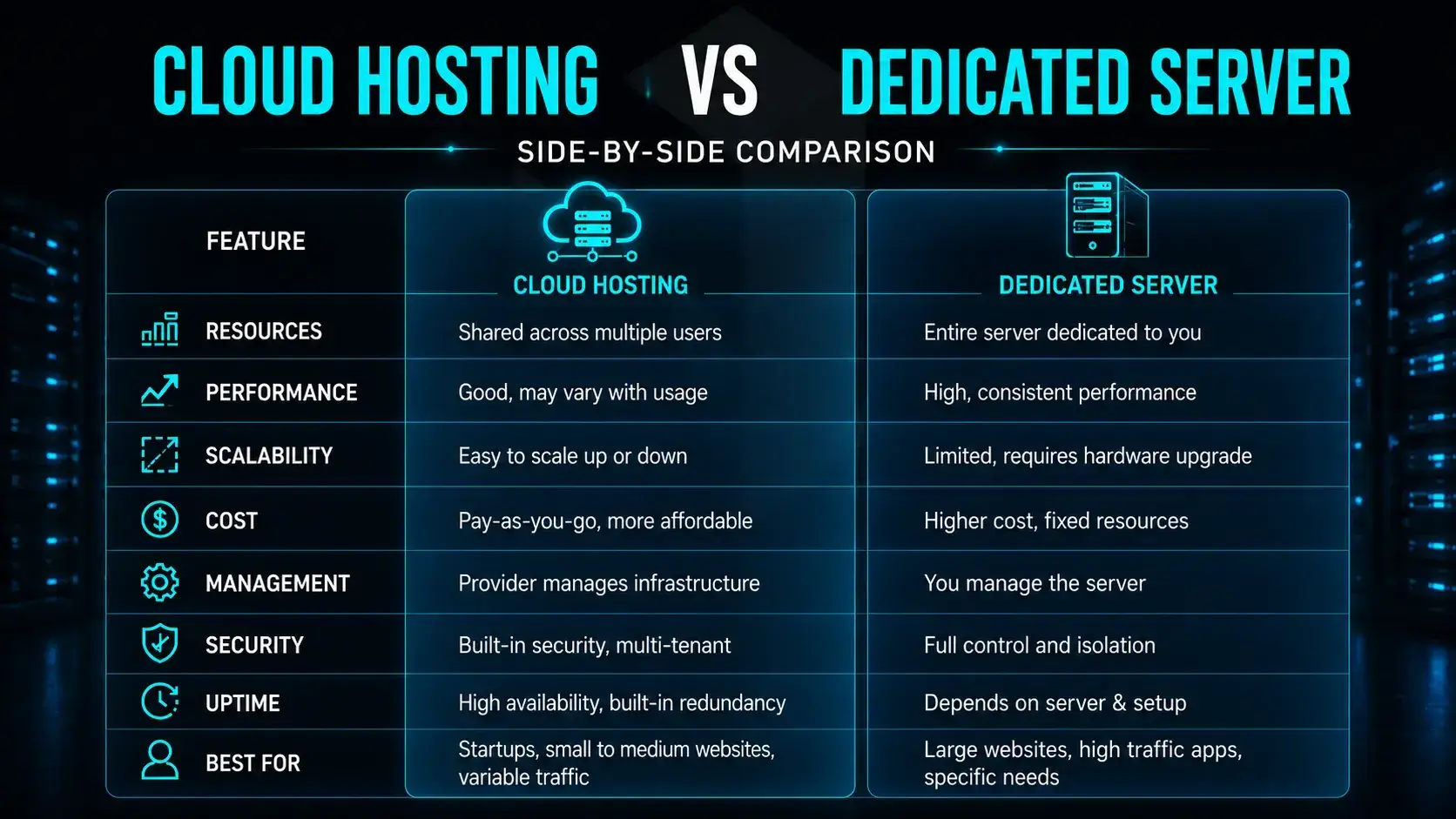
Cloud Hosting versus Dedicated Server: Side-by-Side Comparison Table
Choosing between cloud hosting and a dedicated server can feel simple at first, but the impact shows up later. Cloud hosting gives you flexibility and quick scaling when things change. A dedicated server focuses on stability and full control from the start. This quick comparison helps you see the difference fast, so you can decide without getting stuck in technical details.
| Category | Cloud Hosting | Dedicated Server |
| Performance | 🟡 Flexible but can vary | 🟢 Stable and consistent |
| Traffic Handling | 🟢 Elastic for spikes | 🟡 Strong but fixed |
| Uptime | 🟢 High availability | 🟡 Reliable (single server) |
| Cost | 🟢 Pay as you go | 🔴 Higher fixed cost |
| Security | 🟡 Shared environment | 🟢 Full isolation |
| Scalability | 🟢 Instant scaling | 🟡 Manual scaling |
| Resources | 🟡 Shared resources | 🟢 Fully dedicated |
| Control | 🟡 Limited control | 🟢 Full control |
| Management | 🟢 Easy / managed | 🔴 Needs expertise |
| Best For | 🟢 Growing workloads | 🟢 High-performance systems |
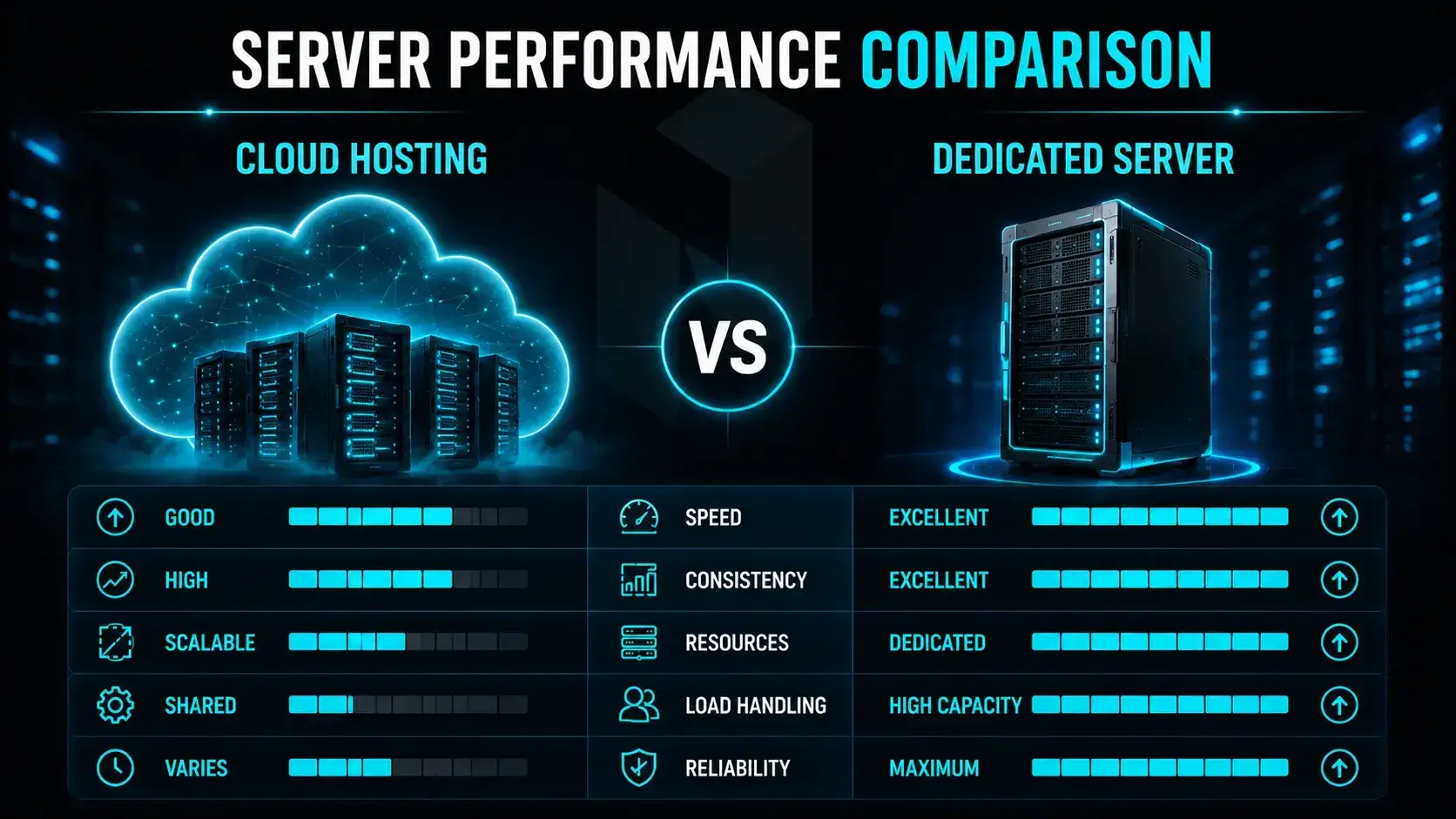
Cloud Hosting versus Dedicated Server Performance Comparison
Performance is usually where the decision becomes obvious.
It is not just about speed. It is about how your system behaves under pressure, during traffic spikes, and over long periods of time.
Consistent Performance vs Distributed Systems
Cloud systems are built for resilience.
Your application runs across multiple servers inside a larger cloud infrastructure. If one node slows down or fails, another takes over. That is why uptime is strong.
But there is a catch.
Because cloud servers rely on shared environments, performance is not always identical from one moment to the next. Most of the time, you will not notice it. Under heavy load, small fluctuations can happen.
A dedicated server feels different.
All computing power is reserved for you. No shared workloads. No external interference. What you get is stable, predictable output.
For applications that cannot tolerate variation, that difference matters.
Handling High Traffic and Workloads
Cloud hosting is built for change.
Traffic spikes, sudden growth, unpredictable demand. The system adjusts by adding more resources automatically. You do not need to step in or plan ahead every time usage increases.
That makes cloud a strong fit for dynamic workloads.
Dedicated servers take another approach.
They do not expand automatically, but they deliver raw power. If your workload is heavy and constant, performance stays consistent. No scaling delay, no dependency on other nodes.
This is why dedicated setups are often used for big data analytics, high performance computing, and systems that process large volumes of data continuously.
Uptime and Reliability
Cloud platforms focus on redundancy.
If one server fails, another one picks up the workload. This design supports high availability and helps maintain uptime even during hardware issues.
It is built for continuity.
Dedicated servers rely on a single machine.
That might sound like a weakness, but it depends on how it is managed. With proper configuration, monitoring, and backup strategies, uptime can still be very strong.
The difference is in behavior.
Cloud recovers automatically. Dedicated stays stable and predictable.
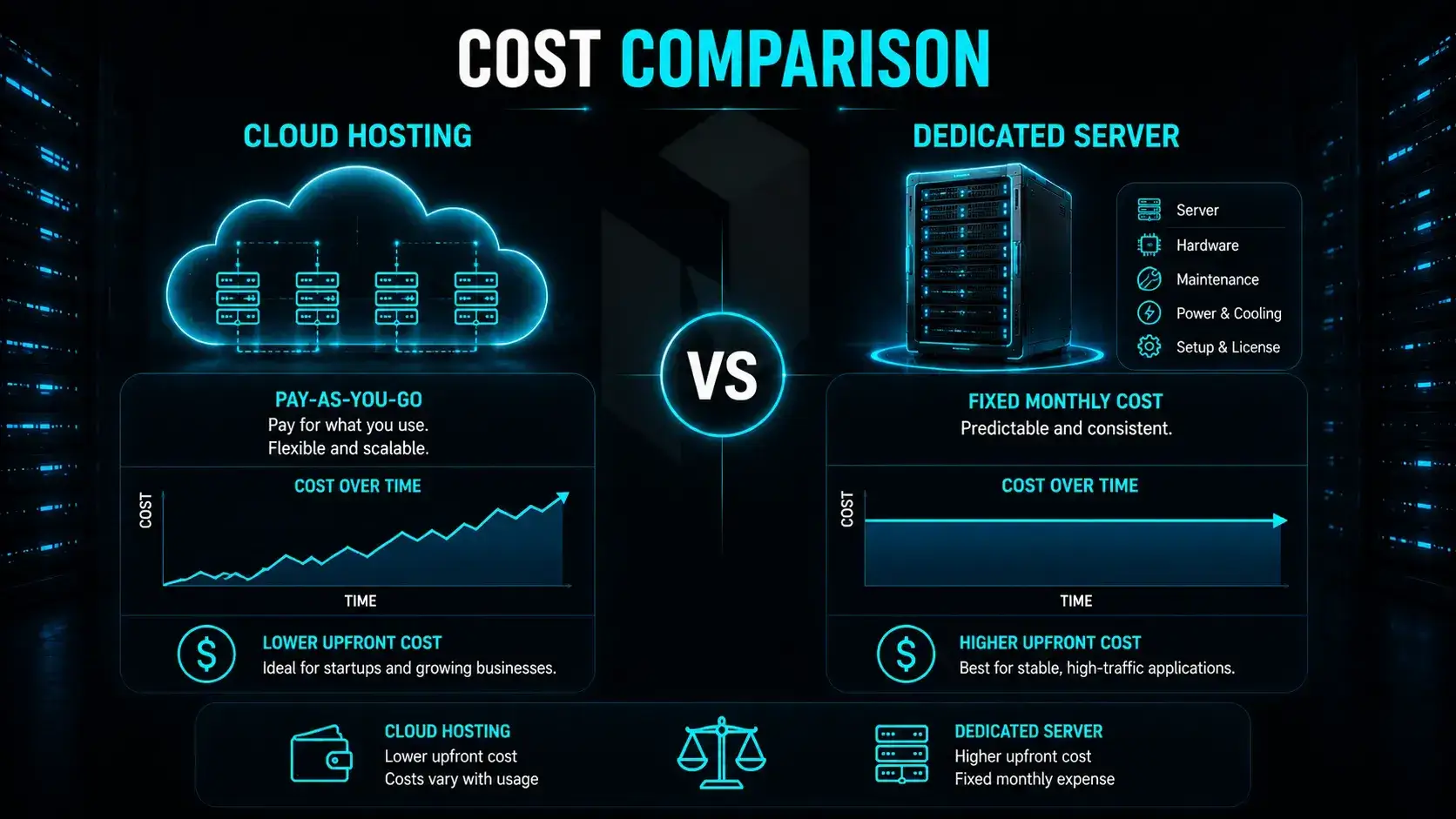
Cloud Hosting versus Dedicated Server Cost Comparison
Cost is rarely just about the monthly price.
It is about how pricing behaves as your usage changes.
Pay-as-You-Go vs Fixed Pricing
Cloud hosting follows a usage-based model.
You pay for the computing resources you consume. CPU, storage, bandwidth. Everything scales with your activity.
At first, this feels efficient. You avoid paying for unused capacity.
But it also means costs can change quickly.
A dedicated server is simpler.
You pay a fixed price for the entire server. Whether you use all the resources or not, the cost stays the same.
This makes budgeting easier. No surprises.
Long-Term Cost Efficiency
Cloud hosting is often more cost effective in the early stages.
If your workload is small or fluctuates, you only pay for what you need. That flexibility is valuable when growth is uncertain.
Over time, things can shift.
As usage increases and stays high, the pay-as-you-go model can become expensive. You keep paying for scaling.
Dedicated servers become more attractive here.
If you consistently use large amounts of computing power, owning all resources at a fixed cost can be more efficient in the long run.
So the real question is not which is cheaper.
It is how your workload behaves over time.
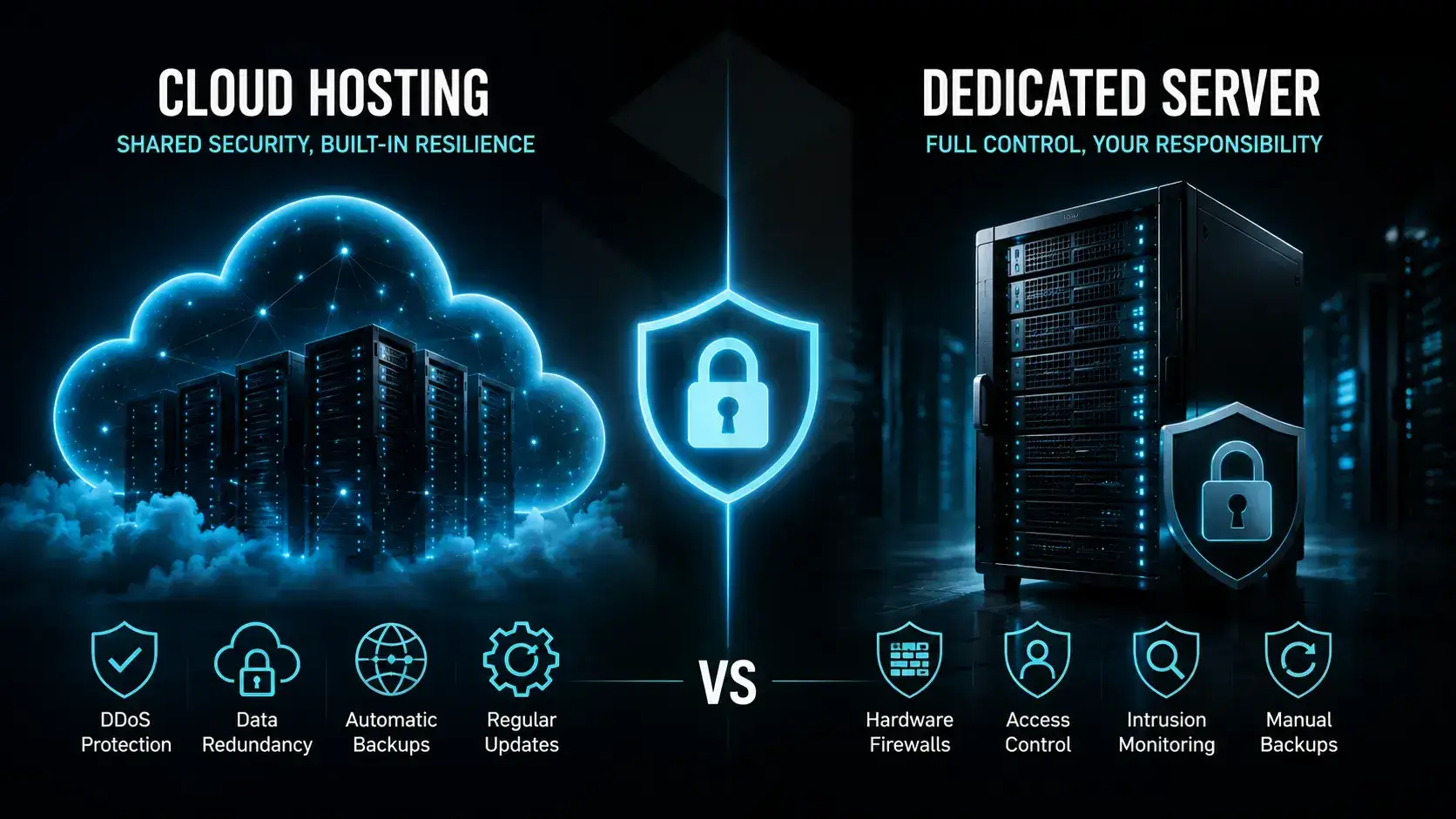
Cloud Hosting versus Dedicated Server Security Comparison
Security is not only about tools.
It is about isolation, control, and how much responsibility you want to handle.
Isolation and Risk Levels
Cloud environments are secure by design.
Major cloud providers invest heavily in infrastructure, monitoring, and security layers. For most applications, that level of protection is more than enough.
Still, the environment is shared.
Several users operate within the same underlying system. Even with strong isolation through virtualization, some businesses are not comfortable with that model.
Dedicated servers remove that concern.
You get complete hardware isolation. No shared access. No overlap with other users.
That alone reduces certain types of risk.
Compliance and Data Protection
For businesses dealing with sensitive data, control becomes critical.
In cloud environments, compliance is possible, but often requires careful configuration. You need to understand how data is stored, processed, and secured within the provider’s system.
With a dedicated server, you control everything.
You define security policies. You choose tools. You manage how data is handled from end to end.
That level of control makes it easier to meet strict compliance requirements.
It also gives you confidence in how data protection is implemented.
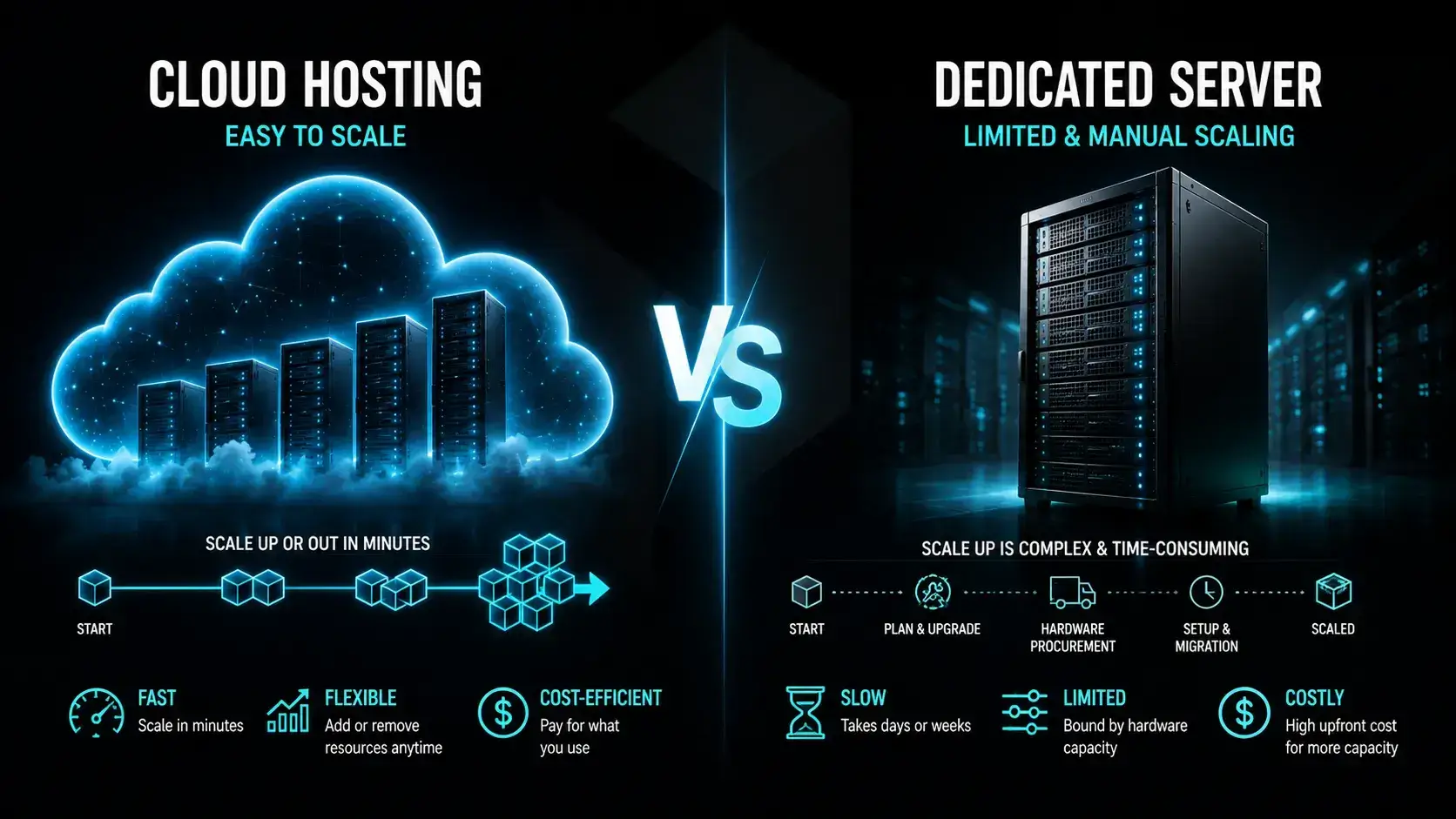
Cloud Hosting versus Dedicated Server Scalability Comparison
Scalability is where cloud hosting usually stands out.
But there is more to it than speed.
Scaling with Cloud Hosting
Cloud systems are designed to grow instantly.
Need more CPU or memory? You can scale resources with a few clicks. In many cases, it happens automatically based on demand.
This is known as dynamic scaling.
It is ideal for applications that experience sudden traffic spikes or unpredictable usage patterns.
You do not need to plan every upgrade in advance. The system adjusts as needed.
That flexibility is hard to match.
Scaling with Dedicated Servers
Dedicated servers scale differently.
There is no instant expansion. If you need more capacity, you have to upgrade hardware or move to a more powerful server.
That takes time.
But once the upgrade is done, you get stable performance with no dependency on shared infrastructure.
For businesses with steady growth or predictable workloads, this is not a problem.
In fact, it can be an advantage.
You know exactly how much capacity you have, and it does not change unexpectedly.
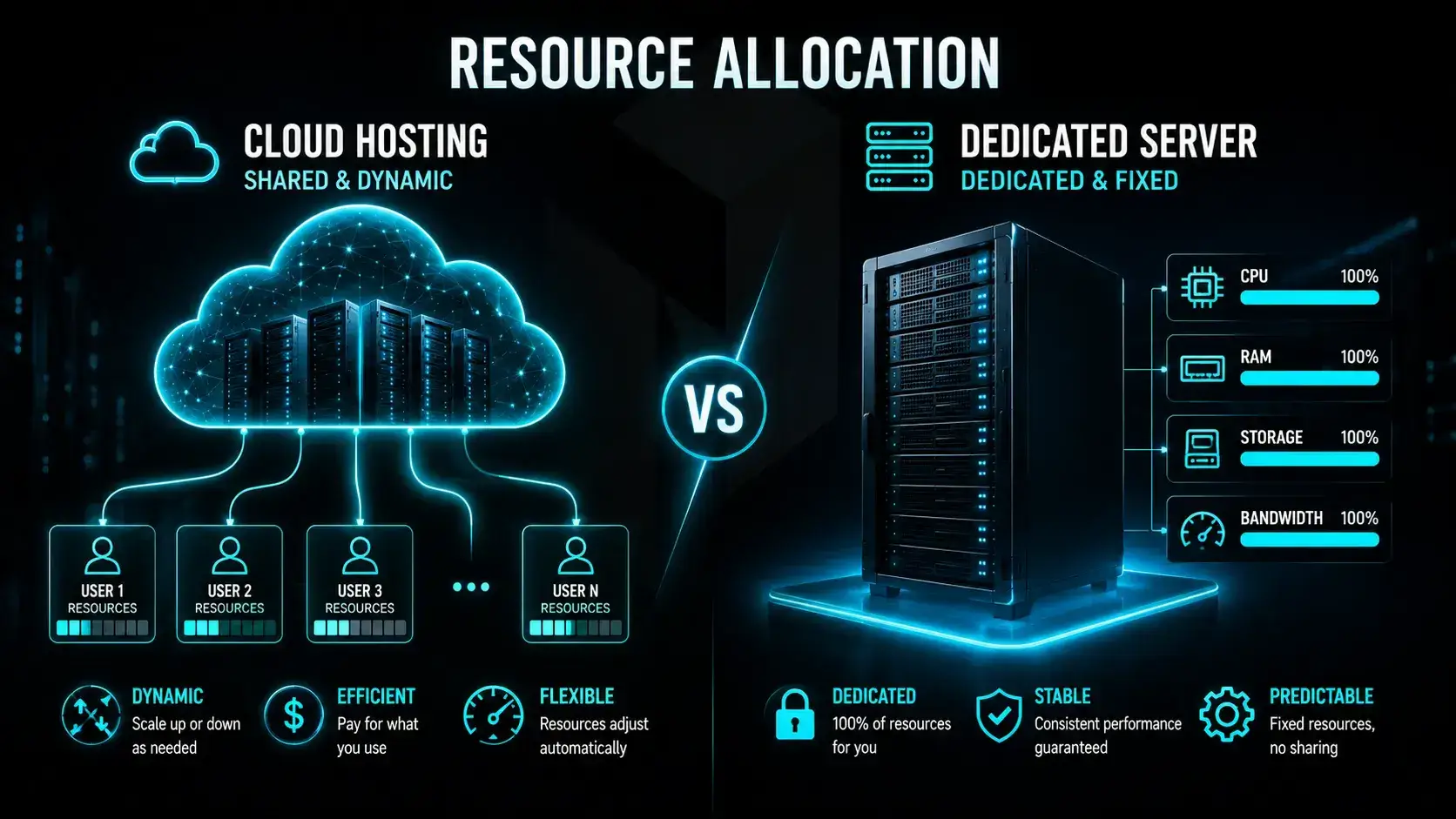
Resource Allocation in Cloud Hosting versus Dedicated Server
Cloud and dedicated environments treat resources very differently. This is where many real performance differences start.
How Cloud Servers Allocate Shared Resources Across Multiple Servers
In cloud hosting, your workload runs across multiple servers inside a larger cloud infrastructure. Instead of relying on a single physical server, the system pulls computing resources from a network of machines.
This is why cloud servers rely on distributed architecture.
If one node is busy, another can take over. If demand increases, the system can scale resources automatically. Often, it only takes a few clicks to increase CPU or memory.
That flexibility is powerful.
But there is a trade-off.
Because workloads move across virtual servers and cloud environments, resource allocation is dynamic. You are not always tied to fixed hardware resources. That means performance can vary slightly depending on system load, even though modern cloud providers do a strong job balancing it.
For businesses with dynamic workloads, this approach works extremely well. It supports high availability, business continuity, and fast scaling without touching the underlying physical hardware.
How Dedicated Servers Provide Exclusively Allocated Hardware Resources
A dedicated server works in a completely different way.
You get an entire physical server. Not part of it. Not shared. Everything.
All server resources are dedicated to your environment. CPU, RAM, storage, and bandwidth are yours at all times.
This is what people mean when they say dedicated servers provide consistency.
There is no resource competition. No noisy neighbors. No unexpected slowdowns from other users.
That leads to consistent performance, especially for resource intensive tasks like big data analytics, gaming servers, or high performance computing.
It also gives you complete hardware isolation. Your workloads run directly on exclusive hardware, without interference from other tenants.
If your priority is stability and predictability, this model is hard to beat.
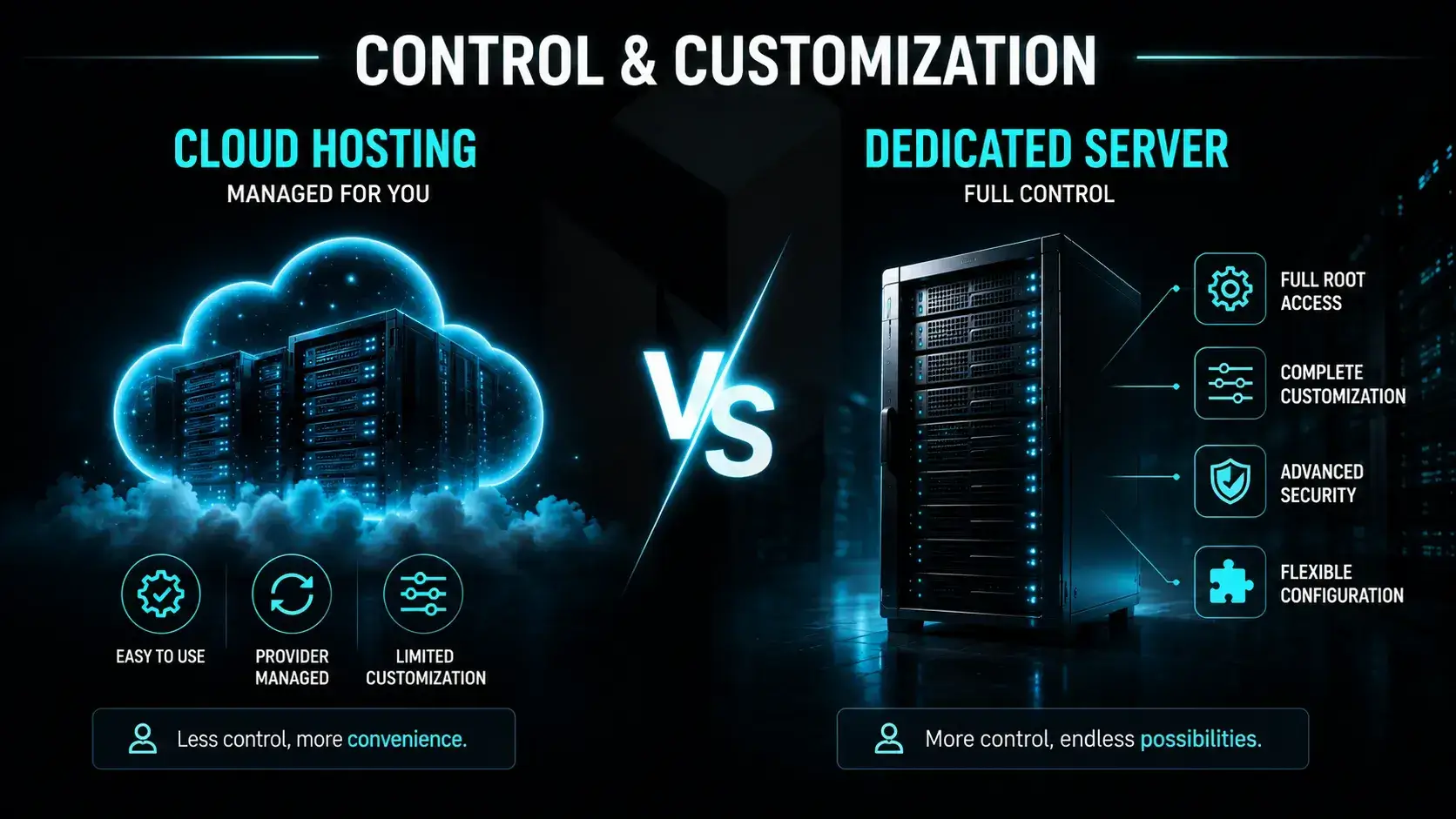
Control and Customization: Cloud vs Dedicated Server
Control is not just a technical detail. It affects how far you can optimize your system.
Full Control with Dedicated Servers
With dedicated hosting, you get full control over your environment.
You can choose your operating system, define your server configuration, and even decide how the physical hardware is used.
Need a specific kernel version? You can install it. Need custom networking rules? No problem. Want to install custom software tailored to your workload? Go ahead.
That level of access is what makes dedicated servers offer maximum flexibility.
You are not limited by a platform. You are not constrained by shared architecture.
This is especially important for businesses handling sensitive data, running custom software, or requiring strict compliance.
You also get exclusive access to all hardware resources, which means you can fine tune performance exactly how you want.
Limitations of Control in Cloud Environments
Cloud platforms still give you control. Just not at the same level.
You can configure your virtual machine, choose an operating system, and deploy applications. For many use cases, that is enough.
But there are limits.
You do not control the underlying physical hardware. You cannot fully dictate how resources are distributed across multiple servers. Some configurations are restricted by the platform.
This is the trade-off behind cloud solutions.
You gain flexibility and speed. You lose some depth of control.
For most businesses, especially those using managed hosting services, this is not a problem. It actually simplifies operations.
But for highly customized environments, it can become a constraint.
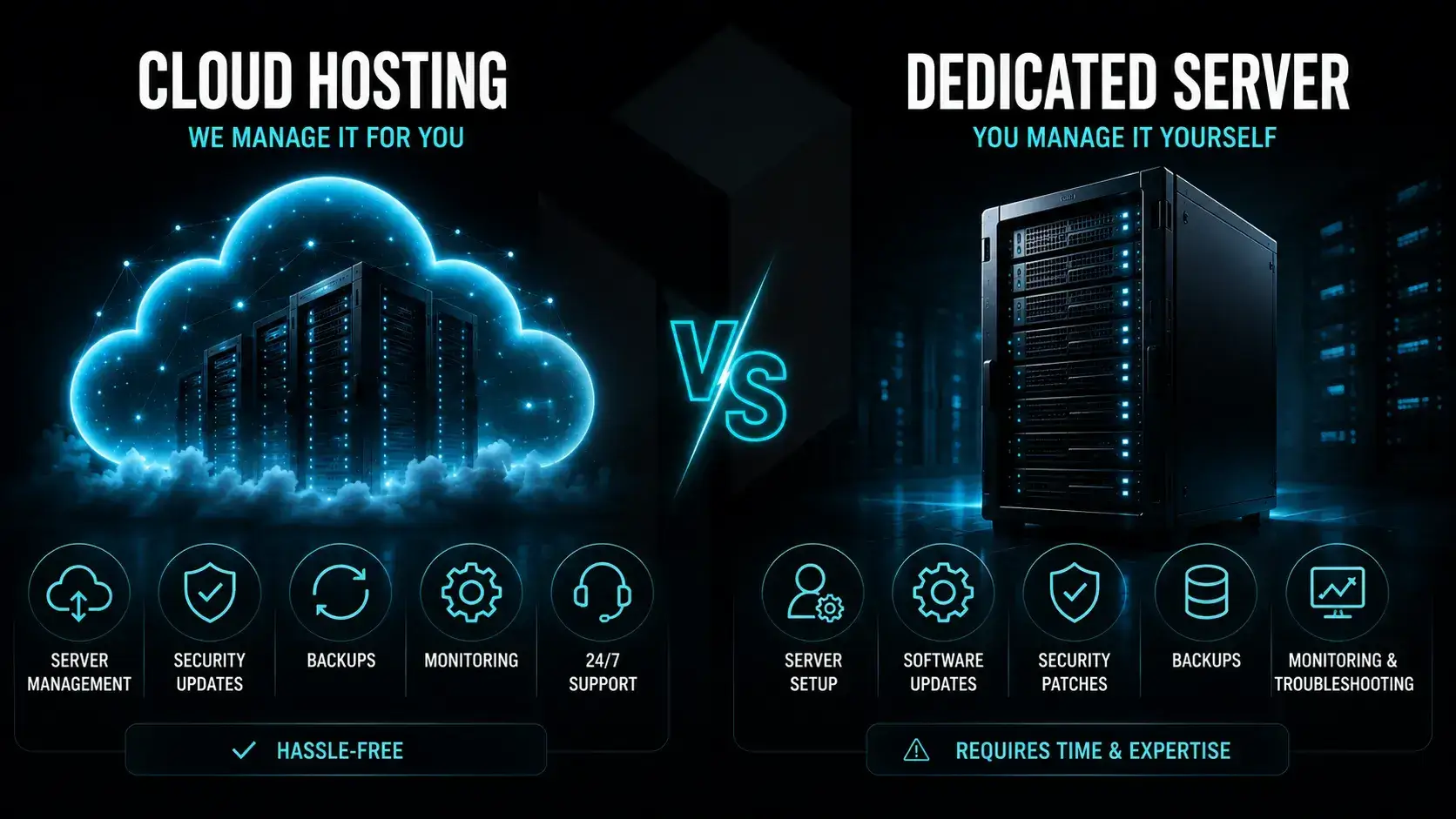
Management and Maintenance: Which One Is Easier to Manage?
This is where many businesses underestimate the difference.
Managed Cloud Hosting vs Self Managed Infrastructure
With cloud hosting, management is often simplified.
Most cloud providers offer managed hosting services that handle updates, monitoring, backups, and scaling.
You focus on your application. The provider handles the infrastructure.
This is why many teams prefer cloud environments. They reduce the need for deep technical expertise.
You can launch instances, adjust resource allocation, and manage systems with a dashboard. Sometimes, it really is just a few clicks.
This makes cloud a cost effective and practical option for growing teams.
Technical Expertise Required for Dedicated Servers
A dedicated server is different.
You are responsible for more.
That includes server configuration, security hardening, performance tuning, and ongoing maintenance.
If something breaks, your team needs to fix it.
That means you need stronger technical expertise or external support from hosting providers.
The upside is control.
The downside is complexity.
For companies with in house engineers, this is not a problem. In fact, it is often preferred.
For smaller teams, it can become a bottleneck.
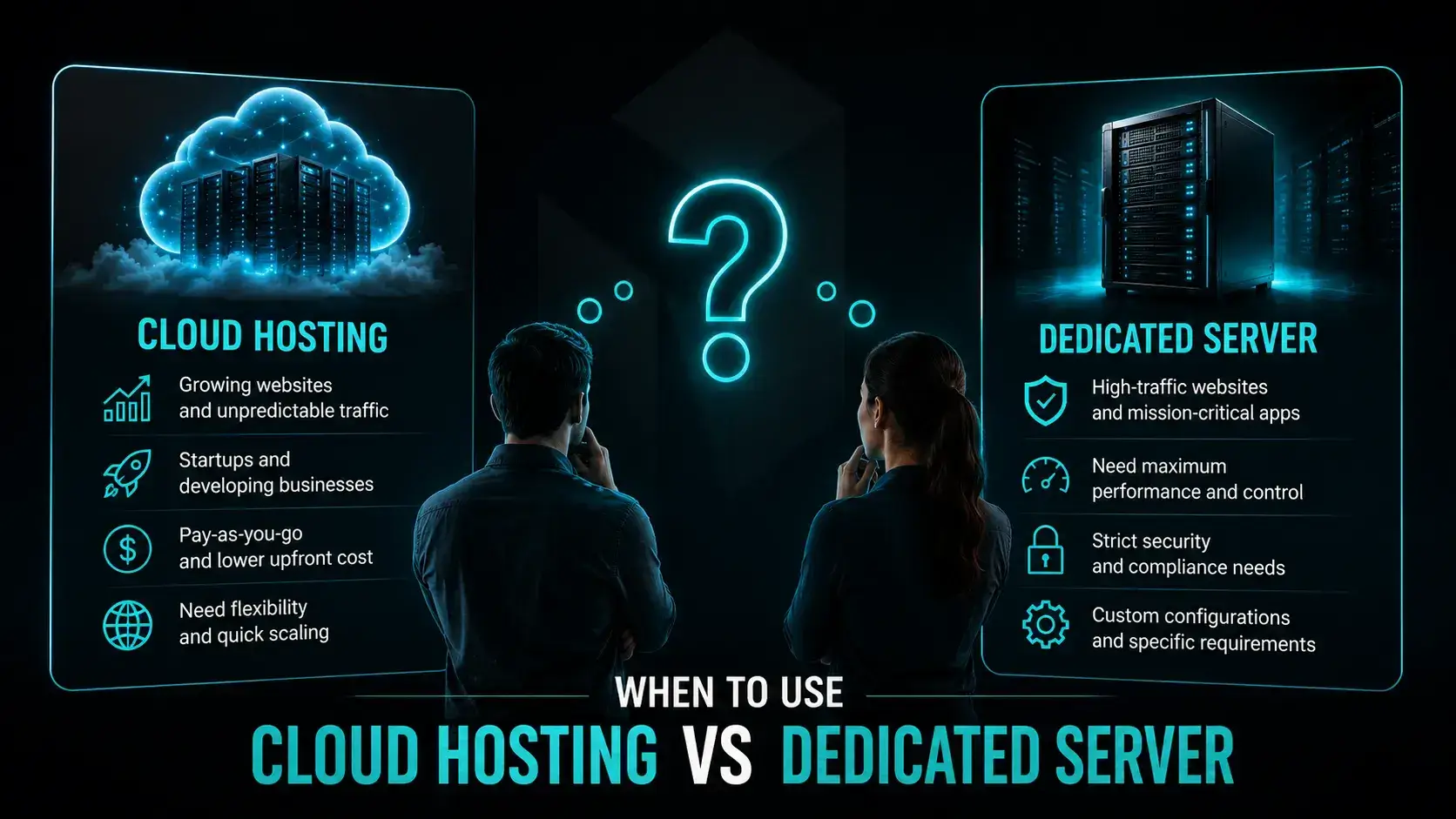
When to Use Cloud Hosting versus Dedicated Server
Not every business needs the same setup. The right choice depends on your workload.
Best Use Cases for Cloud Hosting
Cloud hosting works best when flexibility matters more than raw power.
It is ideal for:
- Startups and fast growing platforms
- Applications with dynamic workloads
- Businesses that need high availability
- Projects that require quick deployment
- Teams without deep infrastructure expertise
If your traffic fluctuates, or if you need to scale resources quickly, cloud makes sense.
It also works well for development environments, SaaS platforms, and applications that need to expand across regions.
Best Use Cases for Dedicated Servers
A dedicated server is built for performance and control.
It is the better choice for:
- High traffic websites
- Resource intensive tasks
- Applications that require consistent performance
- Systems handling sensitive data
- Workloads that need maximum security
If your application demands stable computing power, or if downtime is not acceptable, dedicated infrastructure is the safer option.
It is also common in industries where compliance and data protection are critical.
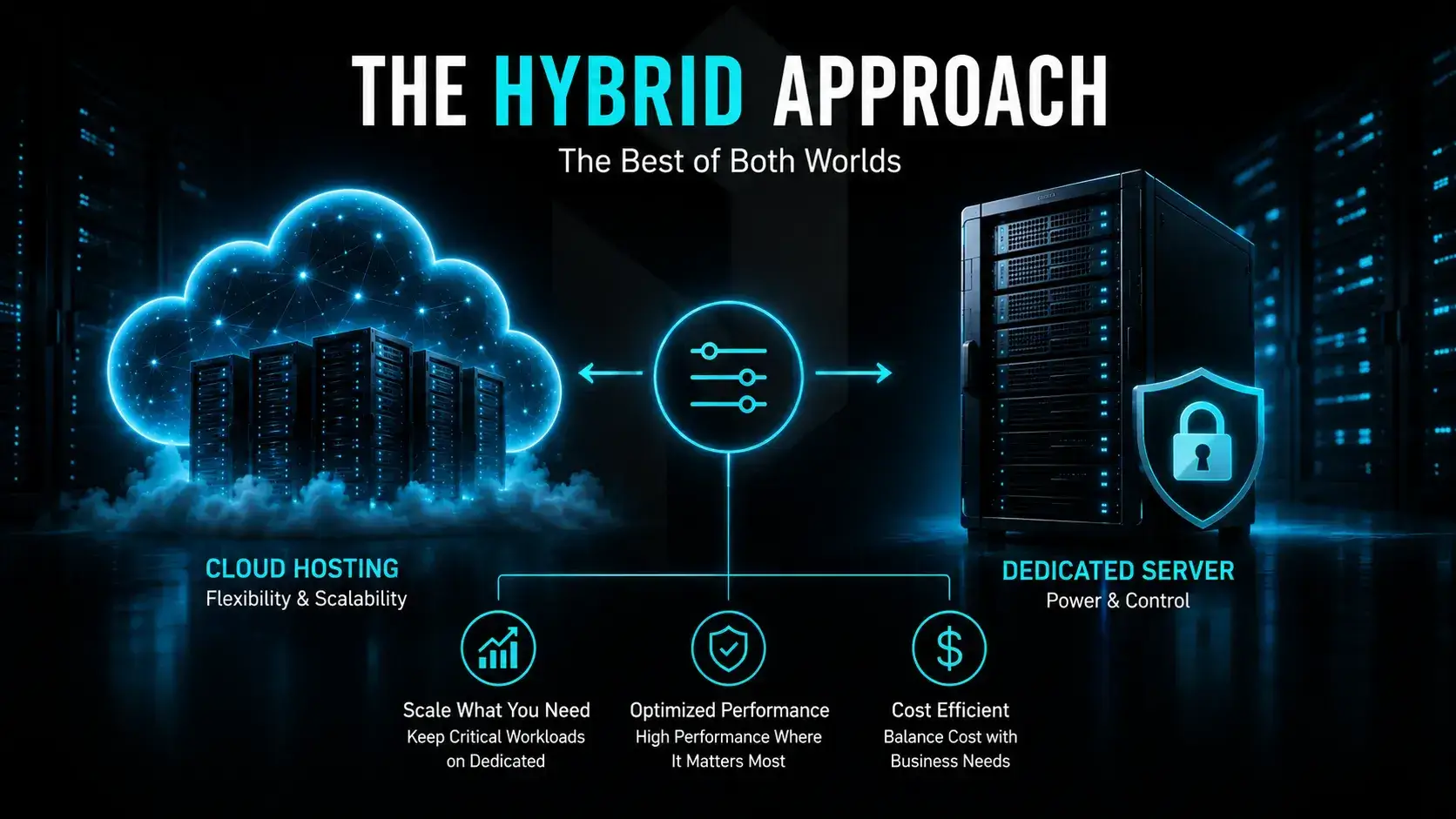
Hybrid Approach: Using Cloud and Dedicated Together
Sometimes the best answer is not choosing one.
What Is a Hybrid Infrastructure
A hybrid setup combines cloud and dedicated environments.
You might run your core application on dedicated physical servers while using cloud services for scaling, backups, or global distribution.
This gives you the best of both worlds.
Stable performance where it matters. Flexibility where you need it.
When Hybrid Hosting Makes Sense
Hybrid works well when:
- You need consistent performance for core systems
- You also need dynamic scaling for traffic spikes
- You want redundancy across environments
- You are transitioning from cloud to dedicated or vice versa
Many modern hosting solutions follow this model.
It is not about choosing sides. It is about building the right hosting solution for your workload.
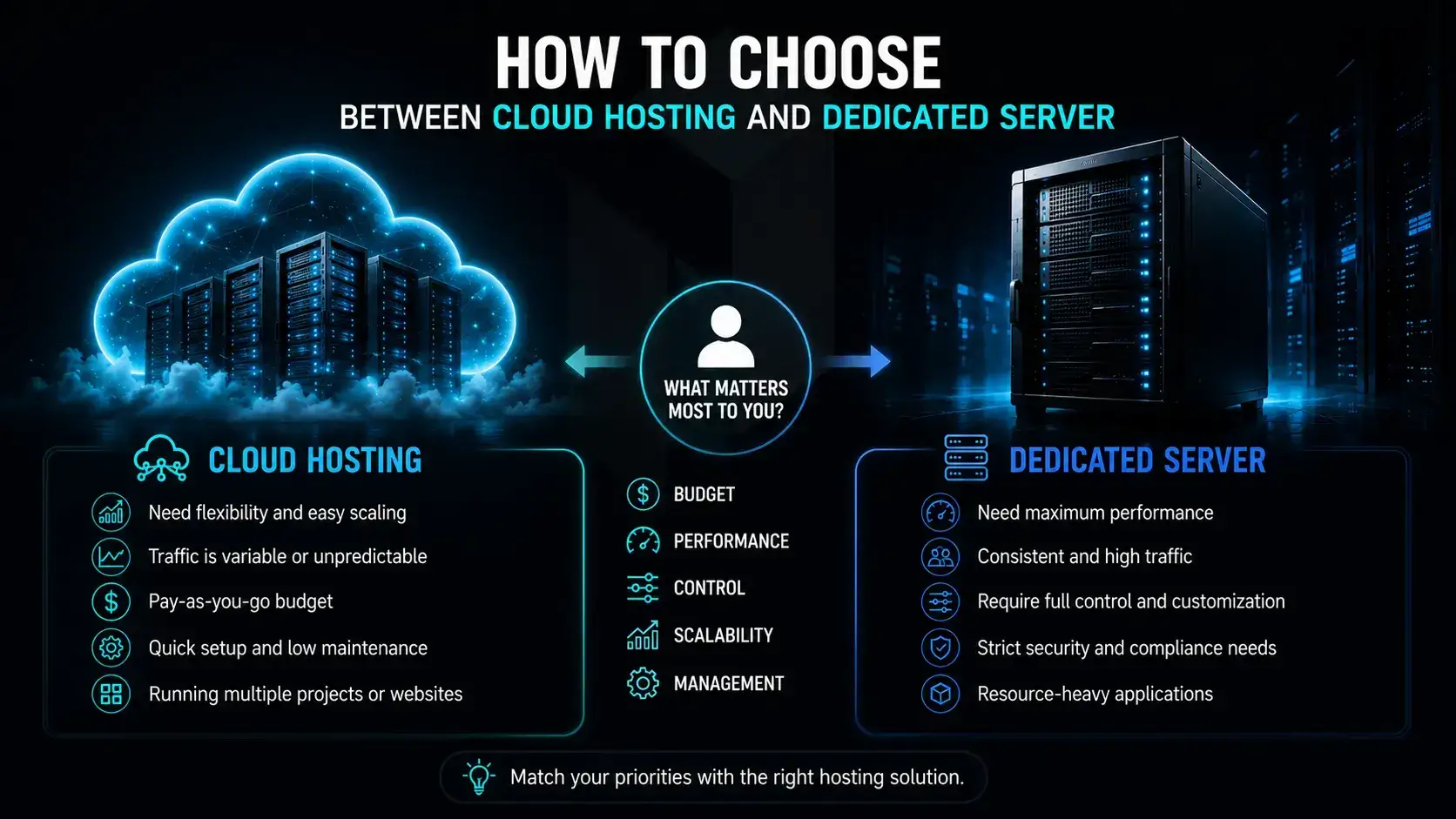
How to Choose Between Cloud Hosting and Dedicated Server
There is no universal answer. But there are clear decision points.
Budget Considerations
If budget is tight, cloud hosting is usually the starting point.
It is cost effective, flexible, and avoids large upfront investment.
A dedicated server costs more, but you are paying for all the resources and exclusive access.
Performance Requirements
If you need high performance, go dedicated.
If your workload is moderate or unpredictable, cloud is often enough.
This is one of the most important key differences.
Technical Expertise
Cloud reduces complexity.
Dedicated requires more skill.
If your team lacks deep infrastructure experience, cloud will be easier to manage.
Growth Plans
Think long term.
If you expect rapid growth, cloud gives you flexibility early on.
But if your application will eventually require high performance hardware, planning a move to dedicated hosting is smart.
Which One Should You Choose?
There is no single winner in the cloud hosting versus dedicated server debate.
It depends on what your business needs today and where it is heading.
If you value flexibility, fast deployment, and easier management, cloud hosting is the better fit.
If you need complete control, consistent performance, and full access to dedicated resources, a dedicated server is the stronger choice.
Some businesses stay in the cloud.
Others move to dedicated as they grow.
Many combine both.
The goal is not to pick what sounds better.
It is to choose what actually supports your workload, your team, and your future growth.
Frequently Asked Questions
What is the main difference between cloud hosting versus dedicated server? Cloud hosting uses a network of multiple servers to distribute workloads, while a dedicated server gives you one physical machine with all resources exclusively allocated to you. The difference shows up in flexibility versus control.
Is cloud hosting faster than a dedicated server? Not always. Cloud hosting can handle spikes well, but performance may vary slightly. A dedicated server delivers more consistent performance because all computing power is reserved for you.
Which is more secure, cloud hosting or dedicated server? Both can be secure, but dedicated servers offer higher isolation. Since no other users share the environment, it is often preferred for sensitive data and strict compliance needs.
When should I choose cloud hosting? Cloud hosting is a good fit if your traffic is unpredictable, or if you need to scale resources quickly without dealing with hardware changes.
When is a dedicated server the better choice? A dedicated server makes more sense when you need stable performance, full control, and the ability to run resource intensive tasks without limitations.
Is cloud hosting more cost effective than dedicated hosting? For smaller or growing workloads, yes. You only pay for what you use. But for long term, high usage, a dedicated server can become more cost efficient.
Can I scale a dedicated server like cloud hosting? You can scale, but it is not instant. It usually requires upgrading hardware or migrating to a more powerful setup, which takes more planning.
Do I need technical expertise to manage a dedicated server? Yes, especially if it is unmanaged. You are responsible for configuration, updates, and security. Cloud hosting often reduces that burden with managed services.
Can I use both cloud and dedicated servers together? Yes. Many businesses use a hybrid setup. They run core systems on dedicated hardware and use cloud services for scaling or backup.
Which option is better for long term business growth? It depends on your growth pattern. Cloud hosting supports fast and flexible growth early on. Dedicated servers become valuable when you need consistent performance and full control at scale.
Still not sure about the cloud or dedicated servers for your infrastructure? Check out our recent blog: How to Choose the Right IT Infrastructure for Your Business?
Find out your hosting options Netrouting is here to help you make the right decision for your business needs. Our experts are happy to assess your business needs with you to help you improve your business IT infrastructure. Please contact us at sales@netrouting.com or +31 (0)88 270 02 00
Cloud Hosting vs Dedicated Server: Which Should You Choose?
Choosing between cloud hosting vs dedicated server is not just about infrastructure. It shapes how your business performs, how it scales, and how much control you actually have over your systems.
Pick the wrong setup and you will feel it quickly. Slower response times. Unpredictable costs. Systems that struggle under pressure. Pick the right one and things simply work. Better speed. More flexibility. Less friction as you grow.
Both options are powerful. They just solve different problems.
Cloud Hosting vs Dedicated Server in Simple Terms
At a glance, the difference is simple.
A cloud server runs on a network of multiple servers. Your data and workloads are spread across a cloud infrastructure. That means flexibility. It also means you are sharing underlying hardware resources with other users.
A dedicated server is the opposite. You get an entire physical server for your own use. No sharing. No competition. Just dedicated resources and full access to all computing power available.
So the real comparison is this. Flexibility versus control. Shared systems versus isolated environments.
What Is the Difference Between Cloud Hosting and Dedicated Server?
The difference comes down to how server resources are handled and how much authority you have over them.
Core Differences at a Glance
In cloud hosting, workloads run inside virtual servers powered by virtualization technology. These environments pull computing resources from a shared pool across multiple servers.
With dedicated hosting, everything sits on one physical server. All hardware resources are exclusively allocated to you.
That alone changes how performance, cost, and scalability behave.
How Resource Allocation Works
In cloud environments, allocation is dynamic. If your application needs more capacity, the system can scale resources almost instantly. It happens behind the scenes.
With dedicated physical servers, allocation is fixed. You have access to all the resources, but they do not automatically expand. If you need more, it usually involves physical hardware changes or migration.
Key Trade-offs You Need to Know
Cloud gives you flexibility and cost efficiency. It adapts well to dynamic workloads.
Dedicated gives you consistent performance, complete control, and predictable behavior.
There is no universal winner. It depends on what your workload demands.
How Cloud Hosting Works
To understand why cloud is flexible, you need to see how it operates.
What Is Cloud Hosting?
Cloud hosting is a model where applications run on a network of servers instead of a single machine. These systems are managed by cloud providers and delivered as scalable cloud services.
Instead of one machine doing all the work, the load is distributed.
How Cloud Infrastructure Distributes Resources
Inside a data center, cloud servers rely on clusters of machines. Each virtual machine draws from shared computing resources.
If one node fails, another takes over. This is how cloud systems maintain high availability and business continuity.
It is also what makes them resilient.
Benefits of Cloud Hosting
There are several compelling advantages.
- First, flexibility. You can scale resources instantly.
- Second, availability. Systems stay online even if one server fails.
- Third, cost. Many setups are cost effective because you only pay for what you use.
For businesses dealing with traffic spikes or rapid growth, this matters.
Limitations of Cloud Hosting
Cloud is not perfect.
Because it operates across multiple users, performance can fluctuate slightly. Not always noticeable, but it exists.
You also have less full control over the underlying physical hardware. Some server configuration options are restricted depending on the provider.
How Dedicated Server Hosting Works
Dedicated infrastructure takes a very different approach.
What Is a Dedicated Server?
A dedicated server is a single physical server assigned to one client. No sharing. No resource pooling.
Everything is yours. CPU, RAM, storage, network bandwidth.
How Dedicated Infrastructure Operates
All workloads run directly on dedicated hardware. There is no abstraction layer unless you add one yourself.
This means you have direct access to high performance hardware and complete authority over the operating system.
Benefits of Dedicated Hosting
Dedicated servers offer stability.
- You get consistent performance because no one else is using the machine.
- You also get complete hardware isolation, which improves data security.
- Another major benefit is customization. You can install custom software, tune the system, and optimize for specific workloads.
Limitations of Dedicated Servers
The trade off is flexibility.
Scaling requires planning. You may need new hardware or migration. It also demands more technical expertise, especially without managed hosting services.
Cloud Hosting vs Dedicated Server: Side-by-Side Comparison Table
Choosing between cloud hosting and a dedicated server can feel simple at first, but the impact shows up later. Cloud hosting gives you flexibility and quick scaling when things change. A dedicated server focuses on stability and full control from the start. This quick comparison helps you see the difference fast, so you can decide without getting stuck in technical details.
| Category | Cloud Hosting | Dedicated Server |
| Performance | 🟡 Flexible but can vary | 🟢 Stable and consistent |
| Traffic Handling | 🟢 Elastic for spikes | 🟡 Strong but fixed |
| Uptime | 🟢 High availability | 🟡 Reliable (single server) |
| Cost | 🟢 Pay as you go | 🔴 Higher fixed cost |
| Security | 🟡 Shared environment | 🟢 Full isolation |
| Scalability | 🟢 Instant scaling | 🟡 Manual scaling |
| Resources | 🟡 Shared resources | 🟢 Fully dedicated |
| Control | 🟡 Limited control | 🟢 Full control |
| Management | 🟢 Easy / managed | 🔴 Needs expertise |
| Best For | 🟢 Growing workloads | 🟢 High-performance systems |
Cloud Hosting vs Dedicated Server Performance Comparison
Performance is usually where the decision becomes obvious.
It is not just about speed. It is about how your system behaves under pressure, during traffic spikes, and over long periods of time.
Consistent Performance vs Distributed Systems
Cloud systems are built for resilience.
Your application runs across multiple servers inside a larger cloud infrastructure. If one node slows down or fails, another takes over. That is why uptime is strong.
But there is a catch.
Because cloud servers rely on shared environments, performance is not always identical from one moment to the next. Most of the time, you will not notice it. Under heavy load, small fluctuations can happen.
A dedicated server feels different.
All computing power is reserved for you. No shared workloads. No external interference. What you get is stable, predictable output.
For applications that cannot tolerate variation, that difference matters.
Handling High Traffic and Workloads
Cloud hosting is built for change.
Traffic spikes, sudden growth, unpredictable demand. The system adjusts by adding more resources automatically. You do not need to step in or plan ahead every time usage increases.
That makes cloud a strong fit for dynamic workloads.
Dedicated servers take another approach.
They do not expand automatically, but they deliver raw power. If your workload is heavy and constant, performance stays consistent. No scaling delay, no dependency on other nodes.
This is why dedicated setups are often used for big data analytics, high performance computing, and systems that process large volumes of data continuously.
Uptime and Reliability
Cloud platforms focus on redundancy.
If one server fails, another one picks up the workload. This design supports high availability and helps maintain uptime even during hardware issues.
It is built for continuity.
Dedicated servers rely on a single machine.
That might sound like a weakness, but it depends on how it is managed. With proper configuration, monitoring, and backup strategies, uptime can still be very strong.
The difference is in behavior.
Cloud recovers automatically. Dedicated stays stable and predictable.
Cloud Hosting vs Dedicated Server Cost Comparison
Cost is rarely just about the monthly price.
It is about how pricing behaves as your usage changes.
Pay-as-You-Go vs Fixed Pricing
Cloud hosting follows a usage-based model.
You pay for the computing resources you consume. CPU, storage, bandwidth. Everything scales with your activity.
At first, this feels efficient. You avoid paying for unused capacity.
But it also means costs can change quickly.
A dedicated server is simpler.
You pay a fixed price for the entire server. Whether you use all the resources or not, the cost stays the same.
This makes budgeting easier. No surprises.
Long-Term Cost Efficiency
Cloud hosting is often more cost effective in the early stages.
If your workload is small or fluctuates, you only pay for what you need. That flexibility is valuable when growth is uncertain.
Over time, things can shift.
As usage increases and stays high, the pay-as-you-go model can become expensive. You keep paying for scaling.
Dedicated servers become more attractive here.
If you consistently use large amounts of computing power, owning all resources at a fixed cost can be more efficient in the long run.
So the real question is not which is cheaper.
It is how your workload behaves over time.
Cloud Hosting vs Dedicated Server Security Comparison
Security is not only about tools.
It is about isolation, control, and how much responsibility you want to handle.
Isolation and Risk Levels
Cloud environments are secure by design.
Major cloud providers invest heavily in infrastructure, monitoring, and security layers. For most applications, that level of protection is more than enough.
Still, the environment is shared.
Multiple users operate within the same underlying system. Even with strong isolation through virtualization, some businesses are not comfortable with that model.
Dedicated servers remove that concern.
You get complete hardware isolation. No shared access. No overlap with other users.
That alone reduces certain types of risk.
Compliance and Data Protection
For businesses dealing with sensitive data, control becomes critical.
In cloud environments, compliance is possible, but often requires careful configuration. You need to understand how data is stored, processed, and secured within the provider’s system.
With a dedicated server, you control everything.
You define security policies. You choose tools. You manage how data is handled from end to end.
That level of control makes it easier to meet strict compliance requirements.
It also gives you confidence in how data protection is implemented.
Cloud Hosting vs Dedicated Server Scalability Comparison
Scalability is where cloud hosting usually stands out.
But there is more to it than speed.
Scaling with Cloud Hosting
Cloud systems are designed to grow instantly.
Need more CPU or memory? You can scale resources with a few clicks. In many cases, it happens automatically based on demand.
This is known as dynamic scaling.
It is ideal for applications that experience sudden traffic spikes or unpredictable usage patterns.
You do not need to plan every upgrade in advance. The system adjusts as needed.
That flexibility is hard to match.
Scaling with Dedicated Servers
Dedicated servers scale differently.
There is no instant expansion. If you need more capacity, you have to upgrade hardware or move to a more powerful server.
That takes time.
But once the upgrade is done, you get stable performance with no dependency on shared infrastructure.
For businesses with steady growth or predictable workloads, this is not a problem.
In fact, it can be an advantage.
You know exactly how much capacity you have, and it does not change unexpectedly.
Resource Allocation in Cloud Hosting vs Dedicated Server
Cloud and dedicated environments treat resources very differently. This is where many real performance differences start.
How Cloud Servers Allocate Shared Resources Across Multiple Servers
In cloud hosting, your workload runs across multiple servers inside a larger cloud infrastructure. Instead of relying on a single physical server, the system pulls computing resources from a network of machines.
This is why cloud servers rely on distributed architecture.
If one node is busy, another can take over. If demand increases, the system can scale resources automatically. Often, it only takes a few clicks to increase CPU or memory.
That flexibility is powerful.
But there is a trade-off.
Because workloads move across virtual servers and cloud environments, resource allocation is dynamic. You are not always tied to fixed hardware resources. That means performance can vary slightly depending on system load, even though modern cloud providers do a strong job balancing it.
For businesses with dynamic workloads, this approach works extremely well. It supports high availability, business continuity, and fast scaling without touching the underlying physical hardware.
How Dedicated Servers Provide Exclusively Allocated Hardware Resources
A dedicated server works in a completely different way.
You get an entire physical server. Not part of it. Not shared. Everything.
All server resources are exclusively allocated to your environment. CPU, RAM, storage, and bandwidth are yours at all times.
This is what people mean when they say dedicated servers provide consistency.
There is no resource competition. No noisy neighbors. No unexpected slowdowns from other users.
That leads to consistent performance, especially for resource intensive tasks like big data analytics, gaming servers, or high performance computing.
It also gives you complete hardware isolation. Your workloads run directly on dedicated hardware, without interference from other tenants.
If your priority is stability and predictability, this model is hard to beat.
Control and Customization: Cloud vs Dedicated Server
Control is not just a technical detail. It affects how far you can optimize your system.
Full Control with Dedicated Servers
With dedicated hosting, you get full control over your environment.
You can choose your operating system, define your server configuration, and even decide how the physical hardware is used.
Need a specific kernel version? You can install it. Need custom networking rules? No problem. Want to install custom software tailored to your workload? Go ahead.
That level of access is what makes dedicated servers offer maximum flexibility.
You are not limited by a platform. You are not constrained by shared architecture.
This is especially important for businesses handling sensitive data, running custom software, or requiring strict compliance.
You also get exclusive access to all hardware resources, which means you can fine tune performance exactly how you want.
Limitations of Control in Cloud Environments
Cloud platforms still give you control. Just not at the same level.
You can configure your virtual machine, choose an operating system, and deploy applications. For many use cases, that is enough.
But there are limits.
You do not control the underlying physical hardware. You cannot fully dictate how resources are distributed across multiple servers. Some configurations are restricted by the platform.
This is the trade-off behind cloud solutions.
You gain flexibility and speed. You lose some depth of control.
For most businesses, especially those using managed hosting services, this is not a problem. It actually simplifies operations.
But for highly customized environments, it can become a constraint.
Management and Maintenance: Which One Is Easier to Manage?
This is where many businesses underestimate the difference.
Managed Cloud Hosting vs Self Managed Infrastructure
With cloud hosting, management is often simplified.
Most cloud providers offer managed hosting services that handle updates, monitoring, backups, and scaling.
You focus on your application. The provider handles the infrastructure.
This is why many teams prefer cloud environments. They reduce the need for deep technical expertise.
You can launch instances, adjust resource allocation, and manage systems with a dashboard. Sometimes, it really is just a few clicks.
This makes cloud a cost effective and practical option for growing teams.
Technical Expertise Required for Dedicated Servers
A dedicated server is different.
You are responsible for more.
That includes server configuration, security hardening, performance tuning, and ongoing maintenance.
If something breaks, your team needs to fix it.
That means you need stronger technical expertise or external support from hosting providers.
The upside is control.
The downside is complexity.
For companies with in house engineers, this is not a problem. In fact, it is often preferred.
For smaller teams, it can become a bottleneck.
When to Use Cloud Hosting vs Dedicated Server
Not every business needs the same setup. The right choice depends on your workload.
Best Use Cases for Cloud Hosting
Cloud hosting works best when flexibility matters more than raw power.
It is ideal for:
- Startups and fast growing platforms
- Applications with dynamic workloads
- Businesses that need high availability
- Projects that require quick deployment
- Teams without deep infrastructure expertise
If your traffic fluctuates, or if you need to scale resources quickly, cloud makes sense.
It also works well for development environments, SaaS platforms, and applications that need to expand across regions.
Best Use Cases for Dedicated Servers
A dedicated server is built for performance and control.
It is the better choice for:
- High traffic websites
- Resource intensive tasks
- Applications that require consistent performance
- Systems handling sensitive data
- Workloads that need maximum security
If your application demands stable computing power, or if downtime is not acceptable, dedicated infrastructure is the safer option.
It is also common in industries where compliance and data protection are critical.
Hybrid Approach: Using Cloud and Dedicated Together
Sometimes the best answer is not choosing one.
What Is a Hybrid Infrastructure
A hybrid setup combines cloud and dedicated environments.
You might run your core application on dedicated physical servers while using cloud services for scaling, backups, or global distribution.
This gives you the best of both worlds.
Stable performance where it matters. Flexibility where you need it.
When Hybrid Hosting Makes Sense
Hybrid works well when:
- You need consistent performance for core systems
- You also need dynamic scaling for traffic spikes
- You want redundancy across environments
- You are transitioning from cloud to dedicated or vice versa
Many modern hosting solutions follow this model.
It is not about choosing sides. It is about building the right hosting solution for your workload.
How to Choose Between Cloud Hosting and Dedicated Server
There is no universal answer. But there are clear decision points.
Budget Considerations
If budget is tight, cloud hosting is usually the starting point.
It is cost effective, flexible, and avoids large upfront investment.
A dedicated server costs more, but you are paying for all the resources and exclusive access.
Performance Requirements
If you need high performance, go dedicated.
If your workload is moderate or unpredictable, cloud is often enough.
This is one of the most important key differences.
Technical Expertise
Cloud reduces complexity.
Dedicated requires more skill.
If your team lacks deep infrastructure experience, cloud will be easier to manage.
Growth Plans
Think long term.
If you expect rapid growth, cloud gives you flexibility early on.
But if your application will eventually require high performance hardware, planning a move to dedicated hosting is smart.
Which One Should You Choose?
There is no single winner in the cloud hosting vs dedicated server debate.
It depends on what your business needs today and where it is heading.
If you value flexibility, fast deployment, and easier management, cloud hosting is the better fit.
If you need complete control, consistent performance, and full access to dedicated resources, a dedicated server is the stronger choice.
Some businesses stay in the cloud.
Others move to dedicated as they grow.
Many combine both.
The goal is not to pick what sounds better.
It is to choose what actually supports your workload, your team, and your future growth.
Frequently Asked Questions
What is the main difference between cloud hosting vs dedicated server? Cloud hosting uses a network of multiple servers to distribute workloads, while a dedicated server gives you one physical machine with all resources exclusively allocated to you. The difference shows up in flexibility versus control.
Is cloud hosting faster than a dedicated server? Not always. Cloud hosting can handle spikes well, but performance may vary slightly. A dedicated server delivers more consistent performance because all computing power is reserved for you.
Which is more secure, cloud hosting or dedicated server? Both can be secure, but dedicated servers offer higher isolation. Since no other users share the environment, it is often preferred for sensitive data and strict compliance needs.
When should I choose cloud hosting? Cloud hosting is a good fit if your traffic is unpredictable, or if you need to scale resources quickly without dealing with hardware changes.
When is a dedicated server the better choice? A dedicated server makes more sense when you need stable performance, full control, and the ability to run resource intensive tasks without limitations.
Is cloud hosting more cost effective than dedicated hosting? For smaller or growing workloads, yes. You only pay for what you use. But for long term, high usage, a dedicated server can become more cost efficient.
Can I scale a dedicated server like cloud hosting? You can scale, but it is not instant. It usually requires upgrading hardware or migrating to a more powerful setup, which takes more planning.
Do I need technical expertise to manage a dedicated server? Yes, especially if it is unmanaged. You are responsible for configuration, updates, and security. Cloud hosting often reduces that burden with managed services.
Can I use both cloud and dedicated servers together? Yes. Many businesses use a hybrid setup. They run core systems on dedicated hardware and use cloud services for scaling or backup.
Which option is better for long term business growth? It depends on your growth pattern. Cloud hosting supports fast and flexible growth early on. Dedicated servers become valuable when you need consistent performance and full control at scale.
Still not sure about the cloud or dedicated servers for your infrastructure? Check out our recent blog: How to Choose the Right IT Infrastructure for Your Business?
Find out your hosting options Netrouting is here to help you make the right decision for your business needs. Our experts are happy to assess your business needs with you to help you improve your business IT infrastructure. Please contact us at sales@netrouting.com or +31 (0)88 270 02 00