
Your SSH public keys are kept in one store on your account. Add a key once and it's offered everywhere a machine gets a system: a bare-metal reinstall, a cloud rebuild, or a live update to an instance that's already running. When a machine is installed with keys, root can log in with those keys and nothing else: password login over SSH is switched off.
Only the public half ever leaves your computer. If you haven't made a key pair yet, here's how:
ssh-keygen -t ed25519 -C "you@laptop"
cat ~/.ssh/id_ed25519.pub
The second command prints the line you'll paste, which starts with ssh-ed25519 (or ssh-rsa, ecdsa-).
Method 1: In the portal
Store a key
- Log in at amoni.app and pick SSH Keys from the left-hand menu.
- Under Add a key, give it a name you'll recognize later (work laptop, ci-runner) and paste in what's in the
.pubfile. - Click Add key. The key shows up in the list with its fingerprint. Paste something that isn't an OpenSSH public key and the portal turns it down, telling you what a valid one starts with. A key you've already stored is refused too, and the message names it.
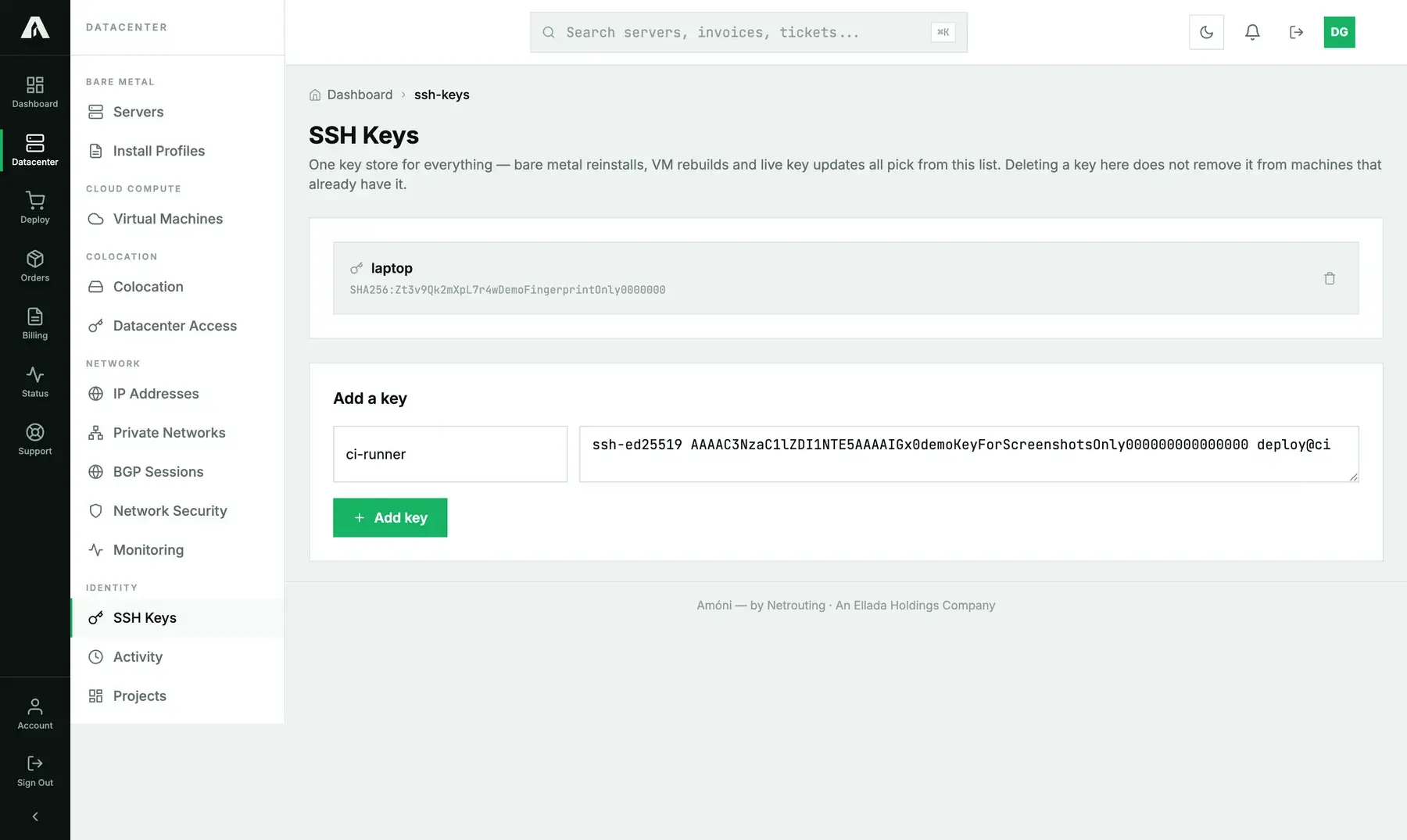
Deleting a key here (the trash icon) only takes it off the list. Machines that already have it keep it until their next reinstall or rebuild. To get it off a running machine, edit ~/.ssh/authorized_keys on that machine, or use the live update below.
Use keys on a fresh system
- Bare metal: on the server's Reinstall tab, tick the stored keys you want under SSH Keys, or paste in extra ones. Details: reinstall the operating system.
- Cloud: in the Rebuild VM dialog, the keys are listed under SSH keys for the new system; tick the ones you want. See rebuild.
The server's own SSH Keys tab shows the same list read-only, so you can see what a reinstall is going to offer.
Apply keys to a running cloud instance
- Go to the instance and open its SSH Keys tab.
- Tick every key that should be on the machine. The button keeps count: Apply to VM (1).
- Click Apply to VM. That writes the selected set to the machine's provisioning drive, where it replaces whatever was applied that way before.
- From the instance header, do a Stop and then a Start. That's what regenerates the provisioning drive. A plain reboot doesn't, so the keys would never land.
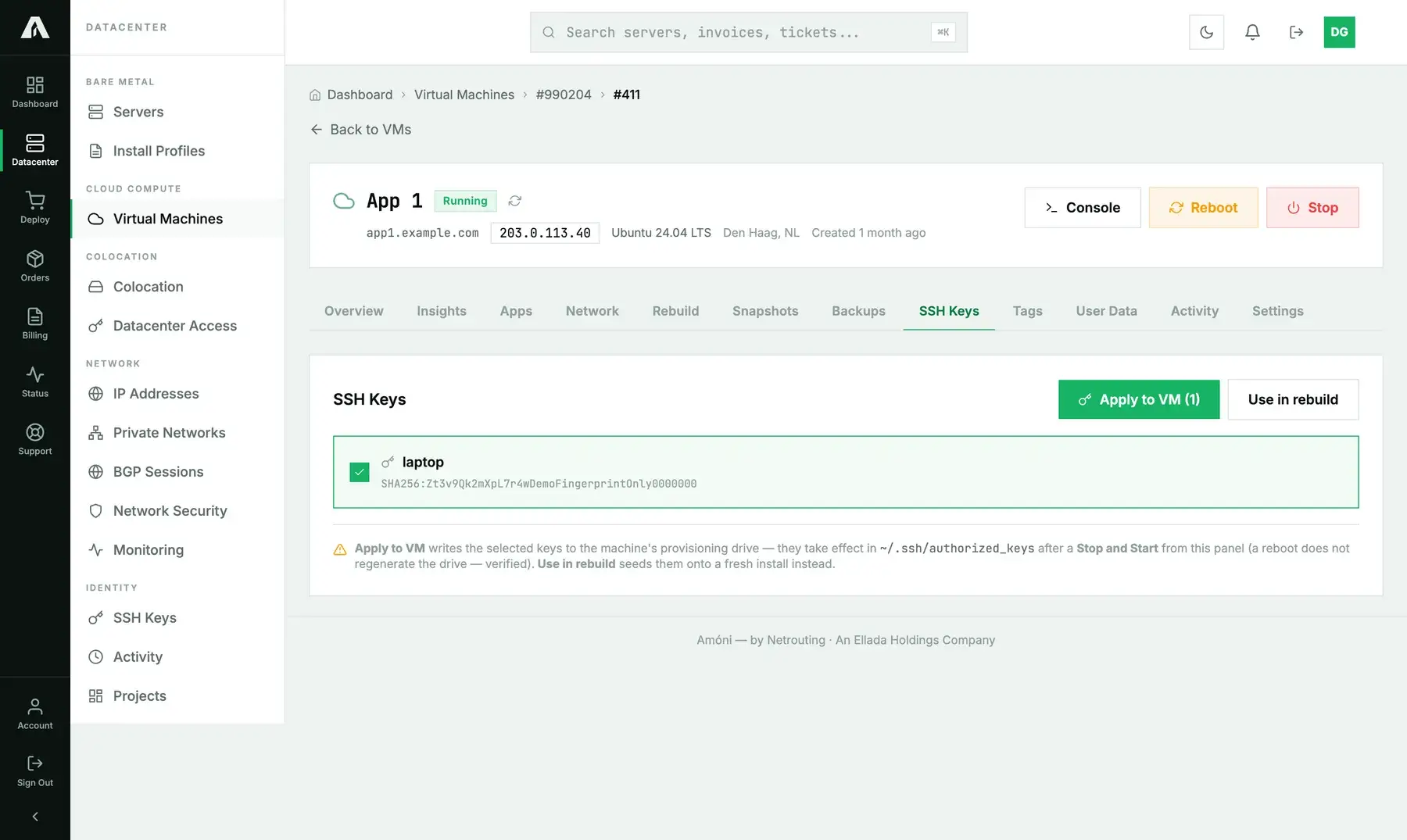
Use in rebuild, on the same tab, opens the rebuild dialog with those keys already selected. Use it when you wanted a fresh system anyway.
Method 2: With the API
Changing the key store takes the SSH Keys scope (sshkeys.write), while listing it takes read. Applying keys to an instance needs vms.write. Reference: api.amoni.app/v1/docs.
Store a key
curl -s -X POST https://api.amoni.app/v1/ssh-keys \
  -H "Authorization: Bearer nr_live_..." \
  -H "Content-Type: application/json" \
  -d "{\"name\": \"ci-runner\", \"public_key\": \"$(cat ~/.ssh/id_ed25519.pub)\"}"
{ "success": true, "data": { "id": 42, "fingerprint": "SHA256:Zt3v9Qk2mXpL7r4w...", "key_type": "ssh-ed25519" } }List and delete
curl -s https://api.amoni.app/v1/ssh-keys -H "Authorization: Bearer nr_live_..."{ "success": true, "data": [ { "id": 42, "name": "ci-runner", "public_key": "ssh-ed25519 AAAA...", "key": "ssh-ed25519 AAAA...",
"fingerprint": "SHA256:...", "key_type": "ssh-ed25519", "created_at": "2026-09-15 10:12:00" } ] }key is a copy of public_key. Both stay in the response so older clients keep working.
curl -s -X DELETE https://api.amoni.app/v1/ssh-keys/42 -H "Authorization: Bearer nr_live_..."Use the ids everywhere else
Pass stored key ids as ssh_key_ids to POST /v1/servers/{id}/reinstall and POST /v1/vms/{accountId}/{vpsId}/rebuild. Raw keys, one per line, go in sshkeys, and you can send both in the same call.
Apply to a running instance
curl -s -X PUT https://api.amoni.app/v1/vms/990204/411/ssh-keys \
  -H "Authorization: Bearer nr_live_..." \
  -H "Content-Type: application/json" \
  -d '{"ssh_key_ids": [42]}'
{
"success": true,
"data": {
"username": "root",
"applied": [ { "name": "ci-runner", "fingerprint": "SHA256:..." } ],
"pasted_key_count": 0,
"message": "Keys saved to the machine's provisioning drive. ..."
}
}Then stop and start the instance (POST .../power with stop, then start) to regenerate the drive. Container-type instances don't have a provisioning drive, so for them the call answers 422 and keys land only at creation.
What the API will tell you
| Status | code |
Meaning |
|---|---|---|
| 201 / 200 | none | Key stored / applied. |
| 401 / 403 | insufficient_scope |
Bad key, or missing sshkeys.write / vms.write. |
| 404 | none | There's no such key id or instance on your account. Body: {"success": false, "error": "Not found"}. |
| 422 | invalid_key |
That isn't an OpenSSH public key. Paste the .pub contents. |
| 422 | duplicate_key |
You've stored that key already, and the error names it. |
| 422 | no_keys |
Apply was called with nothing selected or pasted. |
| 500 | none | “The keys could not be applied to this VM. It may not support automated configuration. Contact support.” |
Troubleshooting
- “Permission denied (publickey)”. The machine has keys, just not the one you're offering. Check with
ssh -vwhich key gets tried, then point at the right one with-i. If none of your keys is on the machine, you get back in with the password (on the console) or a reinstall with the right key. - I applied keys to a running instance and they do not work. Check that you did a stop and a start, because a reboot isn't enough. Also, the set you apply replaces the one applied before it.
- The portal refuses my key. Paste the single line from the
.pubfile: not the private key, and not a PuTTY-format block. On PuTTY, export the OpenSSH public key from PuTTYgen (“Public key for pasting into OpenSSH authorized_keys file”). - I deleted a key but it still logs in. Deleting from the store never touches the machines themselves. Remove the line from
~/.ssh/authorized_keyson each one, or apply a new set to the instance. - Keys for a Windows server? Windows images don't use the key store. Log in with the password, over the console or RDP.
Still stuck?
Open a support ticket, select the machine, and include the fingerprint of the key you expect to work (ssh-keygen -lf ~/.ssh/id_ed25519.pub). Never send us the private key.